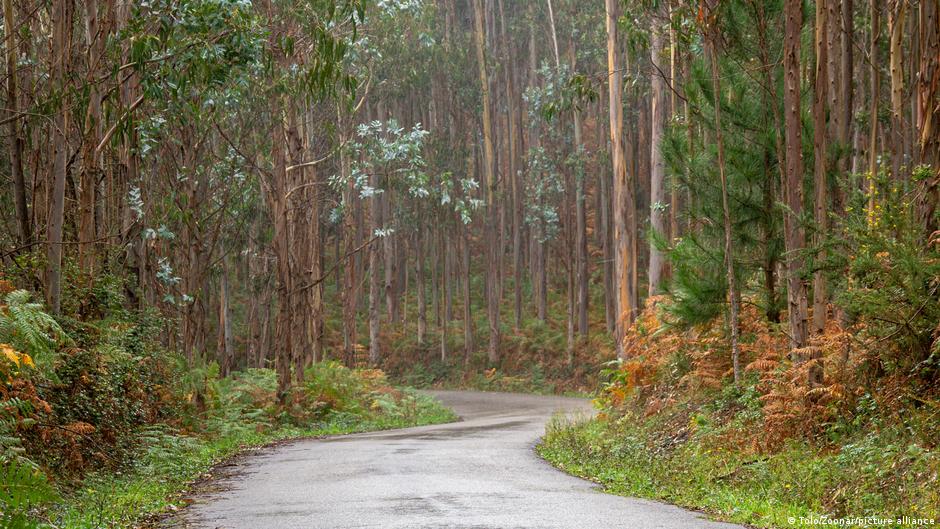
Every year, more than 400,000 hikers descend on Galicia for the Camino de Santiago pilgrimage, crossing misty hills and dense green forests. But much of the forest around the route is no longer original.
Instead of indigenous oaks and chestnuts, large parts of north-western Spain are now dominated by eucalyptus.
That change is not unique to Galicia. Prized by the pulp and timber industries for its rapid growth and profitability, vast monocultures of the Australian tree have been planted in places such as Brazil, Chile, California, India and South Africa.
Globally, eucalyptus plantations now cover 22 million hectares in more than 90 countries, and in many regions, they have become a cornerstone of rural economies. But the landscape hidden beneath the seemingly tranquil canopy is highly vulnerable to wildfire because scientists consider the trees highly flammable.
European heatwave raises concerns
Europe is already scorching this summer, with concerns that unusually early heat waves could increase fire danger. Some parts of the southern continent have been affected in recent days. Last year was the worst wildfire year on record, with more than 1 million hectares of land burned – much of it on the Iberian Peninsula.
Researchers say that although eucalyptus trees are not the culprit for sparking these fires, once they do start they can significantly accelerate fires.
“Eucalyptus forests are clearly one of the most flammable forests we have in the world,” Tim Curran of Lincoln University in New Zealand told DW.
“If you put eucalypt into a new environment, you’re very likely to change what we call fire regimes. So things like fire intensity, fire frequency; how hot the fire gets and how often you get fire.”
The leaves of the trees contain highly flammable oil, and strips of bark can turn into burning embers. In extreme conditions, those embers can travel great distances to start secondary fires, as happened during Australia’s devastating 2009 Black Saturday fires.
“There is evidence that embers were blown more than 30 kilometers away from the fire front to start new fires,” Curran said. He said that this was not a one-time fire.
In Galicia, plantations can easily exceed their native limits because where native oaks and chestnuts can take more than 80 years to reach maturity, eucalyptus needs just 15 years. As a result, they recover quickly when landscapes are destroyed by fire, giving them a competitive advantage over native species.
This creates a self-reinforcing cycle that eventually allows monoculture to expand further, increasing the risk of wildfire.
Eucalyptus divides opinions
Planting in Galicia dates back to the 1970s but actually began two decades later.
In 1992, the regional government released a forestry plan that estimated eucalyptus would reach 250,000 hectares by 2030. It took them 30 years to update that plan, during which time eucalyptus spread extensively.
“It is now about half a million hectares, which is a huge amount of land,” said local community leader Jom Evans Pimm.
Although the regional government has since banned new eucalyptus plantations, campaigners say enforcement is uneven, and illegal planting continues.
On the one hand, there is money in eucalyptus – Galician plantations, which mainly feed the pulp and wood industries, produced €167 million in 2024 alone.
But there is also mismanagement. As younger generations leave rural lifestyles and move to urban centres, they are leaving behind uncontrolled plantations.
“[Eucalyptus growth] This is happening because of plantations, many of which are illegal, but also because of land abandonment, because of forest fires, because of the invasive nature of the species. So it’s a combination of all of these that has led to this outcome.”
What did the government do and what it did not do
Critics accuse regional authorities of failing to control the expansion for too long. Luisa Piñeiro, director general of forest management for the Galician government, told DW that there have been failures in the past.
“back then [in the 1990s]Probably there was not adequate forest management. There was not as much control over the plantations or the species being planted,” she said.
Nevertheless, the government does not classify eucalyptus as invasive, and Piñeiro rejects calls for a complete ban. Instead she argues for better management and greater species diversity.
“Instead of banning things, we should first make a forest management plan,” he said. “We believe that forests should have a diversity of species.”
Galicia has come to be considered the heritage of eucalyptus
Looking out over his community’s land in Froxán, about 40 kilometers west of Santiago de Compostela, Evans Pym remembers the wildfires that ravaged the surrounding hills.
“This is an area that was affected by a huge fire in 2006. All the forests around the village burned down and after that it became overgrown with eucalyptus,” he told DW.
When another fire occurred ten years later the community decided to take action. He founded the De-Eucalyptus Brigade volunteer group, which is working to raise awareness of eucalyptus-like species and remove them from community-owned lands. What started as a team of 50 people has now grown to 1500 people throughout Galicia.
“We’re eliminating eucalyptus and allowing native trees to take over that space,” Evans Pimm said. “We want to create a green fire break… and ultimately our goal is to create a land that manages itself. Where we don’t need to intervene, and that is resilient to fire, climate change and prolonged drought.”
Portugal’s devastating wildfires in 2017, in which people died trying to escape, serve as a warning.
“Portugal lived the experience a few years ago; people died, their cars caught on fire,” he said. “We would really hope that we don’t have to go there to make real change in terms of enforcing existing laws and improving all the laws that are taken seriously.”
That message is increasingly being repeated by scientists, forestry groups and activists, who say unmanaged land is becoming one of the biggest fire threats not only in Europe but around the world.
Researchers say the economic benefits of eucalyptus need to be balanced against the risks of increasing wildfires.
“There’s definitely a place for eucalyptus, there’s definitely a place for the pulp industry,” said Joaquim Sand Silva of the Polytechnic University of Coimbra. “But it has to be very strict in terms of how you plant trees and what ecosystem you are changing.”
Edited by: Tamsin Walker