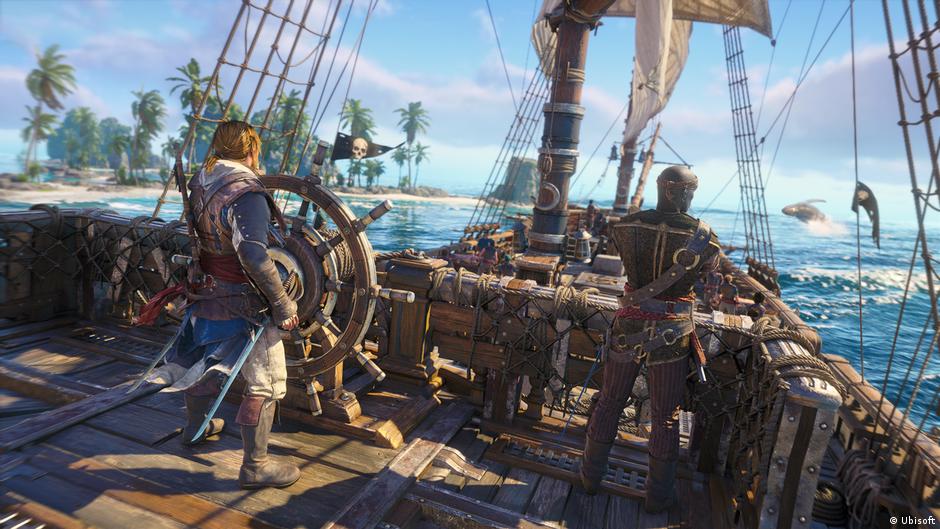
A bright, almost cloudless sky. Waves crash against jackdaws. Its sails fly in the wind.
Towards the horizon, single-masted ships sail across the ocean. Far to starboard stretches an empty sandy beach fringed with palm trees.
Standing at the wheel of my own pirate ship, I listen to my crew as they sail to their next hut. The salty scent of freedom washes my face—and all this despite the fact that I’m actually at home, sitting on my couch. I’m playing “Assassin’s Creed Black Flag Resynced”.
The video game is a completely new version of the popular pirate adventure from 2013. With updated graphics and additional missions, it is expected to be a hit among gamers. After all, pirates never go out of style, being a long-standing mainstay of popular culture.
Writers such as Emilio Salgari (1862–1911) and Rafael Sabatini (1875–1950) created countless pirate stories that later inspired Hollywood films, including “Captain Blood” (1935) and “The Black Swan” (1942).
Robert Louis Stevenson’s adventure novel “Treasure Island” (1883) has also seen several film adaptations. The “Pirates of the Caribbean” theme park attraction at Disneyland inspired game developer Ron Gilbert to create the “Monkey Island” video game series, which was first released in 1990. Both Disney rides and games influenced the “Pirates of the Caribbean” film franchise.
There are several pirate-themed games set for release in 2026 alone, including city-building title “Corsair’s Cove” and action games “Windows” and “Assassin’s Creed Black Flag Resynced.”
A romantic image of the ‘golden age’ of piracy
While pirates have existed since ancient times, today’s popular image is largely based on the so-called Golden Age of Piracy, which began in the late 17th century and lasted only a few decades.
During that period, European powers expanded their colonies in the Caribbean and the West African coast. Trading ships carried goods from Europe to those areas and brought back colonial products with them. The pirates would attack those ships, plunder their loot, and return to sea. Most did not survive long; Many were captured or killed.
As historian Jane M. Witt states, pirates were simply criminals. “The pirates that people imagine today have nothing to do with reality. It’s a romantic image,” he told DW.
Additionally, some scholars have portrayed pirates as early proponents of a more democratic, community-oriented social order. However, Witt stated that such claims are difficult to support due to limited historical sources. Charles Johnson’s “A General History of the Pirates” (1724) is often cited. Witt considers it more “sensational journalism” than scholarly research.
“I know a lot of pop culture’s idea of piracy is romanticized and that’s great,” musician and folklorist Shawn Daugher, who himself has spent time on the high seas, told DW. “It’s not piracy that people love – it’s the romantic idea of pop culture.”
Dagher, who contributed the shackles for “Assassin’s Creed Black Flag Resynced”, said that the sea shackles serve a practical purpose. They were not just for entertainment, but were also tools that helped the crew coordinate work, such as pulling ropes.
“Shacks are used to coordinate work,” Dagher said. “If everyone is pulling the rope at the same time, it’s better than if people are pulling whenever they want.”
Shanty singers often improvised verses to motivate workers during long, exhausting tasks, sometimes using humorous or crude lyrics to boost morale at the end of the job.
Freedom, escape and adventure
“I think the thing that attracts people about sailing in general is the idea of going somewhere far away,” Daugher said. “Although life on the ship was hard, the idea of going somewhere new and getting away from the troubles of your current life is exciting.”
Paul Fu, creative director of “Assassin’s Creed Black Flag Resynced,” also points to the sense of freedom.
“Pirates attract people because I think it gives people a sense of freedom and adventure,” Fu said.
He also noted that pirate ships were not, in fact, places of freedom: they were governed by a strict hierarchy. Life at sea was difficult, with limited food and poor medical care.
The game reflects that brutality through combat tactics involving hidden blades, swords, pistols, and smoke bombs. Still, the game world is not intentionally bleak. Developers adjusted the lighting and time cycles so that the day feels longer and brighter than the night, Fu said.
How the myth of freedom took hold
According to historian Eugen Pfister, pirate stories have always had a cultural function.
Pfister said, “Pirates stood for cultural and political purposes even during their lifetimes.” “These stories showed a brief escape from social hierarchies and structures.”
The stories were intended to reinforce social norms for their audiences, whether they encountered them in books, on stage, or on the big screen. They depicted a brief break from the hierarchies and social order of society. Until the 1950s, pirate stories often focused on a respectable man forced into piracy by circumstances who eventually returns to society.
The changing winds of the pirate myth
That narrative changed in the 1990s. The respectable pirate gave way to what Pfister calls the “liberal adventure capitalist” — a self-interested, profit-driven individual bound only by his own rules, like Jack Sparrow in “Pirates of the Caribbean” or Edward Kenway in “Assassin’s Creed.” Whereas pop culture pirates in the past often regressed into society, modern pirates stand outside it.
Despite these changes, Pfister said one constant remained: pirate stories show little regard for historical accuracy. Instead, they rely on far-flung, dream-like settings and borrow selectively from pirate folklore to match the spirit of the times.
This article was originally written in German.