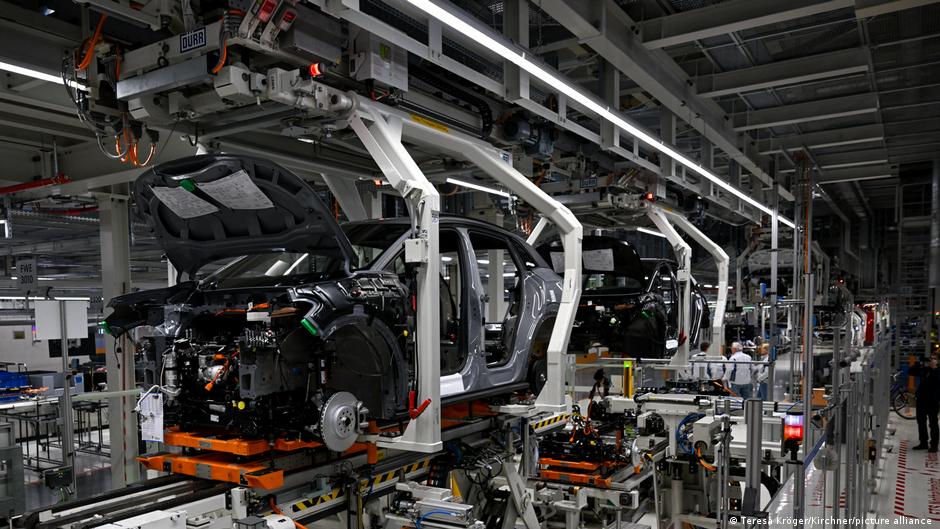
German companies are increasingly moving abroad – and this applies to businesses of all sizes. Gardena, the Ulm-based garden equipment specialist, plans to cut 250 jobs in Germany and partially move operations to the Czech Republic, according to press reports. This is equivalent to a 10% reduction in its domestic workforce.
Major global players such as BASF are also continuing to invest abroad. Earlier this year, it became known that the chemical company intended to relocate service positions to India, with many jobs at its Berlin site coming under particular pressure.
Relocation and job loss
Last year the situation was described in even more dramatic terms.
“Germany’s industrial crisis is running at full speed,” the online magazine Finanzmarktwelt wrote in November, citing Federal Statistics Office data from 2018 to 2023. More recent figures have not yet been published by the office.
According to the data, about 1,300 German companies with more than 50 employees moved business operations abroad between 2021 and 2023. This is equivalent to 2.2% of all companies of that size based in Germany in 2023.
It is said that these transfers resulted in the loss of approximately 50,800 domestic jobs. Many feared that this trend would continue or accelerate given Germany’s high energy and labor costs.
However, Germany’s state-owned development bank KfW is already seeing a different trend. In June, its research department announced that: “Many medium-sized companies are withdrawing from international trade.” According to the bank’s findings, the number of German medium-sized companies operating abroad is expected to decline from about 880,000 in 2022 to about 760,000 a year later.
KfW chief economist Dirk Schumacher said, “General conditions for foreign trade have deteriorated significantly,” which he attributed to “geopolitical tensions in Ukraine and the Middle East, increasing export competition from China in key industries, and the protectionist trade policy of the United States.”
consistently inconsistent
The Association of German Chambers of Commerce and Industry (DIHK) has presented a different picture.
Referring to its business climate survey for early 2026, DIHK spokesman Sven Ehling said cost pressures on German industry had reached record highs, prompting many companies to plan large investments abroad.
According to DIHK, 43% of industrial companies are planning foreign investments this year, three percentage points more than last year. “The reasons are clear: rising costs, structural problems and weak economic conditions in Germany as a business location,” said Volker Treuer, DIHK’s head of international trade.
Changing reasons for investing abroad
In the past, foreign investment strengthened domestic operations, leading to increased employment at home. It was a true investment aimed specifically at opening new markets or expanding sales and customer service. However, according to the DIHK survey, the share of German companies investing abroad primarily for market development has fallen from 30% to 28%.
“Companies are now being forced to invest abroad primarily for cost reasons. This often leads to significant cutbacks at domestic sites,” Trayer said. Foreign investment is now helping to cut costs rather than promoting expansion.
Overall, the trend of foreign investment is not clear. The current situation more resembles a move sideways. According to Professor Stefan Müller of the Leibniz Institute for Economic Research Halle (IWH), direct investment abroad by German companies is “well below high levels.”
Müller told DW that Bundesbank figures show an annual transaction value of €120 billion between 2017 and 2022. In contrast, the figures for 2024 were €80 billion and less than €100 billion for 2025. These figures “give little reason to believe that significantly more capital is flowing out than in previous years.”
Loss to America, benefit to Asia
The survey reveals significant variations in the sectors targeted for German foreign investment. The attractiveness of North America in particular is declining, with the share of German companies planning investments there falling from 48% to 44%.
Additionally, connectivity is increasing in Asia. According to DIHK, the share of industrial companies investing in China is increasing from 31% to 34%. The importance of the Asia-Pacific region (except China) is also increasing, rising from 21% to 26%.
“The tariff dispute with the United States is fueling uncertainty and forcing companies to postpone decisions,” Trayer said.
With 64%, the Eurozone remains the most important region for investment for German companies. Stability, the common single market and the common currency provide reliable framework conditions – a particularly important factor in investment decisions in times of geopolitical uncertainty, the DIHK representative noted.
This piece was originally published in German.