Glenda Banda returned to Zambia with her baby strapped to her back and little more than the clothes she was wearing, amid rising anti-immigrant sentiment in South Africa.
South Africa has been his home for a decade. It was here that he found work, raised his family and hoped to build a better future. She told DW that within a matter of days everything she had worked for was gone.
“I came wearing only the clothes on my body. I had no clothes to change into,” Banda said. He said the local mayor had sent youths to his house to ask the landlord to throw him and his family out.
“The landlord was forced to keep all our belongings out and lock the house,” Banda told DW. “We had to run away and leave everything behind.”
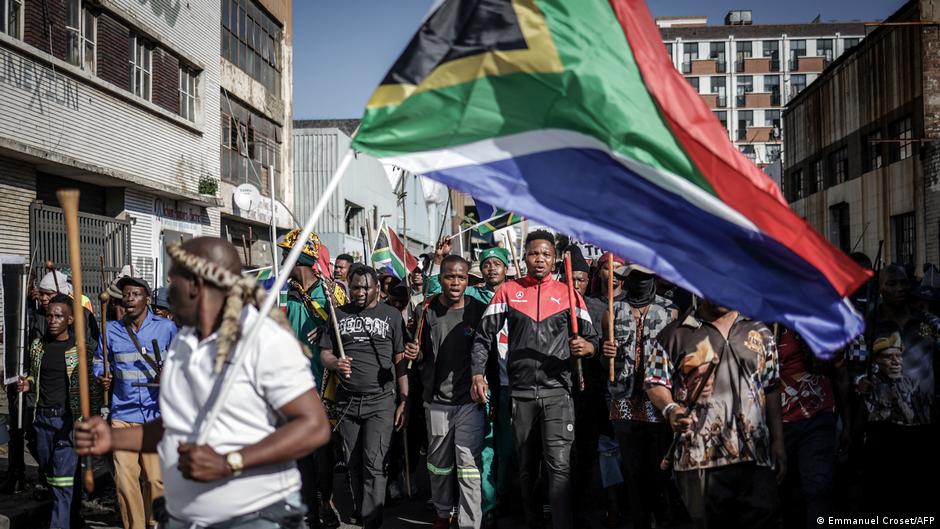
Banda is among more than 100 Zambians who returned to their homeland after anti-migrant protests – some of which turned violent – demanded the migrants be deported.
Everything they had built was left behind
Bernadette Mwelwa tells a similar story. After living in South Africa for more than 20 years, she returned to Zambia losing not only her livelihood, but also the life she had built there.
“Regardless of whether you were a refugee or an asylum seeker, as long as you were a foreigner, they didn’t want us there,” he said.
“I can’t go back to South Africa because I’ve lost a lot of things. The mayor took the keys to my salon,” Mwelwa told DW. “I left my husband, who is Congolese, to take care of our supermarket, but it was looted and everything was gone.”
Nigeria, Mozambique and Ghana have all expressed concern about attacks on their citizens living in South Africa.
Nigeria on Sunday condemned the deaths of two of its citizens in South Africa and warned that foreign nationals were being “unfairly targeted” amid anti-migrant protests. South Africa’s main police watchdog said it had launched an investigation, Reuters reported.
Mozambique’s government said five of its citizens were killed “as a direct result of xenophobic attacks” that erupted after a march against undocumented migrants in the South African city of Mossel Bay in late May.
Governments should step up
According to news agency Associated Press, South African police said only two Mozambicans died in the attack after the march, and would not say whether it was linked to anti-migrant sentiment.
Ghana said one of its citizens was seriously injured in shooting during anti-migrant protests last week. South Africa said his killing was not linked to the protests and accused Ghana of spreading misinformation.
While many migrants are still in South Africa, thousands have left after weeks of anti-migrant sentiment, threats and, in some cases, physical violence.
Several African governments, including Nigeria, Malawi, Ghana, Zimbabwe and Mozambique, have organized voluntary repatriation flights and buses for their citizens.
Why is stress increasing?
Anti-xenophobic violence has erupted repeatedly in South Africa since 2008. They often coincide with periods of high unemployment, poverty and frustration over public services, with foreign nationals often accused of taking jobs or contributing to crime.
However, researchers say migrants are often blamed for broader economic and governance challenges.
“The most important thing for Zambians is to stay safe and come back home. Home is home,” Zambia’s Vice President Mutale Nalumango told reporters in Lusaka. He said officials would assess individual cases before determining what assistance could be provided.
South African President Cyril Ramaphosa rejected suggestions that South Africans are inherently xenophobic, saying migration presents complex challenges that require political solutions.
“South Africans are not xenophobic. South Africans are Africans, and they want to live in peace with other Africans,” Ramaphosa said in a recent national address. “Our people are calling on us as leaders to solve the many challenges that arise because of migration.”
Call to stop more violence
The International Organization for Migration (IOM) says protecting migrants and preventing further violence remains an urgent priority.
“We are deeply concerned about the situation, and we are fully committed to supporting the government,” Ytna Getachew, IOM’s chief of mission to South Africa, said at a symposium on migration and social cohesion at Wits University in Johannesburg late last month.
“And the United Nations, we look at it two ways. One is the immediate danger that lurks, the escalation of tensions. We believe this needs to be addressed immediately. We are calling for de-escalation; we are calling for peace.”
Lisa Thompson-Smedal, a psychologist in the South African city of Stellenbosch, says that returning home may provide physical safety, but it is not necessary for emotional recovery.
“Returning home after experiencing xenophobic violence does not automatically provide healing, safety, or health,” he told DW. He said many survivors are still struggling with grief, anxiety and trauma after losing homes, livelihoods and communities.
Reconstructing their lives in Zambia
According to Lorraine Landau, a senior migration researcher at the University of the Witwatersrand (Wits) African Center for Migration and Society in Johannesburg, anti-foreigner sentiment is often driven by broader governance and economic problems, including unemployment, inequality and poor service delivery, rather than migration.
recently paperLandau says governments should strengthen social cohesion and improve governance rather than blaming migrants for broader socioeconomic challenges.
For Banda and Mwelwa, however, those policy debates seem far-fetched.
He has found safety in Zambia. But the process of rebuilding their lives, restoring their livelihoods, and healing from the emotional wounds of displacement has just begun.
Edited by: Keith Walker