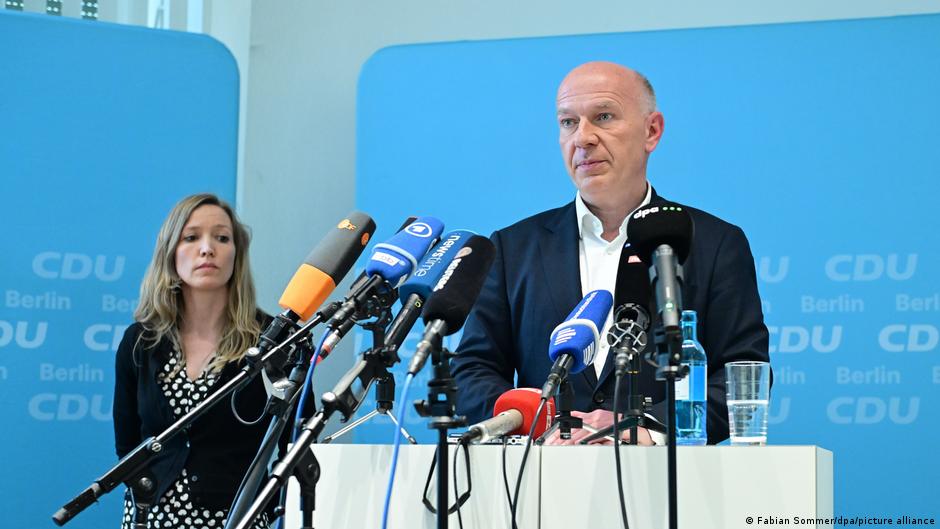
In the end, it was a little white lie: Kai Wegener, mayor of the German capital Berlin and a member of Chancellor Friedrich Merz’s center-right Christian Democratic Union (CDU), has decided not to run again in the upcoming Berlin state election in September. He made the announcement on Friday afternoon and insisted he intended to remain in office until then: “I have been elected as mayor,” he said almost defiantly at a news conference.
Since April 2023, Wagner has led a coalition of conservatives and centre-left Social Democrats. He later made negative headlines for his decision to play tennis during a power cut across much of the German capital at the beginning of the year.
Iconic result of power cut in Berlin
On January 3, 2026, there was a power outage in the southwestern part of Germany’s largest city. Reason: Unknown criminals had committed arson on high-voltage cables.
This left approximately 45,000 homes without electricity and heating during the sub-zero temperatures. It took more than four days to reconnect all residents to the grid, making it the longest power outage in the city since World War II.
About 100,000 people were affected. Power outages affected private homes, hospitals, schools and, most dramatically, nursing homes, forcing the elderly to be evacuated to warm shelters.
The far-left extremist group “Vulkangroup” initially claimed responsibility for the attack but later denied it. The attack sparked debate about the security of key infrastructure in Berlin as well as the city’s crisis response plans.
A tennis match instead of going to a shelter
And Mayor Kai Wagner? He had gone to play tennis that day.
He accepted this only after continuous questioning by journalists. But, he said, he was available at all times and immediately began coordinating the city’s efforts to help people via telephone.
Yet time and again, his account remained riddled with half-truths, and he acknowledged only what the media had already revealed about his dubious role on that bitterly cold January day. Reputation remained at stake: Berlin’s most powerful politician did not take seriously the city’s worst power cuts since the end of World War II.
And this week it was revealed that Wagner had not, as claimed, handled the situation by phone that day. Now, suddenly, talking was limited to just a few text messages. And that’s when even conservatives in the capital lost their patience: the CDU’s youth organization, the Jung Union, called on Wagner to withdraw his candidacy for the September election, and CDU members in the capital demanded the same in an open letter.
Now, it is unclear who will run for the CDU in the September election to replace Wagner. Coupled with the scandal surrounding Wagner, the CDU has slipped to fourth place in the polls – behind the socialist Left Party, the environmentalist Greens and the far-right Alternative for Germany (AfD).
For this reason alone, it is difficult to imagine that Wagner will be able to remain in office until the elections, as have been announced.
This article has been translated from German.