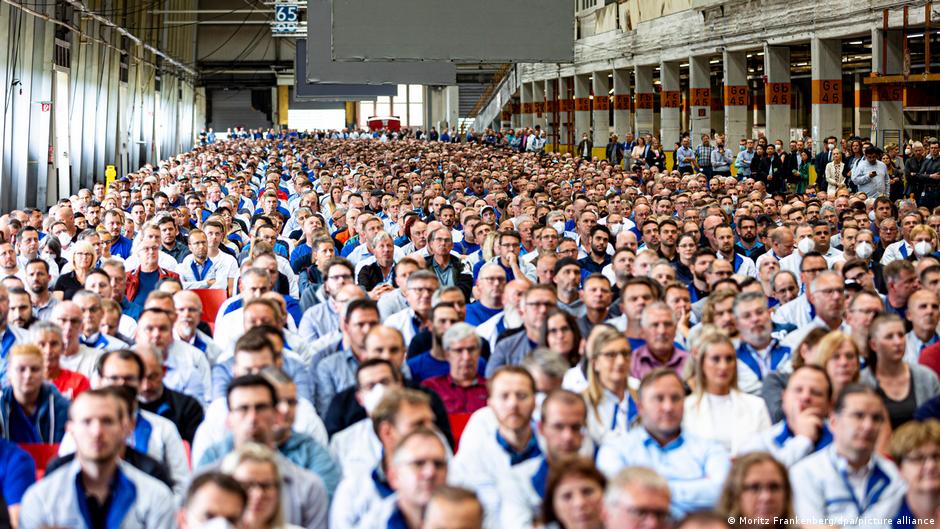
Volkswagen has built one of the largest workforces in the global auto industry.
At about 630,000 people – 680,000 if you count joint ventures in China – VW employs about 60% more workers than Toyota, 140% more than Stellantis and about 240% more than Ford.
That number was once a sign of Germany’s industrial might and VW’s huge profits. Now, this is becoming a major burden, forcing the company to make painful job cuts to survive against nimble Chinese competitors.
After cutting thousands of positions last year due to pressure on profits, Volkswagen is now preparing to cut 100,000 jobs worldwide, including thousands in Germany. He also wants to close four German factories.
These cuts include VW luxury brands like Porsche and Audi. Other German automakers and suppliers are facing similar pressure. Mercedes-Benz plans to cut several thousand jobs, and suppliers such as Bosch have announced major cost savings.
How did VW get to this point?
Most of VW’s workforce issues stem from long-standing strategic decisions.
Meghan Ostertag, an economic policy analyst at the US-based Information Technology and Innovation Foundation, says VW’s much larger workforce was needed because the company chose to control more stages of production than its peers.
“The company manufactures many of its components and software internally, which increases labor demand and, of course, also increases labor costs,” Ostertag told DW. He said factory costs in Germany could be “up to double that of competitors.”
Other experts point to an aggressive acquisition strategy over the past few years that has brought brands including Skoda, Porsche, Seat and Bugatti into VW’s fold – not to mention several truck makers.
“That strategy works to some extent, but the complexities of integrating all those brands, supply chains and different designs makes it very complex for VW to operate,” Daniel Harrison, senior automotive analyst at London-based Ultima Media, told DW.
Why did the VW model break?
Although Volkswagen escaped the 2015 dieselgate emissions scandal without lasting financial damage, the company faced huge costs and soon faced a new set of problems.
The company was slow to transition its production to electric vehicles (EVs) – just as Chinese EV makers gained serious traction and technological edge. That delay contributed to slow sales in China, which accounts for a third of total VW sales, as well as softening demand in Europe and other major markets.
VW also repeated a mistake made by the American auto industry decades ago. In the 1960s and 1970s, the Big Three – Ford, GM, and Chrysler (now part of Stellantis) – were bloated and slow to adapt when Japanese and European competitors began to capture their market share.
By the time American carmakers moved toward lean production methods, a decade had passed and they were far behind, Ostertag said.
Toyota, which makes the same number of vehicles as VW, operates with about half the number of workers by relying more on suppliers, higher automation and a simpler management structure.
In a recent research note, auto industry analyst Matthias Schmidt pointed to another factor: trade unions and a major shareholder have a “hold” on VW. This, he said, has helped cause “years of neglect in readjusting workforce numbers.”
The northern German state of Lower Saxony — home to Volkswagen’s global headquarters in Wolfsburg — holds 20% of the voting rights in the company, can veto major decisions, and has previously pressured executives not to close plants or lay off workers, especially during Dieselgate and the COVID supply chain crisis. This time also the pressure is increasing.
Meanwhile, for decades, Germany’s powerful unions have repeatedly demanded higher wage increases and generous benefits, making VW employees among the highest-paid autoworkers in the world.
Is VW’s turnaround plan enough?
While the same unions are fiercely opposed to VW’s latest plans, analysts have warned that the company is expected to face cuts of more than €4 billion annually to secure its future.
He says the current proposals will bring savings, reduce excess capacity at German plants and help improve short-term profitability. But VW’s underlying cost base and slow decision-making culture mean that deeper, more radical reforms may be needed.
Ostertag told DW that VW should “invest more in automation,” adding that it would allow carmakers to “compete better with weaker companies,” such as China’s BYD, which is one of the fastest-growing EV brands in Europe.
Analysts say VW has lagged its peers in the level of plant automation, but has increased investment in robotics and digital upgrades for its EV production. The company is also planning its first EV priced under 20,000 euros next year.
With China responsible for about 30% of VW’s global vehicle production, Harrison predicts more production shifts to Asia and the possibility of sharing VW’s European plants with Chinese EV producers, something previously seen as “unimaginable”.
German government, EU offer a lifeline
On the policy front, the German government is providing subsidies and loans for domestic EV battery plants to help cut dependence on Chinese imports.
Meanwhile, the EU is pushing the Industrial Accelerator Act (IAA). The IAA aims to boost the bloc’s competitiveness and protect strategic industries from unfair competition from China.
The EU has already imposed tariffs of up to 45% on Chinese-made EVs. But they are well below the 100% tariffs imposed by the US, which have largely driven Chinese competitors out of the US auto market.
Harvard University historian Niall Ferguson warned that Europe has been slow to respond to China’s strategy of giving heavy subsidies to EV makers that help it outperform European rivals.
“Unless there is a radical change, I predict: Europeans will very soon be driving Chinese cars on a large scale,” Ferguson told Germany. south german newspaper Last week’s newspaper.
During the same interview, economist Moritz Schularich, president of the Kiel Institute for the World Economy, suggested using market access as leverage – only allowing Chinese brands to sell in Europe if they produce locally.
When asked about VW’s long-term future, Schulrick responded provocatively, predicting that the German auto giant will “probably be bought out by a Chinese carmaker like BYD.”
Editing: Ashutosh Pandey