Buoyed by its security and economic alliance with Moscow and flush with cash after sending troops and military equipment to support Russia’s invasion of Ukraine, North Korea is testing limits closer to home.
In a meeting with the United Nations Command in late June, South Korea’s Defense Ministry expressed concern about the activity of North Korean engineers at several locations along the length of the 238-kilometre-long (148 mi) Demilitarized Zone (DMZ), which has divided the Korean Peninsula since the armistice that brought the 1950–53 Korean War to an uneasy conclusion.
In the decades since, there have been countless skirmishes and incursions along the DMZ, with underground tunnels vulnerable to North Korean aggression, defectors risking their lives to cross minefields and barbed wire networks to reach freedom in the South, as well as the occasional firefight.
Is North Korea increasing borders in the DMZ?
Chu Jae-woo, a foreign policy professor at Kyung Hee University in Seoul, believes the North is now trying to see how far it can advance before facing resistance.
“They are testing the limits,” he told DW. “They know they have the support of both Russia and China in all their endeavors – military, economic, geopolitical – and Pyongyang feels now is the time to see how far it can go.”
“We see it elsewhere, the way the North is building advanced new warships, and I wouldn’t be surprised if we start to see similar testing of the NLL [the Northern Limit Line] In the Western Sea,” he said.
The NLL is a maritime boundary on the peninsula’s western coast that North Korea disputes and has seen several deadly clashes, most recently in 2010 when North Korea fired approximately 170 artillery rounds at Yeonpyeong Island, killing four South Koreans and wounding 19.
Months after Kim Jong Un announced he was redefining ties with South Korea, the North stepped up scrutiny of what the UN command finds acceptable at the DMZ around April 2024, experts say.
Instead of the stated aim of reconciliation and reunification, Pyongyang now sees relations as between “two enemy countries and two belligerent countries at war”.
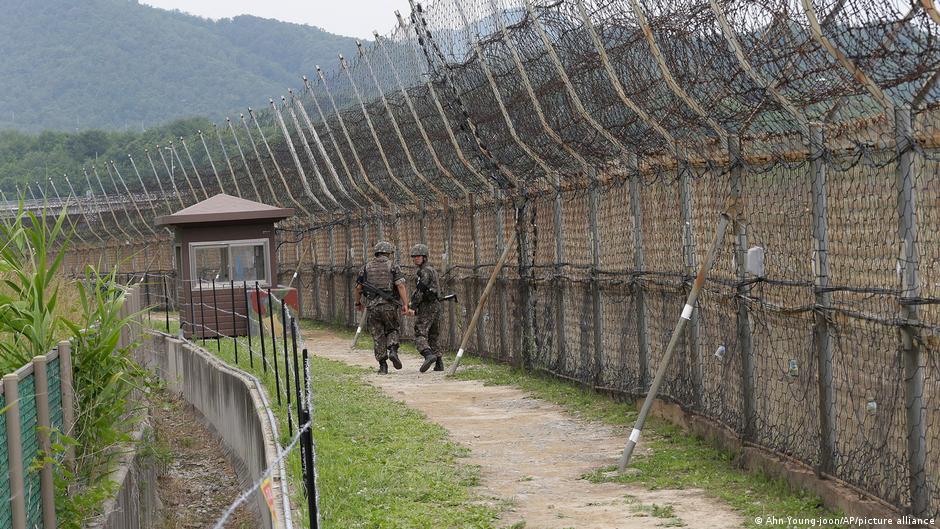
North Korean engineering troops have erected new fences, built anti-tank berms and trenches, dug trenches, built new military roads for greater access, cleared land and laid new landmines.
The work has been done north of the Military Demarcation Line (MDL), but has come even closer to that marker, which is exactly the half-way point in the 4-km-wide DMZ.
closure of military demarcation line
The South Korean military said that in some areas, the actions have been carried out less than 100 meters (about 330 feet) from the MDL, which Seoul says is a violation of the armistice.
South Korean Defense Ministry spokesman Chung Binna said during a press conference on June 25 that adding additional military capabilities near the halfway point effectively neutralizes the DMZ’s function as a buffer zone.
Dan Pinkston, professor of international relations at Troy University’s Seoul campus, believes Pyongyang has learned from China’s growing acquisition of territory at the extremes of its borders – such as the atolls of the South China Sea – and the lack of a coordinated international pushback against land grabs.
“This is a revisionist force that is dissatisfied with global governance and wants to take advantage in any way possible,” Pinkston told DW.
“They are cooperating with Moscow in trade in the Russian Far East and in obtaining advanced military equipment and dual-use technology from China,” he said.
And with the explicit support of both Moscow and Beijing, Kim Jong Un believes he can push the envelope, Pinkston said.
However, the expert stressed that North Korea’s actions so far amount to a violation of the 1953 armistice agreement.
What is the UN Command’s view on the situation?
In a statement released to DW, the UN Command said it continues to monitor and evaluate activities within the DMZ to ensure compliance with the 1953 agreement.
It added, “Activities within the DMZ must be understood in their full context and evaluated based on the specific facts, circumstances and applicable provisions of the Armistice Agreement and subsequent agreements.”
It states, “Construction, fortification and other defensive measures do not automatically constitute a violation of the armistice agreement.”
“When appropriate, the UNC addresses armistice-related concerns through established mechanisms and is committed to maintaining peace and stability on the Korean Peninsula.”
In a fact sheet published on 23 June, the UN Command said that construction of roads and fences is permitted under the terms of the ceasefire, as long as they remain north of the MDL.
Laying mines is also permitted, it said, adding that South Korean troops also conduct vegetation clearing projects. It said there was no indication of the North bringing “heavy weapons or drone capabilities” into the DMZ, which would violate the agreement.
The UN Command also noted that it is still investigating reports that the North Korean fence crosses the MDL and that mines have been laid on the South Korean side of the line.
“Placing mines south of the MDL is no longer defensible and is an automatic violation,” it says. “Any confirmed crossing will trigger immediate ceasefire violation protocols.”
Carefully monitor developments in the South
Chu believes that the changes the North has announced to its constitution in relation to South Korea are motivating its actions.
“The new Constitution redefines the concept of the country’s borders and territories,” he said. “They now see the MDL – exactly halfway up the DMZ – as their southern border and they are taking steps to greatly expand their control over that land. They no longer see the DMZ as a buffer zone, they want to control it as their territory.”
Pinkston said the confirmed reports of North Korean activities so far would not constitute a violation of the agreement, but would require careful monitoring of the work being done by Pyongyang’s troops.
“Barbed wire fences, landmines, anti-tank obstacles are all defensive measures, but the nature of warfare has changed dramatically over the years and the South will monitor very carefully to ensure that these do not turn into violations,” he said.
Edited by: Srinivas Majumdaru