When Alexandra Weimer remembers the night of July 14, 2021, what she remembers most is “water suddenly coming from every direction.” It was 10:30 at night when she felt that he was coming fast towards her.
The normally gentle Ahr River, which begins in the mountains of western Germany and flows more than 85 kilometers (53 miles) before emptying into the mighty Rhine, has burst its banks.
The region received an entire month’s worth of rainfall in just two days, turning normal rain into torrential rains. The force of the water swept away cars, houses, trees and other boats, which also broke bridges.
Alexandra Weimer and her son managed to escape to safety, but many others were not so lucky. The flood, the worst in the country’s living memory, killed 135 people, most of them in the town of Bad Neuenahr-Ahrweiler in Weimar. About 80% of the city was submerged. The raging waters caused billions of euros worth of damage to homes and infrastructure.
Five years later, the valley is the site of a massive reconstruction, as several billions of euros – mostly from state and federal money – have been invested in reconstruction and preparation for future floods.
How Ahar Valley towns are developing for the better
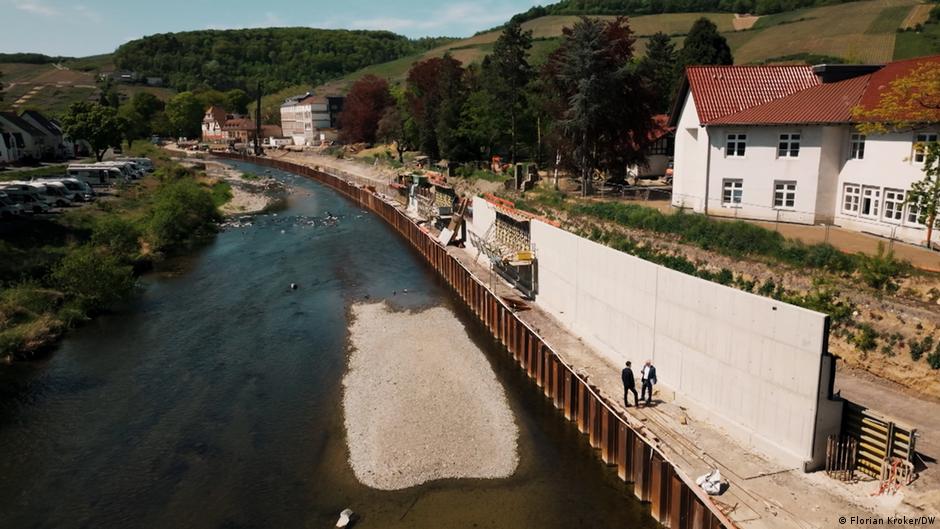
A particularly large construction site is located right along the river in Bad Neuenahr-Ahrweiler, where water breached the medieval town wall and flooded the historic old town. Now a new 480 meter long retaining wall is being built as additional security.
“It is a very solidly reinforced wall, built from bored piles 1.20 meters in diameter and 15 meters deep,” says Hermann-Joseph Pelgrim, managing director of the local Reconstruction and Development Corporation.
Pelgrim says many other security measures are more subtle, but just as effective. These included the construction of a new fire station built on stilts underground to prevent easy collapse. In the inner city, green spaces are being linked to underground drainage ditches to absorb and redirect heavy rainfall.
16 bridges destroyed in 2021 are being redesigned. The remains of the five-arched medieval arch will be left standing as a monument, and its replacement will consist of only one wide arch to allow water and debris to pass safely underneath.
“This bridge will not collapse under any circumstances,” explains Pelgrim, “not even in extreme flood conditions.” But he also says preventing another disaster requires a joint, inter-community effort. “We can prepare for what’s going to come our way. But it would be better if so much didn’t come our way in the first place – and that’s the responsibility of those who lead the way.”
Giving more space to the Ahr River (again)
Old maps from about 220 years ago show the Ahr River meandering across its valley floor, sometimes in several branches at once. But as more people moved into the valley, they diverted the river and built on its banks, meaning floodwaters have nowhere to go but straight into built-up and agricultural areas.
The town of Altenberg, located a few kilometers from Bad Neuenahr-Ahrweiler, is an example of this. Water levels were highest here during the 2021 floods – more than 7 meters instead of the regular 70 centimeters. In an aerial photograph taken at that time, only the upper floors of the town’s houses were visible above the water.
Bruno Buchele, the engineer coordinating the waterway restoration, says the main challenge now is to return the Ahr to its natural place. To do this, the county administration has purchased plots along the river bank from local farmers and private owners to convert them into floodplains. The idea is to plant shrubs, trees and bushes on the land.
“But these efforts will be fully effective only if retention measures technically reduce the amount of runoff coming here,” says Buchele. Both he and Pelgrim say flood prevention should start higher up, with the construction of dams on the river and its tributaries.
One such dam already exists in a side valley. Just outside the village of Adenau, it spills out into a stream, turning the grassland behind it into a basin. When water rises during floods, it accumulates behind the dam. In 2021, it held 40 million liters of water and although it leaked a little, it did not break. A second basin nearby did the same, preventing disaster at Adenau.
Because the system is working so well, 17 more such dams are being planned on the Ahar and its tributaries. But these will be very big, up to 25 meters high. The estimated cost is more than €1.5 billion ($1.7 billion) and if all goes according to plan construction will take decades.
New start of old plans
Similar plans were made for the Ahr valley after another devastating flood in 1910 but were never put into action. The flood faded from memory, and the allocated funds went elsewhere, including the construction of the nearby Nürburgring racing circuit.
But even if everything goes according to plan this time, Alexandra Weimer is also taking her precautions. After the flood, she moved to a different house. His basement windows now have flood barriers, and right next to them is a pile of sandbags, partially hidden by bushes.
“These are precautions so that if anything were to happen, we could take immediate action,” she says.
Like all flood survivors, she has lived in the city – and as close to the river as she was in her old home. The reason, she says, is simple. “Because it’s nice to live by the water. And because I’m not afraid. Period.”
Edited by: Tamsin Walker