The US Federal Bureau of Investigation (FBI) called it “Operation Hard Ball” – The largest ever international action against India-based organized crime gangs.
Last week, it led to the arrest of 24 suspects and the indictment of 37 defendants across the United States, Canada and Spain.
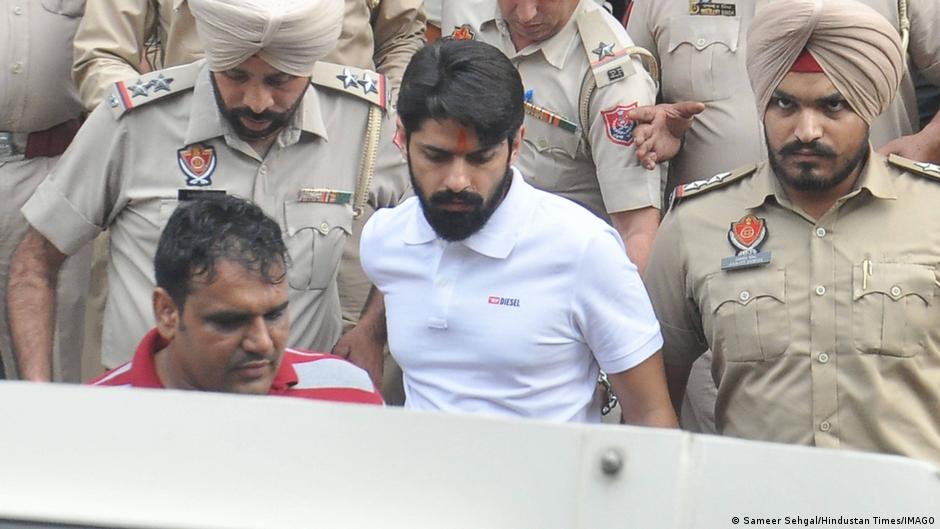
At the center of it was Lawrence Bishnoi, a jailed Indian gangster who was accused by US prosecutors of directing murders, extortion and international drug trafficking from inside a prison in Gujarat state using a smuggled mobile phone.
His alleged deputy Goldie Brar, also known as Satinderjit Singh Brar, has an FBI bounty of $50,000 (€43,735) on his head and remains a fugitive.
From Punjab to North America
India on Tuesday welcomed the US indictment of Bishnoi and several associates over the 2023 killing of Sikh separatist leader Hardeep Singh Nijjar in Canada, saying the case underlines the growing threat posed by transnational organized crime.
External Affairs Ministry spokesperson Randhir Jaiswal said India and the US have a “strong and growing” partnership in combating organized crime and terrorism.
But experts say the importance of Operation Hard Ball goes beyond just one gang. It shows how India-based organized crime gangs have evolved from a domestic law-and-order problem to an international criminal enterprise spanning North America, Europe and beyond.
According to the indictment, the Bishnoi organization used violence, drug trafficking and extortion to gain influence among the Indian diaspora.
Prosecutors allege the gang demanded millions of dollars from business owners across North America and ordered violence against those who refused to pay.
The indictment also accuses Bishnoi and Brar of directing the killing of Nijjar outside a gurudwara (Sikh place of worship) in Surrey, British Columbia in 2023 – a killing that plunged India-Canada relations into crisis. However, the charging document does not allege any Indian government involvement in the murder.
A new generation of organized crime
However, organized crime involving India did not begin with Lawrence Bishnoi.
In the 1980s and 1990s, Indian gangster Dawood Ibrahim created an international organized crime syndicate – called D-Company – which operated from Dubai and later Karachi, using smuggling, narcotics, extortion and hawala networks that extended across Asia, the Gulf and Europe.
His former lieutenant Chhota Rajan had built a rival network across Southeast Asia before his arrest in Indonesia in 2015. These syndicates depended on geographic safe bases, political patronage, and tightly controlled hierarchies.
“Unlike Dawood Ibrahim’s D-Company or Chhota Rajan’s syndicate, which operated largely through the Dubai-Mumbai axis using smuggling networks centered on gold, silver and hawala, the Bishnoi gang represents a new generation of Indian organized crime,” renowned counter-narcotics expert Srikumar Menon told DW.
Its operations extended to India, Canada and the United States, without the protection of any foreign government.
Instead, investigators say it relies on migrant networks, digital communications, drug trafficking and firearms to maintain extortion rackets and project influence across continents.
Menon said the growing Indian diaspora, particularly in North America, has created new markets and opportunities for criminal networks.
Unlike earlier syndicates, the Bishnoi gang operates in a far more technologically sophisticated environment, using encrypted communications and overseas operations to coordinate activity.
Menon said, “Although it cannot be compared with the scale of the Colombian cartels, its emergence marks a significant shift in the North American drug and extortion landscape. Indian gangs were long seen as regional actors, but the Bishnoi case shows that they are now becoming players in transnational organized crime.”
Technology rewrites the underworld
Unlike its predecessors, Bishnoi Network is younger, more decentralized and digitally enabled.
Investigators say the gang links local criminal networks in India with foreign affiliates who identify targets, collect extortion payments, transport drugs and buy weapons.
Encrypted messaging apps allow jailed leaders to direct operations, while social media aid in recruitment, intimidation and propaganda.
That growth has turned the Indian diaspora into both a source and target of opportunity.
Business owners in Canada, the US and the UK have reported extortion demands linked to India-based gangs, while foreign operations reportedly carried out threats away from the gang’s traditional strongholds in the northern Indian states of Punjab, Haryana and Gujarat.
Crime, once rooted in local land disputes and contract killings, is now driven by migration, money and digital communications across borders.
For law enforcement, investigations now require intelligence sharing, coordinated arrests, and tracing encrypted communications and financial flows across borders.
Operation Hard Ball brought together agencies from the US, Canada, Spain and India, reflecting the international nature of the threat.
Can international policing catch up?
Ajay Sawhney, executive director of the Institute for Conflict Management, said Operation Hard Ball highlighted a threat that had been evolving for decades, rather than highlighting an entirely new phenomenon.
“The Bishnoi case does not mark the beginning of the internationalization of Indian organized crime,” Sawhney told DW.
“This marks the point at which international law enforcement has finally caught up to a threat that has been evolving for decades.”
Sahni said technology has changed the way criminal networks operate.
“Encrypted communications, cryptocurrencies and cheap international travel have enabled loosely connected cells to cooperate across continents without the rigid hierarchies that older syndicates relied on,” he said.
“The business model has not changed – extortion, narcotics, contract killings and financial crime remain the main revenue streams. What has changed is the speed, reach and flexibility of these networks.”
He argued that that development has left law enforcement behind.
“Organized crime has become increasingly international, but policing remains largely national,” he said, “Criminal networks exploit jurisdictional fragmentation, while investigators must overcome legal, diplomatic and procedural barriers before coordinated action is possible.”
Former senior Indian intelligence officer and organized crime expert Avinash Mohanane said that the Bishnoi case is the latest chapter in the evolution of Indian organized crime, not a deviation from it.
“The Bishnoi network is not the first Indian crime syndicate to reach global levels. Like D-Company and the Chhota Rajan gang before it, it has built international networks for extortion, contract killings, drug trafficking and safe havens. What ultimately weakened those syndicates was sustained international cooperation,” Mohanane told DW.
He said, “The actions of U.S. authorities, working with international partners, have the potential to make a significant dent in the Bishnoi network. Previously, Indian crime syndicates were only successfully disrupted when intelligence sharing and law enforcement cooperation crossed national borders.”
Edited by: Srinivas Majumdaru