Since the funeral of Iran’s slain supreme leader, Ayatollah Ali Khamenei, senior figures in the Islamic Republic have significantly increased their rhetoric.
Politicians, state-controlled media outlets and the country’s new supreme leader have publicly called for retaliation for Khamenei’s death.
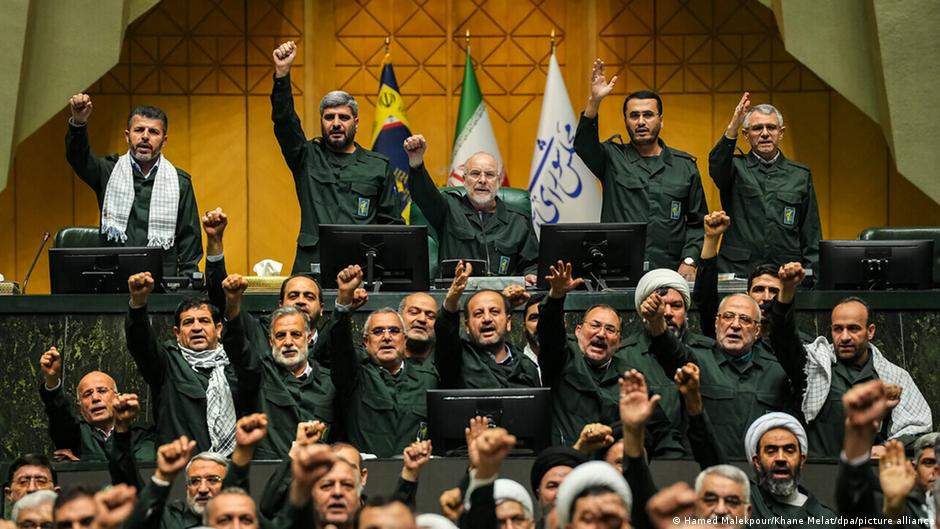
At the first in-person session of Iran’s parliament on July 14 since the beginning of the war, lawmakers waved red flags calling for revenge, according to images published by Iranian media. More than 180 of the 290 members of Parliament supported the demands for reprisals.
However, calls for revenge are not limited to Parliament.
Pro-government media outlets have also promoted them aggressively. On Saturday, the Orthodox daily compatriots It was published as a wanted list under the headline “Retribution is inevitable”.
The list includes 13 Western politicians and military officials, including the foreign and defense ministers, the commander of US Central Command (CENTCOM), and German Chancellor Friedrich Merz.
Psychological warfare?
“These threats should not be dismissed as mere political rhetoric,” legal scholar and human rights researcher Moeen Khazaeli told DW. “At the same time, it is important to distinguish between the ability, intent, and actual possibility of carrying out such threats.”
According to Khazaeli, the Iranian leadership is pursuing several goals through its rhetoric. A significant portion of the threats can be seen as psychological warfare and deterrence tactics, he said, adding that the regime is attempting to portray its weak military and security apparatus as strong and operational.
At the same time, it is indicating that it could resort to terrorist means if international pressure continues – a threat that, given the Islamic Republic’s history of foreign operations, cannot be ruled out outright, Khazeili underlined.
newspaper compatriotsThe city, owned by the Tehran Municipality, is considered close to the conservative camp. It is among those within the Iranian establishment who strongly oppose negotiations with the United States and maintain close ties to the Islamic Revolutionary Guard Corps (IRGC), the country’s most powerful military institution.
show support for the government
Iranian political activist Reza Alijani argues that Ali Khamenei’s mourning ceremonies also served political purposes. Speaking to DW, he said the leadership has tried to make the commemoration important.
In their view, the events were intended to demonstrate support for the ruling establishment, divert attention from military failures, and legitimize the continuation of the conflict under the banner of revenge.
The new supreme leader, Mojtaba Khamenei, reinforced that message shortly after his father’s funeral. Instead of emphasizing reconciliation or reconstruction after months of war, he focused on retaliation.
A statement issued in his name, a day after the end of week-long mourning ceremonies, vowed to continue the path of the slain leader. “We swear to avenge your pure blood and the blood of all the martyrs of these two wars against the criminal and unscrupulous murderers,” the statement said.
Who is the target audience?
“One of the most important target audiences of these threats is the regime’s own supporters,” Khazaeli said.
He underlined, “For years, the Islamic Republic has responded to military defeats or security setbacks with escalated threats. The goal is to create the impression that the regime is determined and capable of taking revenge.”
Additionally, the messages are directed toward an international audience. According to Khazaeli, the targets are not only Western governments but also opponents of the Islamic Republic abroad, including Iranian journalists, political activists, human rights defenders and exiled dissidents.
The influence of this rhetoric on public discussion was also evident in reactions to the recent death of Republican US Senator Lindsey Graham. Iranian state television and several pro-government Telegram channels commented on his death with expressions of satisfaction and, in some cases, even congratulations.
Graham was among the American politicians who in recent years supported a policy of “maximum pressure” against the Islamic Republic and for years called for military strikes and bombings against Iran.
Edited by: Srinivas Majumdaru