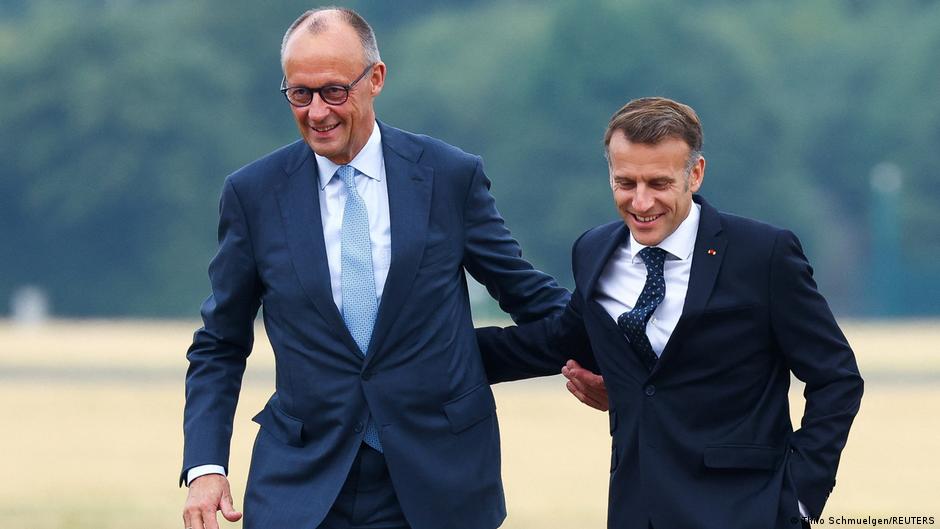
The Franco-German partnership reached a real high point this week with several joint ministerial meetings and a total of four meetings between Chancellor Friedrich Merz and President Emmanuel Macron.
Friday’s venue was particularly symbolic: the Augustusburg Palace in Brühl, West Germany, where President Charles de Gaulle and Chancellor Konrad Adenauer laid the foundation of the Franco-German partnership in 1962. Another highlight was Merz’s participation in the parade on France’s National Day on 14 July in Paris. The last time a German chancellor attended was in 2019, when Angela Merkel was in office.
German government spokesman Stephan Meyer previously said it was a personal honor for the chancellor, and dismissed speculation about a cooling of relations between Merz and Macron: “There is no question of a cooling of relations; on the contrary, relations are very good, and we are continuing to work to ensure that it remains that way.”
But it’s not that simple, believes Stephan Seidendorf, deputy director of the German-French Institute in Ludwigsburg.
“Since Merz took office it has become clear that there are indeed very significant differences between France and Germany and that cooperation is not a sure thing – but requires hard work,” he told DW.
For example, there are differences in energy policy – Germany’s phasing out of nuclear power versus France’s pro-nuclear stance – or in European fiscal policy.
However, cooperation in the field of nuclear deterrence is being stepped up: in Berlin, the feeling is growing that the nuclear security of the United States is becoming unreliable, and, for the first time, German troops are expected to participate in French nuclear exercises in this case.
This year’s Bastille Day parade, the largest since Macron took office in 2017, was held under the theme “Europe’s Strategic Awakening.” Macron wanted to send a clear signal of support for continued aid to Ukraine and for greater European confidence vis-à-vis the United States under Donald Trump.
Regarding Russia’s war against Ukraine, Germany has now, after some initial hesitation, agreed to take part in the first military exercises of the so-called “coalition of the willing”, a group of about 35 countries that want to support Ukraine in the event of an armistice with Russia. The first exercise is going to take place in Poland.
Failed Franco-German projects
In recent weeks, there has been mostly negative news about Franco-German relations: first of all, the failure of major Franco-German defense projects – in addition to the joint FCAS fighter jet project, which has been officially scrapped, the MGCS tank project also appears to be in limbo. The German company Rhinemetall involved in this has raised questions on this project.
And then, in early July, right-wing populist Marine Le Pen announced her candidacy for the presidential elections in the spring of 2027, in which Macron will no longer be eligible to participate. Le Pen has already tried three times, twice losing to Macron in runoff votes. This time, some polls say, he has a chance of becoming the next French president. This would be a nightmare for the German government, which it believes favors nationalism rather than greater European integration.
The question of what will happen if Marine Le Pen of the right-wing National Rally (RN) wins the election next spring hangs over Franco-German relations.
Jakob Ross, a France expert at the German Council on Foreign Relations, says: “First of all, it would mean an immediate loss of trust – in government administration and political cooperation – which would lead to a breakdown in many areas where cooperation currently happens very naturally and organically.”
But Ross does not believe that this will lead to the end of the Franco-German Friendship Treaty: “This will certainly be a very serious stress test for this treaty between Germany and France, as well as for European integration. However, I do not rule out the possibility that a certain pragmatism will set in, that the RN will be distracted by the excessive demands and promises in its platform, and that it will come to its senses after assuming responsibility in government offices.”
Stefan Seidendorf of the Franco-German Institute also points out that Franco-German relations are about more than just politics. In the event of Le Pen’s electoral victory, “the question arises with each of these contacts – in government, business, civil society, city partnerships and student exchanges – how to move forward.”
This article has been translated from German.