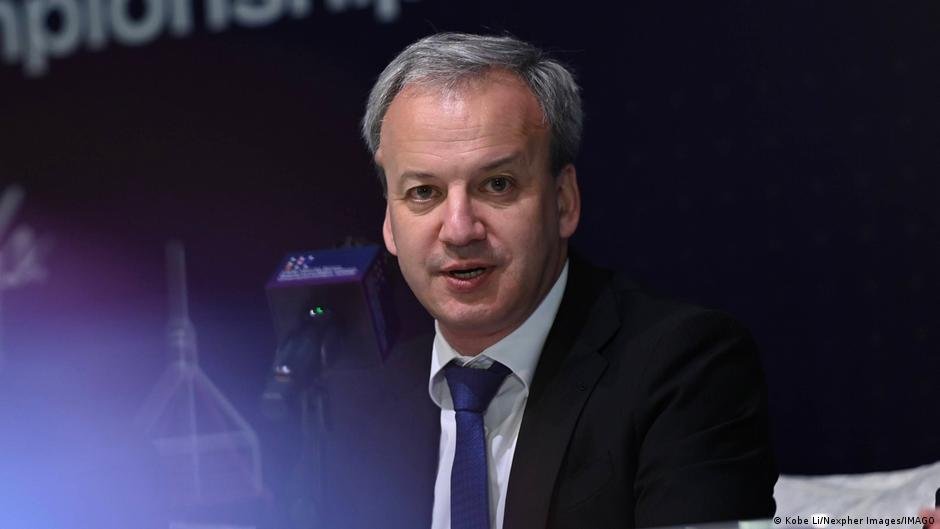
International Chess Federation (FIDE) President Arkady Dvorkovich isn’t going anywhere – at least if things go his way.
“FIDE must become even more open, efficient and responsive,” the former Russian Deputy Prime Minister said when announcing his candidacy for a third term in late June.
The Russian was first elected to the post in 2018. Sanctions imposed on Russian sports over the war in Ukraine have so far failed to rein in the 54-year-old economist and politician. By contrast, in August 2022, months after Russia’s full-scale invasion of Ukraine, Dvorkovich was re-elected with a large majority.
Yet Russia had long ago lost its dominance on the chessboard; Recent world champions have come from China and India. However, within FIDE, Russian influence remains substantial. Without funding, little happens within the organization that is directly or indirectly related to Russia.
One of FIDE’s major sponsors is financier Timur Turlov. Although he became a Kazakh citizen in 2022, he is originally from Russia. Turlov is now running to become FIDE Vice President under Dvorkovich.
Germany’s challengers
However, the vote in September could prove to be a tight race, as two Germans have announced their candidacies for the presidency. Thus, Uzbekistan may see a three-way competition for the votes of about 200 national delegates to the Congress.
“I still consider Arkady Dvorkovich the favorite in this race,” said Peter Heine Nielsen, coach of former world champion Magnus Carlsen of Norway. However, should it be placed under EU sanctions, the situation may change.
Denmark’s Nielsen was on the ticket with Ukrainian grandmaster Andrey Baryshpolets when he unsuccessfully ran for FIDE president in 2022.
This time he is supporting German investor John Heinrich Buettner. The former Internet executive aims to “improve transparency and drive sustainable, long-term growth for our game.”
Buettner’s candidate for Vice President is veteran English chess official Malcolm Peane.
“All over the world, chess has grown tremendously in the last five years – but FIDE has not,” Penn told DW. “We want to change that.”
According to Pean, a major challenge for FIDE is to attract new sponsors that have no ties to Russia. The British are vocal critics of Russia’s dominance of FIDE.
However, the fact that Buettner is now seeking to head FIDE has surprised some in the chess world. Büttner has in recent years helped former world champion Carlsen establish “freestyle” chess – a variant in which starting positions are determined by draw, making memorized opening moves irrelevant. However, to many, he seems more like an outgoing startup entrepreneur than a future Federation President holding a diplomatic passport.
DSB supports Rosenstein
“I cannot fathom the candidacy of Jan Heinrich Büttner, nor do I think it has any chance of success,” Paul Meyer-Dunker, president of the German Chess Federation (DSB), told DW.
“Buettner did not contact us before announcing his candidacy, nor did he cooperate with the DSB on his freestyle activities.”
The DSB is pinning its hopes on another German: Vadim Rosenstein. The 35-year-old entrepreneur from Düsseldorf has been financing and organizing top-level chess competitions around the world since 2022. He also occasionally participates as an amateur player. His vision is to make FIDE “one of the most respected institutions” in international sports.
Mayer-Dunker asserted, “Vadim Rosenstein is someone who doesn’t just talk; he takes action.”
By his own account, Rosenstein has invested millions of euros in the game of chess over the years, partly through his company WR Logistics, which has been a major sponsor of FIDE international events. However, when DW asked him how much he had invested in the game, he gave a figure.
Even the Buettner camp acknowledges that Rosenstein has made great strides in the global chess world. However, questions remain.
“I am grateful for Vadim Rosenstein’s work as a sponsor and organizer of chess competitions around the world,” Pein said. “But I am concerned about the lack of hard facts about his professional background.”
Rosenstein argues that his businesses are private, unlike publicly listed companies, meaning he is under no obligation to release details of his assets. However, he said his companies were active in about 70 countries.
By 2022, Rosenstein, who was born in 1990 in present-day Ukraine, had a main focus on supporting German companies in regions such as Ukraine and Russia. However, in 2022, he stopped doing business with Russia, even though he continued to “formally” own companies there.
DSB President Meyer-Dunker is well aware of the questions surrounding her candidate for the FIDE role.
“There is continued speculation among some about Vadim Rosenstein’s motives and background, but we know that he is a successful and respected entrepreneur and that he loves the game of chess very much,” Mayer-Dunker said.
“In my view, he presents the best chance to oust Dvorkovich and pursue much-needed reforms in international chess.”
Pain sees things differently.
“Vadim Rosenstein asked me to join his ticket, but I declined, because I couldn’t get past my doubts,” Pein said.
“Vadim Rosenstein is evasive on the issue of Russia’s role in chess politics. I demand that he make clear statements about the illegal activities of the Russian Chess Federation in the occupied territories in Ukraine and the participation of Russian players and teams in official FIDE events,” Pein explained.
CAS decision leaves Russia without voting
The Court of Arbitration for Sport (CAS) recently ruled in favor of Ukraine, which had complained that the Russian Chess Federation had organized chess competitions in occupied Ukrainian territories. In June, FIDE suspended the Russian Federation’s membership due to the decision.
Rosenstein, when asked by DW to state his position on the matter, responded, “In principle, I would prefer a world in which every athlete could compete under his or her national flag.”
“At the same time, the President of FIDE must serve each member federation responsibly and within the rules. In this case, there is a clear legal framework: the Russian Chess Federation has been affected by CAS decisions, and those decisions must be implemented immediately.”
The decision also means that, as things stand, the Russian Federation is barred from voting in September’s FIDE elections. Nevertheless, this campaign is being watched with great interest in Russia. There is a favorable article about Dvorkovich’s candidacy as well as Rosenstein’s candidacy on the Russian Chess Federation website.
There is no mention of Jan Heinrich Büttner and Malcolm Peen. Perhaps this was just a coincidence, but Heine was not surprised.
He said, “Generally, in the chess world, players, officials and the wider chess community are happy when interesting tournaments and events are organised.” “And they don’t ask many questions about where the money comes from.”
This article is taken from German language.