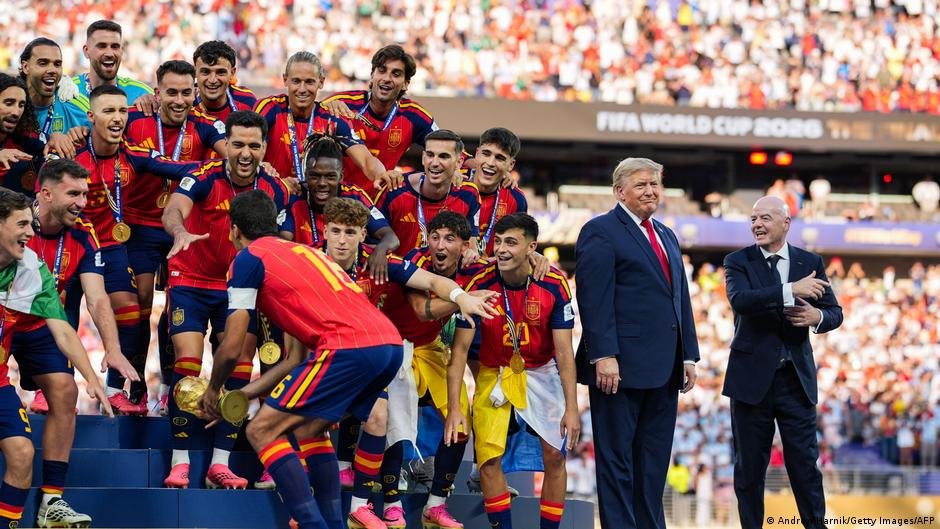
Rodri, like anyone who plays football, had dreamed of this moment. The Spain captain held the World Cup in his hands and was surrounded by his teammates. But, before he could lift the trophy, he had to find a way to politely escort the most powerful man in the world off the stage.
He was not successful at all. In the end, FIFA President Gianni Infantino had to jog in front of the players to try to get Donald Trump to move on. Yet the American president lingered next to Barcelona midfielder Pedri, bathing in the praise he had been denied while having drinks with Infantino just moments earlier. Trump overstayed his welcome in a similar manner at last year’s Club World Cup.
Although Sunday’s final, in which Spain defeated Argentina 1–0, was the first match of the tournament that Trump attended, he declared it “probably the most successful sporting event in the history of the world” and it was a steady attendance even in his absence.
“Trump exerted influence over the entire tournament and weaponized it for domestic political purposes, whether he came to the matches in person or not,” Jules Boykoff, a professor in the department of politics and government at Pacific University in the US state of Oregon, told DW.
Trump’s ‘notorious’ intervention
The Trump administration’s policies denied entry to Somali FIFA referees into the United States, forced Iran to train in Mexico and travel to games in Los Angeles and Seattle, and barred fans from around the world from attending matches. Above all, Boykoff said, Trump’s knockout stage phone call to FIFA “will certainly go down as one of the most infamous political interventions in World Cup history.”
Although Trump successfully lobbied to overturn the red card suspension of star striker Folarin Balogun, the strategy backfired on the field and the United States lost 4-1 to Belgium in their last-16 match. “I knew this was going to cause a lot of controversy,” Balogun said. “I could almost see the nervousness within my teammates because this was something that was so unique.”
Boykoff said the implications of the game may not have been at the forefront of Trump’s mind. “Intervening in the red card situation allowed him to send a message to his political base that he could bend international institutions like FIFA to his will,” said Boykoff, who represented the United States at the youth level as a player. “Most of Trump’s actions during the World Cup should be read as attempts to impress domestic political audiences ahead of key midterm elections, not as attempts to convince international audiences that he is some great guy.”
Trump stressed that the tournament has boosted America’s international reputation. “People from all over the world have come and they love our country,” he told reporters.
Was the Balogun call a mistake for Trump?
Midterm elections in the US are scheduled for November 3 and Trump’s approval rating is below 40% due to the ongoing war in Iran. Although the “shock” of a global organization like FIFA may have appeal with a base he has already won over, Karim Zidane told DW that the Balogun intervention was a political mistake for Trump.
“I think, by boasting about how when the United States men’s national team gave him a chance to rally behind a team that seemed to unite Americans, he managed to find a way to screw it up, and the people who disliked him hated him even more,” said Zidane, an investigative journalist who has long covered Trump’s use of sports in his politics.
Such unprecedented and direct political interference in football decisions caused outrage and fury in much of the world – drawing criticism from everyone including politicians, football associations, fans and coaches. But that won’t cause Trump any trouble, Boykoff said.
“Based on his actions, Trump doesn’t care much about what the rest of the world thinks of him. His anti-immigration policies tarnished the World Cup and undermined FIFA’s slogan that ‘football unites the world.’ “Trump used the tournament to further fragment the world while pandering to the worst tendencies of his base ahead of the midterm elections,” he said.
Shaping the game as American strategy
The Balogun incident was Trump’s first real attack on the tournament and occurred three weeks after it began. Given how present he was in the buildup, this was a surprise to some. But Zidane said the geopolitical situation was keeping him busy, while the 250th US Independence Day event also took up Trump’s time during the tournament.
“His interest is really in making it about himself or gaining any kind of personal prestige from a program,” Zidane said. “So I’m really not surprised at all that he wasn’t present in standard World Cup games.”
Despite his apparent lack of interest, Trump made a play for a future World Cup shortly after the 2026 tournament ended. He told Fox Sports, “I had a great idea for Gianni: You have to announce two countries. Next time announce us again and then announce another country after that. That will reduce the anger and shock to some extent.” “Based on the numbers, we would request it again immediately.”
The US could host the men’s World Cup again in 2038, but Los Angeles will host the Summer Olympics in 2028, ahead of the presidential election in November with Trump still in power. The US is hosting the 2034 Winter Olympics in Salt Lake City and is likely to win the 2031 Women’s World Cup.
UFC is a safe sports haven for Trump
Zidane thinks Trump will first retreat to protect the mixed-martial-arts Ultimate Fighting Championship (UFC), which he managed to incorporate into the celebration of the United States’ 250th anniversary.
Zidane, whose latest book, “The Ultimate Strongman,” focuses on Trump’s relationship with the UFC, said, “Whenever he attended a sporting event that was not a UFC event, he got a standing ovation. He was never given such a warm welcome in the UFC.”
“That’s why he shows up there so often, why he’s hosting a UFC event at the White House. He understands that this is his ideal audience and his safe place, and, no matter how poorly he’s performing and no matter what he’s doing in the world, no matter what war is going on, he will be welcomed back.”
Although FIFA and its president rolled out the red carpet for Trump and the 2026 World Cup made more profits than any tournament before, it is the American voters, not the executive bodies of soccer organizations, whom Trump must now influence. Whatever way the midterms go, it’s unlikely he’ll be ousted from the political stage any time soon.
Edited by: Milan Gagnon