Now more than four years after Russia’s full-scale invasion of Ukraine, the Black Sea has become one of Europe’s key security borders. And yet, it is currently “pretty much empty of warships,” Thomas de Waal, a senior fellow at Carnegie Europe, told DW. “It’s a bit of a contradiction,” he said. To understand this paradox, we first have to take a closer look at the map.
The Black Sea is bordered by six countries: Türkiye, Bulgaria, Romania, Ukraine, Russia, and Georgia. The first three on that list are part of the North Atlantic Treaty Organization, or NATO – the other three are not. To make matters more complicated, two of the latter three are at war with each other.
narrow bottleneck to maneuver
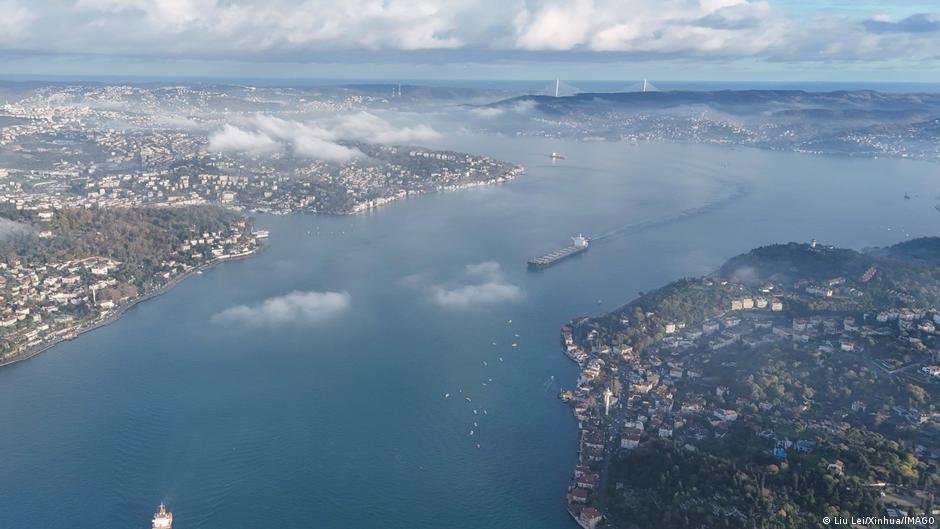
Access to the Black Sea passes through a single, narrow bottleneck. To get there, ships coming from the Mediterranean must pass through the Dardanelles Strait and the Bosphorus, which passes through the center of Istanbul, Turkey’s largest metropolis.
At its narrowest point, the Bosphorus is only 700 meters (0.4 mi) wide. For comparison, another important passage currently in the spotlight is the Strait of Hormuz, which is approximately 33 kilometers (21 mi) wide at its narrowest point.
It is the geographical barrier of the Black Sea that makes it “an economic choke point,” de Waal said. “Whoever controls the Turkish Straits also controls trade through the Black Sea to some extent and also has an enormous military advantage.”
According to Daria Isachenko, visiting fellow at the German Institute for International and Security Affairs, Russia also has a special interest in the Black Sea. “For Russia a strong military position in the Black Sea is not a goal in itself, but also a means of pursuing its geopolitical ambitions and strengthening its great power status.”
The second part of the equation goes back to a treaty signed exactly 90 years ago.
The treaty that made Turkey the gatekeeper
On July 20, 1936, representatives from no less than a dozen countries gathered in the Swiss city of Montreux to resolve a long-standing dilemma: how – and by whom – should these vital waterways be governed? He established the Montreux Convention, an agreement that essentially restored Turkish sovereignty over the Dardanelles Strait and the Bosporus. It came after years of international monitoring following the Ottoman Empire’s defeat in World War I.
The negotiations resulted in a document of approximately 30 pages, which set out the legal framework governing the Turkish Straits to this day. The treaty keeps the strait open to passenger and commercial traffic during peacetime – vital to the vital trade route.
When it comes to military vessels, the Black Sea states are relatively allowed to move their warships through the strait. Any navy outside the region faces restrictions on the size of their fleet, tonnage and how long they are allowed to remain at sea – no more than 21 days during peacetime.
special rules for war
These rules become more strict during times of war. When Turkey is not part of the conflict, warships from any country involved in the fighting are not allowed to pass – a clause that has had a deep impact on the region since February 2022.
This special system of access rights places the Turkish government in a very powerful position. “The most privileged Black Sea state is turkiye Myself,” Isachenko said.
This also helps explain why NATO does not maintain a sustained presence in the Black Sea, unlike other waters such as the Mediterranean or the North Sea. “For NATO, Montreux is an obstacle,” Isachenko said. “For Turkey, it is a tool to maintain balance in the Black Sea.”
Ukraine was testing the Montreux Convention
When Russia launches its full-scale invasion of Ukraine in late February 2022, the Montreux Convention faces arguably its biggest test in decades. A few days after the military operation began, Turkey invoked Article 19 of the treaty, which applies during wartime and prohibits military vessels from countries involved in the fighting from passing through the strait.
Essentially, from that point onward, neither Russia, nor Ukraine, could reinforce their naval forces in the Black Sea – with one exception: warships registered to a home port in the Black Sea could return to their base.
“I think the Montreux Convention and Türkiye’s policy at the beginning of the war were absolutely crucial in allowing Ukraine to survive,” Thomas de Waal told DW.
He argued that this prevented Russia from adding more ships to its Black Sea Fleet, saying “up to 30 Russian ships were left out.” This, he added, helped Ukraine “gain leverage in the Black Sea.”
Those sanctions would also have highlighted how warfare has changed, with Ukraine turning to drones and other modern technology not covered by the 1936 document. According to Romanian foreign policy analyst Iulian Chifu, “Ukraine did not build military ships.” “It changed the generation of attacks,” he said.
The maritime pact has also restricted the options available to Ukraine’s supporters in the West. According to the UK Ministry of Defence, in 2024, the United Kingdom donated two minesweepers to Ukraine, which were unable to enter the Black Sea. This is because Türkiye considers them “ships of war”, according to De Waal. Instead, the ships are docked in Portsmouth, southern England.
For de Waal, this reflects Turkey’s broader approach: “This is a very carefully constructed strategy,” he said, “in which Turkey basically says to other NATO countries: ‘Leave us alone in the Black Sea, we’ll handle it.'”
The key to the lasting relevance of the convention may be its long-term recognition by states. “Türkiye has come up with a system, a regime that Russia is not particularly happy with, but accepts, and that is very important,” he said.
At a time when the international rules-based order has come under increasing pressure, the Montreux Convention is a rare example of a multilateral diplomatic mechanism that is still viewed and respected 90 years after it was signed.
How is NATO adapting?
The geography of the Turkish Straits – as well as their complex governance structure – has led NATO to rethink how it can operate in the region. At times, the issue also creates some tension between members of its alliance: “In the Black Sea,” de Waal explained, “Turkey is actually in first place and NATO is in second place.”
He argued that this security logic has shaped Turkey’s message to its Western allies: “We don’t want to see your permanent presence in the Black Sea, but Romania and Bulgaria have this shared Black Sea ownership, so you can support them.”
As a result, greater attention has been focused on these two Eastern European states, which have been NATO members since 2004. However, some experts remain dubious: “The military capabilities of Bulgaria and Romania,” Chifu said, “are barely limited to their ability to defend their territories.”
Nevertheless, he argued that Romania was trying to “improve our capabilities of building ships” as well as buy military assets with the aim of “enforcing our footprint in the Black Sea”.
An example is the planned expansion of Mihail Kogălniceanu Air Base near the Romanian port city of Constanţa. government of romania The conversion is expected to cost €2.5 billion ($2.8 billion) The largest NATO military base in Europe -Larger than the US military base Ramstein in Germany.
Earlier this month, the region was once again in the headlines as leaders of NATO member states met in the Turkish capital Ankara for their annual summit. There, Türkiye, Romania and Bulgaria announced a trilateral working group for mine-clearing efforts to protect underwater infrastructure.
What’s next for the 90-year-old treaty?
De Waal told DW that the Montreux Convention is “quite an archaic document,” adding that it still refers to the League of Nations – the predecessor to the United Nations, which ceased to exist 80 years ago. “But I think nobody wants to touch it,” he said, out of concern that it “opens a kind of Pandora’s box when all issues have to be renegotiated with Russia.”
“For Türkiye,” Isachenko said, Montreux “is also related to several founding treaties of the Republic of Türkiye.” Beyond its role as a maritime access treaty, it reflects Turkey’s core interests: “sovereignty, security and status,” he said, so challenging Montreux means “dealing with, revising and challenging” those core interests.
Security analyst Chifu stressed that he was “not a revisionist” and believed the conference should last as long as there was anger in Ukraine. “But after the war,” he said, “we must clearly reconsider how this applies to our allies in NATO.”
For them, the question of how the treaty’s clauses are actually implemented and interpreted by Türkiye remains a sore point.
“You have no choice but to work with Türkiye,” is the main message De Waal took from the recent NATO summit in Ankara. “You can’t function without it,” he said, referring to what he calls the strongest force in the Black Sea.
For the past nine decades, the Montreux Convention has endured wars, leaders, and entire generations. And as long as it lasts, Turkey dominates the Black Sea entrance.
Editors: Peter Hille and Don McCottir