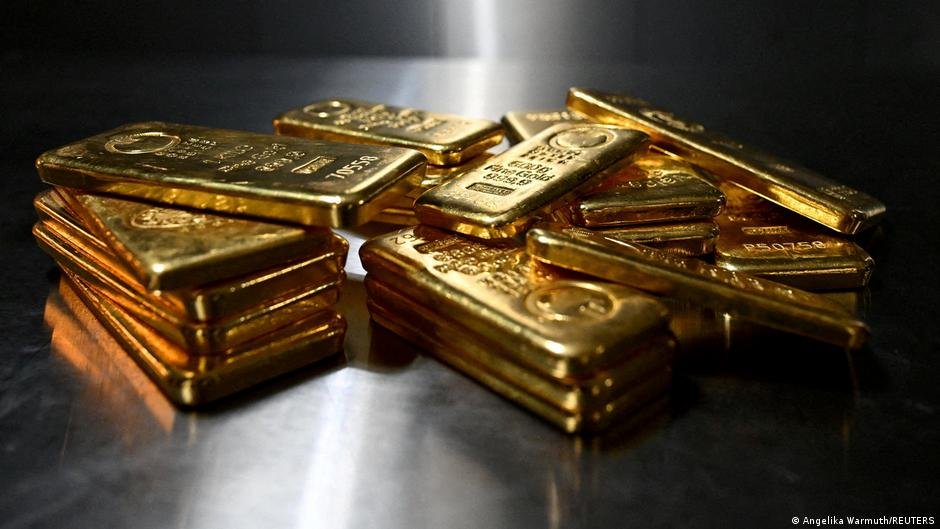
The price of gold has increased continuously in recent years. Apart from the current market decline (see chart below), the uptrend has been going on for years. Since 2020, the price of gold has increased from $1,585 an ounce to more than $4,500 an ounce.
The value of money should not decrease due to inflation. Ideally, it should grow on its own out of interest. But such investments look less promising right now, as central bank interest rates remain relatively low. As a result, investors look for a safe place to keep their money – and precious metals are one option they turn to. Increased demand naturally increases prices.
Economists at Deutsche Bank have shown that central banks around the world are rapidly buying gold. In a search Published on April 27, they found that central banks in China, Russia, India and Türkiye, as well as emerging markets, are increasing their gold reserves. As a result, gold could reach $8,000 an ounce by 2031 – double its current price.
A New Player: Cryptocurrency
Before predicting the future, it’s important to ask what’s behind the current gold rally. Frank Schallenberger of Landesbank Baden-Württemberg (LBBW) cites “interest rate cut expectations and a weaker US dollar, strong buying by central banks, as well as higher demand for coins and bars” as key factors behind rising gold prices.
There is also a relatively new market participant, Shallenberger told DW: cryptocurrencies. They are “becoming an important new source of demand, as they are also diversifying their assets, including buying gold. If this continues, it could provide further momentum to gold prices.”
Michael Huh, a precious metals analyst at Deutsche Bank Research and one of the authors of the previously mentioned study, distinguishes between “inelastic” and “elastic” buyers. He says he has seen that stable, inelastic buyers such as central banks have crowded out more price-sensitive “elastic” customers, including private buyers such as jewelery buyers. This steady demand “has been a major factor behind gold’s strength between 2021 and 2025.”
“The main reason for the rise in the gold price in recent years has been the accumulation of geopolitical uncertainty,” Thomas Kulp, a research analyst at DZ Bank, told DW. The “safe-haven” appeal of the gold market on the one hand, and its status as a guarantee of independence on the other, have been key drivers of demand.
Is the classic ‘safe haven’ still safe?
Gold has long been considered a reliable way to protect wealth. It may not generate returns on its own and is subject to speculation – but the precious metal is certainly safer than hiding cash under the mattress.
But, Shallenberger cautions that its safe-haven reputation is sometimes overstated. He argues that holding large amounts of gold is not a good idea, although it can still serve as a hedge: “Having five or 10% gold in a portfolio is certainly not a bad idea as it can reduce the volatility of the portfolio.”
Michael Huh of Deutsche Bank Research takes a different view: “We believe it makes sense to hold large amounts of gold as a store of value. The main reasons for reserve managers (central banks, ed.) to add gold to their portfolios are diversification, protection against geopolitical risks, and hedging against inflation.”
Thomas Kulp of DZ Bank is a little skeptical about the value of gold in stabilizing investments. “Gold is and will remain the ultimate safe haven. In uncertain periods or times of crisis, the precious metal is usually in demand.” But this doesn’t always apply, he says, because the price can be subject to “sometimes significant fluctuations” – something “investors should always keep in mind when deciding what to do with their assets.”
looking into a crystal ball
Making predictions always involves some degree of uncertainty. This is true when filling out lottery tickets or predicting economic growth. If predictions were generally correct, there would be no economists or business journalists – but many millionaires.
So do the experts interviewed here agree with Deutsche Bank Research’s approach? Frank Shallenberger certainly doesn’t: “The strong gold rally, which temporarily halted in late January, was supported by heavy purchases of gold ETFs as well as a significant increase in central bank gold holdings. But both groups have lost some momentum recently. At current price levels, I do not see strong enough drivers that would allow gold prices to double over the next five years.”
But Deutsche Bank Research study co-author Michael Huh stands by his forecast.
“We examined gold accumulation by emerging market central banks as a potential long-term driver of gold prices,” Sueh told DW. He expects central banks to continue rebuilding their gold reserves in what he calls “the return of history” – a period marked by rising geopolitical tensions reminiscent of the Cold War.
They argue that these more uncertain times could push central banks back to the lows of their pre-1990 range, where gold accounts for about 40% of their reserves. “Assuming that emerging market foreign exchange reserves decline from $8 trillion to $5 trillion, this could correspond to a nominal gold price of $8,000 an ounce.”
DZ Bank analyst Thomas Kulp is more cautious. “Given developments over the past few years, such forecasts are not surprising,” he said.
But he also sees no reason for pessimism: “Over the next 12 months, we expect gold prices to return to the $5,000 an ounce level. The fundamental drivers of demand will remain intact. That’s why we also maintain a positive long-term outlook for gold prices.”
This article was originally published in German.