The 2026 World Cup, co-hosted by the United States, Mexico and Canada, was not going to be easy for soccer.
There were questionable decisions made by the sport’s governing body FIFA, plenty of spectacle and a final in which only one team actually played football.
After a total of 104 games in the biggest World Cup ever, Spain was crowned champion, and for the first time, a country’s men’s and women’s teams were simultaneously world champions.
FIFA President Gianni Infantino described the tournament as “humanity’s greatest sporting, social and cultural event”.
US President Donald Trump congratulated FIFA for “one of the greatest sporting events of all time in history”.
But was it really so? Here’s what will be remembered.
How did the visitors get the biggest cup ever?
Fears of empty stadiums – especially in the United States, where international soccer is not the No. 1 sport – proved unfounded. According to FIFA, 6,810,966 fans attended the tournament, making it the first tournament to be jointly organized by the three countries. This set a new record for World Cup attendance.
Given that the schedule consisted of 104 matches instead of 64 as in previous tournaments, the record attendance is no surprise. Average match attendance was around 65,000, and, according to FIFA, 99.7% of all available seats were filled. However, many empty seats were visible in the stadiums, especially during the group stage.
Hydration breakdown leads to criticism
Fans criticized the newly introduced hydration break. However, most coaches supported the breaks – or, at least, did not complain about them.
On the other hand, now former Uruguay coach Marcelo Bielsa criticized the extra chances for influencing the game.
“Playing four halves instead of two changes the cultural perception of football,” he said. “These breaks add nothing to the game, but take away a lot.”
Many surprises of the 2026 World Cup
World Cup newcomers Cape Verde caused quite a stir. The small African nation held eventual world champions Spain to a 0–0 draw and narrowly lost to defending champions Argentina in extra time in the round of 32.
Democratic Republic of Congo celebrated a 1-1 draw against Portugal and their superstar Cristiano Ronaldo. Paraguay eliminated Germany from the tournament in the Round of 32. Curaçao, the youngest World Cup participant, made history by scoring their first World Cup goal against Germany and earned their first World Cup point against Ecuador.
World Cup price madness
This World Cup was expensive. Fans had to dig deep into their pockets for tickets, hotels, parking fees and flights. Prices inside the stadiums created additional frustration. In the United States, beer prices can reach $20 (€17.50), French fries €17, and even a bottle of water costs €7.
Even in Mexico, food and drinks were significantly more expensive than usual. At the Azteca Stadium, where the opening match took place, the price of a beer was the equivalent of around €15.50 – roughly equivalent to the country’s minimum daily wage.
Donald Trump’s World Cup
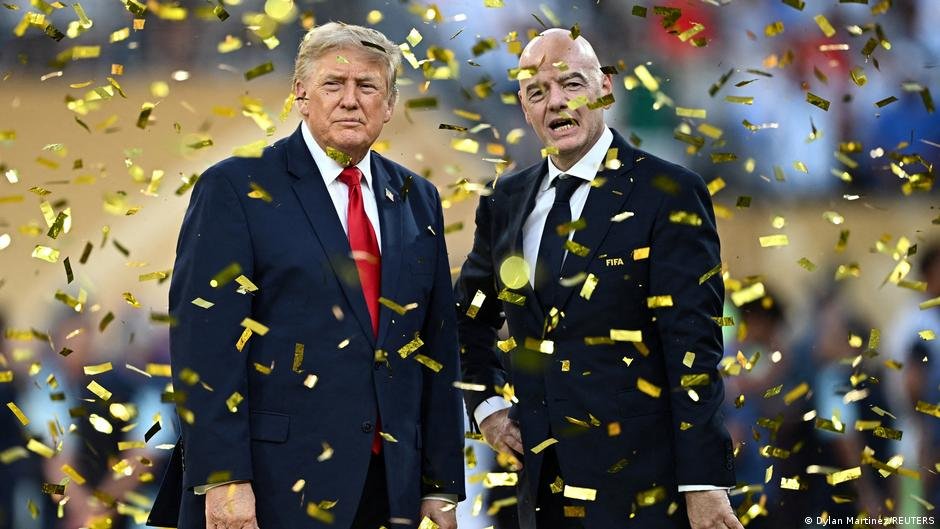
There was widespread concern that Trump might use the World Cup to advance his political agenda. After all, the US President had repeatedly declared the tournament his personal prestige project. Yet Trump was not seen in the stadium until the final and remained largely low profile during the tournament.
Yet, the 80-year-old sparked the biggest scandal of the tournament. After American forward Folarin Balogun was shown a red card, Trump successfully lobbied Infantino to review the automatic ban for the next game.
Balogun was allowed to play in the round-of-16 match against Belgium, but could not prevent the United States from losing 4–1.
“The current FIFA president has bowed to Donald Trump,” said Infantino’s predecessor, FIFA chief Sepp Blatter. However, the criticism is unlikely to jeopardize Infantino’s re-election as FIFA president should he seek a third term in office in March 2027.
world cup events
The war in the Middle East and unrest in Mexico raised significant security concerns ahead of the tournament. Although the Games went off largely without disruption in Canada and the United States, several incidents occurred in Mexico. Fans invaded an already crowded fan zone in Guadalajara, in another incident a car drove into the crowd after a national team victory, and several people died during victory celebrations in Mexico City.
Like many fans, particularly from African countries, Somali referee Omar Artan was denied entry to the United States despite having a valid visa, after US authorities alleged he had ties to a terrorist organization in his home country. Ayrton hopes to receive his salary for the World Cup.
world cup human rights situation
Many human rights organizations have given very poor ratings to FIFA.
“This World Cup has been played against a backdrop of the US government’s abusive immigration crackdown,” said Minky Worden of Human Rights Watch.
He said that “FIFA has failed to maintain its own human rights standards.”
This appears to contradict FIFA’s claims of “the most inclusive World Cup in history”.
Daniel Norona of Amnesty International USA said, “FIFA promised that everyone could feel safe. The reality is different. For example, ICE has doubled the number of arrests.”
Ronan Ewen of the fan organization “Football Supporters Europe” criticized the opaque process of issuing visas to fans, especially those from non-European countries.
“Our observations found little or no evidence that ticket holders from Africa and Asia actually received visas to enter the United States,” Ewen said.
What’s next after the World Cup?
Infantino has discussed his desire to expand the World Cup from 48 to 64 teams. There will now be 128 matches instead of the current 104 matches.
“It is definitely an issue that will be examined after this World Cup and discussed within the committees,” Infantino told Swiss broadcaster Blue Sport.
Despite widespread criticism of Infantino, his position as FIFA president is not in danger. On the contrary: more games means more money it can distribute to member countries.
If re-elected in March, Infantino will remain in charge until 2031, a year after the next World Cup, which is to be spread across three continents. A total of three matches will be played in Uruguay, Paraguay and Argentina before the tournament moves to Spain, Portugal and Morocco.
This article was originally published In German.