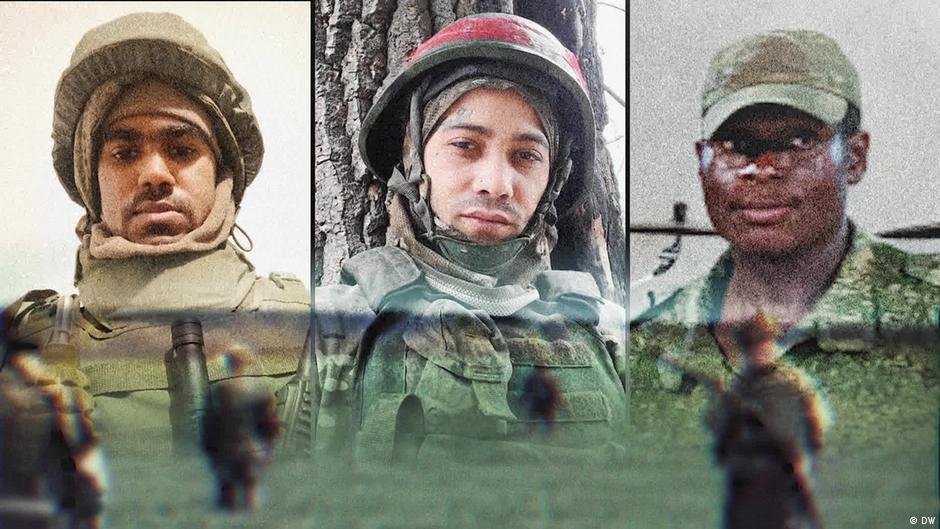
Kenyan Charles Mutoka, 72, mourns his son, Oscar Astron Mutoka, a former soldier who went to Russia in the summer of 2025 in search of work.
Her father said he had tried in vain to talk to her about it. Oscar did not tell her and the rest of his family where he was going, but a week after leaving he sent a photo of himself in uniform and was never contacted again.
His family learned after some time that he had died, but despite appeals to Kenyan authorities, they were unable to recover the body.
In May 2026, the family held a symbolic memorial service and established a temporary burial site for Oscar, so that there would at least be a place where he could pray. Charles Mutoka said, “The worst thing is that I don’t know where he was actually buried, or whether his body was dumped in some forest in Russia.”
According to Ukraine’s Defense Intelligence (HUR), Oskar Mutoka is one of an estimated 27,000 or more foreign nationals recruited by Russia for the war in Ukraine. A joint study conducted by the International Federation for Human Rights (FIDH), the Truth Hounds human rights organization, and the Kazakhstan International Bureau for Human Rights and Rule of Law (KIBHR) provides evidence that Russia has established a global network for the recruitment of foreign nationals.
“This recruitment targets people with economically, socially and legally precarious living situations. The methods employed range from tempting offers to deception and even coercion,” Ilya Nusov, one of the study’s authors, told DW.
‘I don’t want to die in Cuba’
For many people living in the world’s poorest regions, the wages paid by the Russian military are a huge incentive because it means a chance to escape poverty and support their families. That’s why Cuban citizen Yoan Viondy Mendoza decided to work in Russia. He was promised $2,000 (€1,750) a month, a large sum by Cuban standards, where the average wage is $20 (€17.50).
DW learned about Yoan Mendoza’s story from his brother, Michael Duro, who lives in the United States. Yoan wanted to immigrate to America and reunite with his brother, but financial and bureaucratic obstacles made this impossible.
Then he got a job offer in Russia, his brother said. Duro told DW that he had tried in vain to change his brother’s mind, saying, “Yon called and said he found a way. He told me about a ‘project’ in Russia.”
In September 2023, the Reuters news agency filmed young Cubans who wanted to go to Russia, including Yoan Mendoza, who was 23 at the time. He told reporters that he knew exactly where he was going and that he did not want to die in Cuba. He also showed a document that was allegedly a contract with the Russian military, which would also give him Russian citizenship.
Duro said his brother was sent to the front in Ukraine and then tried to escape. “He begged, ‘I made a mistake. Forgive me. Please get me out of here quickly,'” Diro said, adding that there was no further contact. Yoan’s name later appeared in a list of foreign nationals killed in action published by Ukraine.
‘They used us as human shields’
Although Mendoza and Oscar Mutoka probably knew they were going to Russia to fight in the Ukraine war, many other foreign nationals are being duped after being promised jobs in construction, security, logistics or agriculture.
Same thing happened with Arman Mondol of Bangladesh. He wanted to work abroad to bring his family out of poverty. His father, a farmer, sold some property and took a loan to pay a recruiter. Mondol was told that he would work as a packer in a warehouse. With a tourist visa, he traveled through Saudi Arabia to Russia, where he was forced to sign a contract in Russian, which he could not read.
Mondol said he and other foreign nationals were treated badly in the Russian army. “When we were on a mission, they would always send us forward while they stayed behind us. They used us as human shields and pushed us into battle,” he told DW.
During one of those missions, his vehicle hit a landmine. He was one of only two survivors and was taken to a military hospital, from where he managed to escape. Finally, the Bangladeshi Embassy in Moscow helped them return home, but the war still haunts them.
“I still have these images in my mind – people dying, their eyes, their distorted faces. How they are blown up by landmines. How there are drone strikes one after another. How people’s arms and legs are broken. It was horrible,” recalls Mondol, who still has shrapnel in one leg and a heavy limp. Back in his village, he could not find work.
Mercenaries or human trafficking?
Foreign citizens fighting for Russia in Ukraine are often called mercenaries. However, Ilya Nusov pointed out that, strictly speaking, this is not the case according to international law, as people often acquire Russian citizenship before joining the army.
While others had no intention of fighting in the first place. They may be considered victims of human trafficking if they are recruited to the wrong facilities and are forced to stay there. This violates the United Nations Convention against Transnational Organized Crime and the Palermo Protocol, which ban human trafficking and have been ratified by most countries in the world, including Russia.
Russia has insisted that all foreign nationals taking part in “special military operations”, as it calls its war in Ukraine, are on a voluntary basis. In March, Russian Foreign Minister Sergei Lavrov claimed during a press conference with his Kenyan counterpart that “No one is being recruited, just as no one is being recruited in the case of a special military operation. Volunteers arrive there in full compliance with Russian law.”
DW asked for a statement from the Russian Foreign Ministry but had not received a response by the time of publication.
Increase in the number of foreign nationals recruited
The involvement of foreign nationals in the war is receiving increased attention, with their families protesting from Nepal to Peru. Some politicians, including Indian Prime Minister Narendra Modi, have also raised the topic in their meeting with Russian President Vladimir Putin. According to media reports, Russia banned the recruitment of citizens of various “friendly” countries in February 2026. The list of those countries has not been published.
“In some cases, this has contributed to reducing or even temporarily stopping the influx of fighters from some countries,” Nussov said. “But we believe Russia also has ways to avoid this by reducing recruitment in one place and focusing on a different country.” According to Ukraine’s Coordination Headquarters for the Treatment of Prisoners of War, Russia may recruit 18,500 foreign citizens in 2026.
Benjamin Alvarez Gruber, Nahid Anjuman, Felix Maringa contributed to this article, which was originally published in Russian.