Sweden announced plans on Thursday to boost its mining sector, especially when it comes to rare earths, and counter European dependence on China.
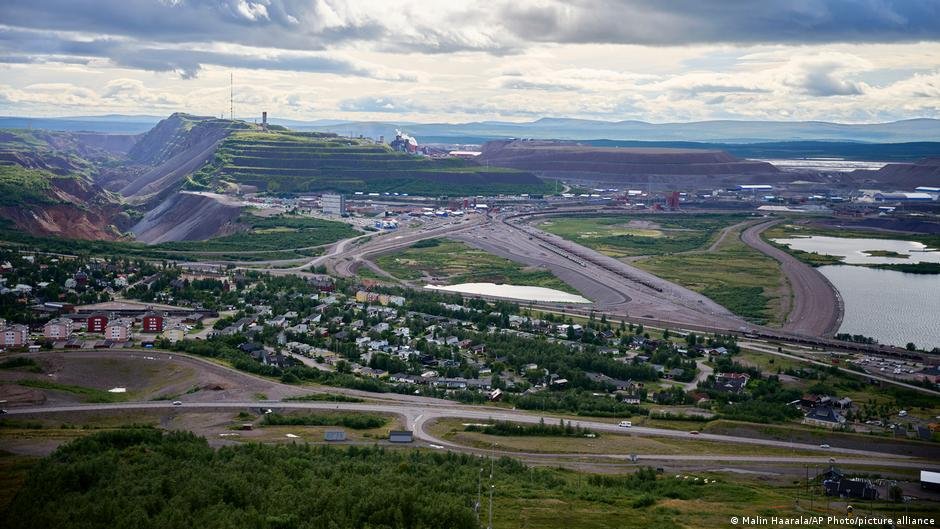
Resource-rich Sweden is already home to Europe’s largest iron ore mine, and considerable reserves of the rare earth have since been found at the same Arctic Circle site in Kiruna.
Rare earth minerals are essential for renewable energy production, defense and electric vehicle production, modern computer manufacturing, and other key industries. China accounts for about 70% of global mining and refining.
What did the Swedish government say about the plan?
The government in Stockholm on Thursday declared the mining of critical metals and rare earth minerals a national security interest.
According to Energy Minister Abba Bush, who is also deputy prime minister, this should simplify and speed up the permit process for new extraction projects and help attract investment.
“Sweden must become a leading mining nation,” he said, outlining the new strategy, adding that the government intended to “streamline authorization processes so that decisions can be taken more quickly.”
Bush described European industry’s dependence on China as a “systemic risk”, saying, “We believe it could make a significant contribution to Sweden’s defense capabilities of both the EU and NATO.”
Bush also said the move would make it easier for the state to allocate land to mining projects, an area of tension with the Sami reindeer-herding indigenous people, who say expanding mining could end their traditional way of life.
The Energy Minister also said that the government is considering setting up a government-owned investment company for the mining sector.
“Today, frankly, the government lacks the concrete tools to contribute intelligently to enhancing and attracting investment in key strategic projects,” he said.
What are Sweden’s current mining credentials?
Sweden has been a European mining giant since the 10th century and the opening of the giant Falun copper mine, which at one time produced two-thirds of the continent’s copper. The distinctive deep red color that adorns many houses, churches and other buildings in the country is called Falu Red and comes from a disused mine. It is now a museum and UNESCO World Heritage Site.
Sweden’s modern-day Falun is the giant LKAB iron ore mine in Kiruna in the Arctic Circle. Sweden holds about 60% of Europe’s known iron ore reserves and, as of 2021, it was responsible for about 90% of the continent’s iron ore extraction, about a third of which was from Kiruna alone.
The giant frozen mining town made headlines in recent years in Kiruna due to the need to relocate various houses and buildings – including the church – as the massive operation literally undermines the town.
More than 90% of Sweden’s mines operate in the sparsely populated and resource-rich Norrland region in Sápmi, the traditional territory of the Sámi.
Near the Kiruna mine is the Per Geyser discovery, a major EU project seeking to reduce mineral dependence on China. This is an area where approximately 1.2 billion tonnes of mineral resources have been identified, including approximately 2.2 million tonnes of rare earth oxides.
Mining group LKAB is investigating the potential of the deposit but estimates it could take 10 years to obtain a permit to drill on Sámi lands.
Four of the EU’s 47 strategic projects aimed at reducing mineral dependence on China are located in Sweden.
Edited by: Shawn Sinico
Don’t let algorithms hide news. If you rely on our team for reliable reporting, please take a moment Choose us as your favorite source on GoogleThat’s why you’ll always see our verified news first.