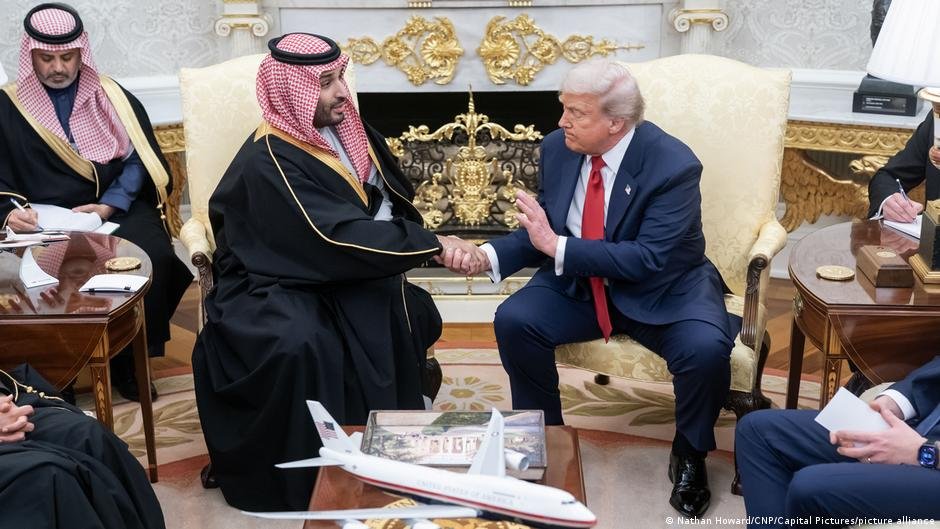
Following new statements from US President Donald Trump on Thursday morning, it is still unclear whether a controversial new deal with Saudi Arabia that allows the Middle Eastern autocracy to establish a civilian nuclear program will go ahead.
Trump said the deal could move forward only if Saudi Arabia normalizes diplomatic relations with Israel. In recent days, the Saudi government has repeatedly said it would do so only if Israel takes real steps toward establishing a Palestinian state. This is unlikely to happen with the current Israeli government.
The deal must also be voted on by the US Congress and critics say it could trigger a nuclear arms race in the Middle East.
One of the main reasons experts are concerned is that in several years’ time, the deal, as it is now, could allow the Saudis to enrich their own uranium. The more uranium is enriched, the more it can be used to make weapons. Recently, Saudi Arabia’s ruler Mohammed bin Salman had said that if Iran makes a nuclear bomb, then Saudi Arabia will also need a nuclear bomb.
Of the approximately 38 countries with civilian nuclear energy programs, most do not enrich uranium. Instead they import it.
The US-Saudi deal also has regional implications, particularly because it appears to have been drafted in a much less stringent manner than similar deals.
UAE: Preferential treatment for Saudis?
The less stringent deal the US has struck with Saudi Arabia is likely to disappoint the UAE, which often competes with the Saudis for geopolitical influence.
The UAE already has one nuclear power plant, Barakah, as a result of an arrangement made with the Americans in 2009.
Like nearly all of the US’s 26 nuclear cooperation agreements, the UAE’s deal also includes what is known as an “additional protocol” signed with the International Atomic Energy Agency, or IAEA. This means that the IAEA can conduct thorough inspections of all nuclear facilities. The UAE also agreed to abandon uranium enrichment.
The Saudi agreement is only bilateral – that is, only between the US and the Saudis and does not involve the IAEA – and the Saudis may eventually be allowed to enrich their own uranium.
Nour Eid told DW earlier this year that for the UAE, nuclear energy was always more about the prestige of being the first Arab nation to develop it than military ambitions. Eid is a Paris-based independent researcher who has published papers on nuclear ambitions in the Middle East for several think tanks.
But, he pointed out, there is also a clause in the UAE agreement that “if a regional or neighboring country has a more flexible agreement they reserve the right to renegotiate their terms.”
Israel: Only one does not have a nuclear bomb?
The Saudi-US nuclear deal will also worry Israelis, especially if it leads to the Gulf state developing a nuclear bomb. This would make Saudi Arabia the only other country in the Middle East to do so.
Israel has never confirmed having nuclear weapons, but it is generally accepted that it probably has about 90 weapons and delivery systems.
Israeli politicians see the Saudi deal as a threat and say their wishes have been ignored. Former Israeli Defense Minister Avigdor Liberman warned, “Every military nuclear program begins with a civilian program.”
The Saudis have lobbied for their own civilian nuclear program for years and, at one time, potential US-Saudi cooperation on this was seen as a foreign policy improvement: If Saudi Arabia, often regarded as the leader of the Islamic world, agreed to normalize diplomatic relations with Israel, it would receive nuclear technology from the US.
Any separation of the nuclear issue from normalization is unlikely to please the Israelis.
James Dorsey, an expert on the region at Singapore’s Rajaratnam School of International Studies, said, “This agreement – along with the possibility of the US selling F-35 fighter aircraft to Turkey – adds to pre-existing differences between the US and Israel over Iran and Israel’s occupation of parts of southern Lebanon and southern Syria.” Wrote in his regular newspaper on Thursday.
Why might America upset its ally?
There are many possible reasons due to which America has brought this agreement.
Paris-based researcher Eid said it may be related to US competition with China and Russia, the world’s major nuclear suppliers. The Chinese and Russians have submitted bids to build nuclear plants in Saudi Arabia, he said, and these come with low conditions. Trump had previously promised to revive the US nuclear sector and the Saudi deal would be worth billions.
There’s also the Iran war to consider. The US–Israeli war on Iran, which began in late February, saw Iran targeting US-allied Gulf countries. This has strained US relations with Saudi Arabia, which is caught between the hegemonic ambitions of Israel and Iran.
Rosemary Kelenic, director of the Middle East program at the Defense Priorities Foundation, a US-based think tank, says the deal ties the US and Saudi Arabia closer together.
For example, it “gives Saudi Arabia a powerful source of leverage to extract future concessions from Washington by threatening to weaponize its program, including new security guarantees, unless the US promises to increase military security,” Kelenic argued. a wednesday press statement.
She says the US may feel forced to trade defense security for the Saudis potentially giving up nuclear weapons, as happened with West Germany and South Korea.
“They have made nuclear progress, we wanted to prevent them from getting the bomb and ultimately we offered them more American military protection so they would give up their programs,” Kelenic said. “Giving uranium enrichment to Riyadh could permanently bind the US with Saudi Arabia.”
He said the agreement could also mean that if the Saudi monarchy was threatened the US would be forced to intervene to save it.
Iran: regional rivalry
When the deal was announced, observers immediately pointed out its inherent hypocrisy. Various experts argued that the Trump administration was now ready to give Saudi Arabia the same things for which they were bombing Iran.
This is a blow to the Iranians because “their arch enemy [the US] … giving our regional rival the edge over its nuclear program,” Kelenic said on the social media platform, X.
He argued that this is why the agreement is unlikely to bring a quick end to the current conflict between Iran and the US. “Iran will certainly be less trusting of the United States and less willing to make any concessions,” Kalanick said online.
The deal makes it more likely that the Iranians will try to rapidly weaponize their nuclear program, he continued.
Other observers also agree with this and fear the start of a nuclear arms race in the Middle East.
However, as Eid pointed out, nothing like this is likely to happen in the near future. He told DW that it would take 10 to 20 years for the Saudis to develop nuclear power, let alone nuclear weapons.