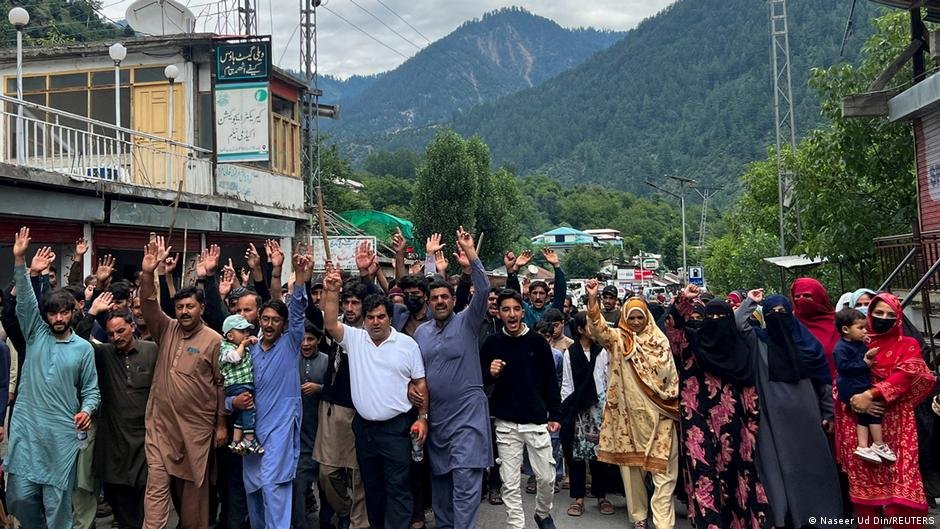
The first phase of local elections in Pakistan-administered Kashmir is scheduled for Monday, July 27, amid a grassroots coalition of civil society groups calling for a boycott of the recently banned Jammu and Kashmir Joint Awami Action Committee (JAAC).
JAAC is demanding the abolition of 12 seats in the regional assembly reserved for people displaced from India-administered Kashmir and living in Pakistan. It argues that only residents of Pakistan-administered Kashmir should be eligible to contest regional elections.
The controversy escalated when the Supreme Court of Pakistan-administered Kashmir ruled that refugee seats are constitutionally protected and cannot be abolished without a constitutional amendment.
The regional government outlawed JAAC under anti-terrorism laws in June, citing threats to public order, and detained dozens of its supporters.
The ban comes amid rising tensions over refugee seats and violent protests sparked by the group’s campaign to eliminate them.
About 30 people have been killed in the unrest since June, according to local estimates cited by Reuters news agency.
India and Pakistan both claim all of Kashmir, but each country controls only a portion of the territory, making the Muslim-majority region a long-term flashpoint between the nuclear-armed neighbors since independence from Britain in 1947.
Voting was overshadowed by protests
Since the beginning of June, Pakistan-administered Kashmir – known locally as Azad Jammu and Kashmir (AJK) – has seen several weeks of protests and sit-ins. While the dispute over refugee seats has become a major issue, JAAC has also campaigned for broader economic and governance reforms.
Following the unrest, authorities split voting into three phases, with voting in Mirpur scheduled for July 27 and elections in the protest-hit Poonch division postponed to August 10.
Voting in the regional capital Muzaffarabad has been delayed till August 2 due to security concerns. JAAC continues its protest in Rawalkot near the Line of Control with India.
Demand for fair representation
As the region heads to the polls, a big question is whether the elections can restore public confidence or merely put a temporary halt to public anger.
“We are just demanding fair representation, which is our right,” Ali Raza, a 22-year-old student protester in Rawalakot told DW. “The local people living here should have the right to elect their representatives, not the refugees who have come and settled here from India.”
Pakistan Peoples Party (PPP) Central Information Secretary Shazia Mary said, “The elections are a big opportunity for the people of AJK to elect their representatives.” “People want their rights protected, their issues addressed and a government that delivers on its promises.”
However, JAAC leaders argue that elections alone cannot resolve the issues that have brought thousands of people onto the streets.
“Our movement is not about replacing one government with another over time; we want our rights, but the campaigns are just political slogans,” a JAAC official told DW on condition of anonymity.
Imran Khan, a geopolitical expert and former director of the US Institute of Peace in Pakistan, hopes that the movement will continue even after the elections.
“Although elections in AJK are important for their own merits and the continuity of the political process, they will not address the political grievances and demands of the people who support JAK,” Khan told DW. “The opposition is outside the assembly. They don’t have full confidence in those institutions anymore.”
Has JAAC changed the political scenario of Kashmir?
Analysts say the JAAC protests marked a significant change in the politics of Pakistan-administered Kashmir by bringing together citizens across party lines on economic and governance issues rather than traditional political rivalry.
For analyst Khan, JAAC is a major political force in significant parts of Pakistan-administered Kashmir.
“Despite allegations of foreign support and funding, he has more street credibility than mainstream politicians and parties. For now, he has disrupted the status quo politics in AJK,” Khan said. He said that the Pakistani establishment has the means and methods to break such political movements.
Experts caution that rebuilding trust will require more than campaign promises.
“[The] Khan argued, “The next government in AJK will be very weak, as it will be caught between pressure from both the Pakistani establishment, which controls AJK through administrative and security structures, and sentiments on the street, which are very supportive of JAAC.”
He said the next government “will have little credibility and limited space to govern unless it reaches an agreement with the JAAC to ease political tensions.”
But Mary the politician believes rebuilding trust happens by listening to people’s concerns, offering practical solutions and empowering elected institutions.
If reforms stall, will protests return?
If key grievances remain unresolved, analysts warned that another wave of protests could not be ruled out.
“It is too early to say whether we will see more waves of protest, but JAAC has the potential to become a lasting political force,” Khan said. He suggested that internal divisions and pressure from the ruling establishment were in danger of weakening the group.
“For now, both sides are proceeding cautiously, with JAAC relying largely on support and the establishment avoiding full-blown action to save time,” Khan said.
While the vote will determine who rules Pakistan-administered Kashmir, it is unlikely to resolve the broader constitutional dispute over Kashmir or end long-standing frustrations with the governance of the region.
Mary said, “Governments must listen to public concerns and address them through dialogue and effective governance. Stability comes from listening to people, respecting the law, and delivering results.”
For Gen Z protester Raza, “The world has changed, and we have seen governments fall through student protests in neighboring countries; we will not stop, and the protests will continue until our rights are given to us.”
Edited by: Keith Walker