Vanilla is almost everywhere – in ice cream, cough syrup, cleaning products and perfumes.
Its ubiquity, due to cheap and widely available synthetic vanillin, has over time made it synonymous with “ordinary” or “plain” in the English language.
Yet natural vanilla is one of the most labor-intensive crops on Earth and one of the most chemically complex, containing more than 200 aromatic compounds. As the world’s second most expensive spice after saffron, it sells for between $100 and $600 (€90 to €550) per kilogram.
And its history is nothing but “vanilla”.
It involves, among others, a stingless bee, colonial conspiracies, as well as the ingenuity of a 12-year-old slave boy named Edmund Albius – whose discovery enriched the colonial treasury and changed the global trajectory of the bean.
From Aztec tribute to colonial ‘discovery’
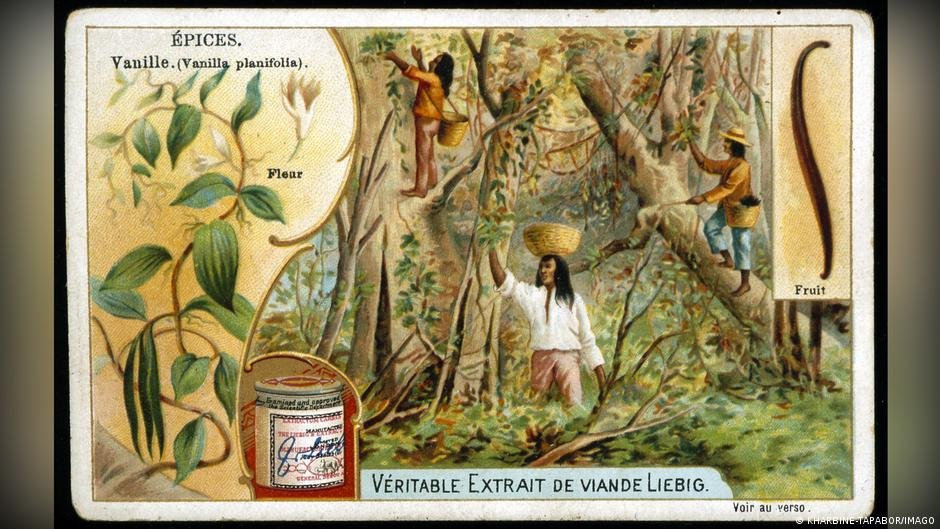
The origin story of vanilla is generally located in ancient Mesoamerica, where the creeping orchid vine – Vanilla planifolia – grew wild in tropical forests.
Early written records show that different communities had their own names for it: the Mexica called it “tlilxochitl,” the Totonacs called it “xanath”, and Maya “Sysbic.” Vanilla was a valuable commodity in these civilizations – used in medicine, in rituals, to scent temples, in cocoa drinks, and as tribute.
The Totonac people, who lived in what is now Veracruz, Mexico, were the first to cultivate the vine, which they prized for its fragrance. When the Aztecs conquered them, they demanded vanilla as tribute and used it to flavor “xocolatl,” a cocoa-based sacred drink reserved for aristocrats and warriors—and the precursor to modern chocolate.
In 1519, shortly before Spain established colonial rule in central Mexico, Aztec emperor Moctezuma Xocoyotzin served this drink to the Spanish army led by Hernán Cortés.
The Spanish later introduced vanilla to Europe, where it was first disseminated to the Spanish royal court through chocolate preparations adopted in Mexico. Vanilla soon reached French and English court kitchens, where it began to serve as the sole flavoring in some sweets and pastries.
A bee stumped Europe
Orchids were cultivated in the botanical gardens of France and England, but no matter how hard Europeans tried, their flowers could not be transformed into fruits.
Colonial administrators exported vines throughout their empires to India, Java, the Philippines, and the French colony of Reunion Island. The vines climbed up and the flowers bloomed, but no vanilla pods were formed. An enigma that persisted for nearly three centuries.
By 1836, when Belgian horticulturist Charles Moran identified the stingless Melipona bee as a natural pollinator of vanilla—an insect geographically native only to Mexico—growers were puzzled. Moran did manage to manually pollinate vanilla in a laboratory, but his method was time-consuming and non-scalable for colonial plantations.
Until 12-year-old Edmund Albius, a slave boy on Reunion Island, cracked the code.
Edmund Albius and his ‘extraordinarily ingenious’ invention
In 1841, Edmund discovered a way to pollinate vanilla flowers by hand.
Using his thumb and a small scraper, he lifted the small flap inside the flower that keeps the pollen and stigma separated, he pressed them together. And voila, the orchids soon produced vanilla pods.
Historian Eric T. Jennings, author of “Vanilla: The History of an Extraordinary Bean” (2025), has tried the technique himself: “Like many brilliant inventions, his invention seems extremely simple after the fact. Putting the male and female parts of vanilla in contact is easier said than done,” he told DW.
Reunion Island dominated the global vanilla market for some time. But in the late 19th and early 20th centuries, French colonial administrators spread Edmond’s hand-pollination method to their second colony, Madagascar, which is still the world’s largest producer of vanilla. The beans grown in these French colonies became known as Bourbon vanilla – named after Reunion’s former colonial name, Île Bourbon.
A footnote in the history of vanilla?
Edmund’s technology is now the universal standard in the global billion-dollar vanilla industry. It is a slow, delicate and labor-intensive endeavor, as each vanilla flower blooms for a single day, and is quickly pollinated by hand.
Nevertheless, Edmund never profited from the industry he created with his ingenuity. He died in poverty in 1880, while the recipe he had devised at the age of 12 had increased the French colonial treasury.
Jennings, whose research took him to Reunion, tells DW that there are two monuments in Edmond’s honor in his native town of Sainte-Suzanne on Reunion Island — a plaque and a statue, and some schools are also named after him. “But their story is still relatively unknown, I think,” says Jennings.
This is despite Edmond’s discovery reshaping Reunion’s agricultural future: “Not only did he bring prosperity to Reunion Island by making it the world’s top vanilla producer within 30 years of his discovery, he also helped re-diversify the island’s crops, which until his discovery had led to a monoculture of sugar that had, in turn, begun to drain and deplete the island’s rich soils,” explains Jennings.
While Jennings agrees that the lack of proper credit or monetary compensation for Edmund’s discovery is also rooted in the fact that he was an enslaved teenager, he points out that Edmund was nevertheless recognized as the inventor of a new method, as a rival white botanist, the chief gardener of Reunion, tried and failed to take credit for the discovery.
Jennings explains, “Indeed, the details we know about Edmund Albius are due to his former owner and acquaintances launching a campaign against this rival claim.”
anything but plain
But after Edmund’s success, Vanilla’s story continued to evolve. Chemists isolated vanillin – the compound behind much of its fragrance – in 1858 and synthesized it in 1874.
Cheap and easy to mass-produce, synthetic vanillin quickly became standard in ice cream, soft drinks, perfumes, baked goods, and processed foods, turning a once-favorite spice into a flavor few of us think twice about.
Jennings says this substitution changed the meaning of the flavor. As synthetic vanillin democratized vanilla consumption between 1880 and 1960, it became less distinctive, more widespread – even boring. Jennings says of its connection to being “plain”, “its “sheer symmetry, the complete flatness of the synthetic produces a numbing effect.”
Yet the real bean, containing more than 200 compounds, was never dull – and neither was its history.
Edited by: Elizabeth Grenier