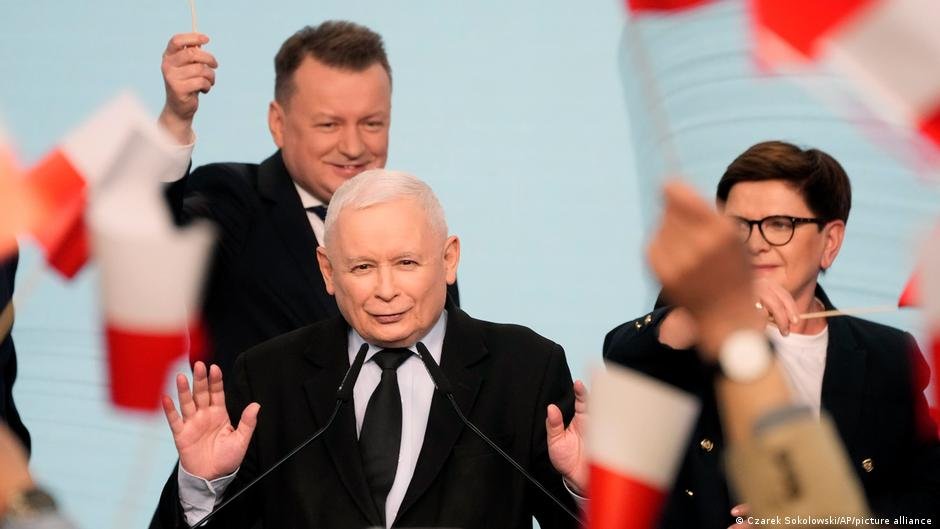
“More than 30 representatives of our group have effectively lost their membership,” Jaroslaw Kaczyński, head of the Law and Justice (PiS) party, said on Friday. He is accusing former Polish Prime Minister Mateusz Morawiecki and dozens of his followers of trying to split the party.
“We couldn’t accept it,” Kaczynski continued. “It’s all done.” For their part, the rebels alleged that he had not resigned but had been “expelled”.
Three-hour “last chance” talks between Kaczyński and Morawiecki ended without any results on Thursday. Piotr Müller, an EU representative close to Morawiecki, later said of the talks at X, “We were looking for understanding, but could not accept subordination.”
The ultimatum that Kaczynski gave to the rebel party members expired at midnight. By then, he was expected to give a written declaration that he would abstain from activities in the Morawiecki-led Rozvoj Plus (Development Plus) association. In Kaczyński’s view, the breakaway coalition weakened his party’s primacy.
“I am not signing any loyalty pledge,” Morawiecki told Polish television station TVN. He alluded to his persecution due to his prominent opposition to his father’s regime at the time, saying, “This is something that would have been expected of me in the 1980s.”
For a quarter of a century, Kaczyński and his PiS party have dominated the right wing of Poland’s party landscape. Any attempts to establish a new, more radical right were successfully quashed. Since 2001, PiS has been in power twice, from 2005–2007 and again from 2015–2023, and has held the post of state president with Kaczyński’s twin brother, Lech, then Andrzej Duda and – since mid-2025 – Karol Nawrocki.
The biggest crisis after the establishment of the party
Just a year before the next parliamentary elections, the party faces its biggest crisis since its inception in 2001.
So far, two parties have established themselves to the right of PiS: the far-right nationalist and liberal coalition Confederation of Liberty and Independence (KWIN), and the extreme right, ultranationalist, traditionalist Confederation of the Polish Crown (KKP). Overall, he enjoys more support in the polls than the PiS party alone. Kaczyński’s party has lost many voters because of these two radical groups.
To win them back, Kaczyński has pushed his party even further to the right. In March, he nominated ultraconservative, ultra-Catholic former Minister of Education and Science Przemysław Czarneck as the party’s lead candidate for the 2027 parliamentary election. Morawiecki and his followers called the move a fundamental mistake.
Two lungs or one fist?
Czarneck is trying to outflank the two confederation parties on the right with verbal attacks against the EU and Ukraine. In the recent Polish-Ukrainian dispute over unresolved historical issues, Czarnyk called for a halt to all military aid to Ukraine unless Kyiv changed its position. Supporters of this hardline stance have said that the party should behave “like a fist”.
Morawiecki responded to his party’s shift to the right by launching the political association Development Plus. He has invited 1,000 guests from various political backgrounds to a policy event in late July, where they can discuss the future of the country over a barbecue.
The former prime minister has been traveling around the country to speak to local politicians and businesses. In early April, he clashed with Kaczyński, who accused him of endangering party unity. However, at the time, the party chief sided with Morawiecki’s efforts and spoke of “two lungs” within the PiS party. That agreement could not last long.
reaching new voters
In public appearances, Morawiecki has repeatedly stressed that he intends to remain within the PiS party. His goal, he said, was to open the party to new voters to ensure that right-wing conservatives return to power in 2027.
Just a few days ago, Morawiecki could count on the support of 40 members of the Sejm, the lower house of Poland’s parliament, and several EU representatives. But at the moment it is not clear whether everyone will be able to withstand Kaczynski’s pressure.
In an opinion poll conducted by Opinia24 for the Polish channels TVN and TVN24 on 22 July, Morawiecki received 6.2% of the vote, while support for PiS fell to 17.7%. In the 2023 parliamentary election, the PiS party, led by Kaczyński, won 35% of the vote.
Of all Kaczynski’s longtime colleagues who have worked with him since the 1990s, Morawiecki is still considered an outsider. Following Poland’s democratic transition, the trained historian held key positions in several banks before joining the PiS party in 2016.
Under the rule of the PiS party he served as Minister of Development and Minister of Finance, and eventually as Prime Minister. Morawiecki and his allies have accused their opponents of plotting against them.
Excitement among the ruling coalition
The centre-right ruling coalition, led by current Prime Minister Donald Tusk, has made no secret of its amusement with the current plight of the PiS party. Foreign Minister Radosław Sikorski joked upon hearing the news, “I like PiS very much, I would love to have two of them.”
Political scientist Danuta Plečka said on Friday that the situation was like “a gift” to the ruling government. “All the scandals of recent months are now fading into the background,” he said. “Tusk doesn’t need to do anything, he can just sit on the river bank and wait for the bodies to float away.”
However, a researcher at the University of Gdańsk believes that the conflict between Kaczyński and Morawiecki may have been a staged showdown. “There are hardly any other programmatic differences between the two,” he told tvN. “The main difference between them is in language and political strategy.”
He believes Morawiecki aims to win over voters who lean more toward the political center. Then, after the election, the two groups could work together, Plekka predicted.
This article was originally written in German.