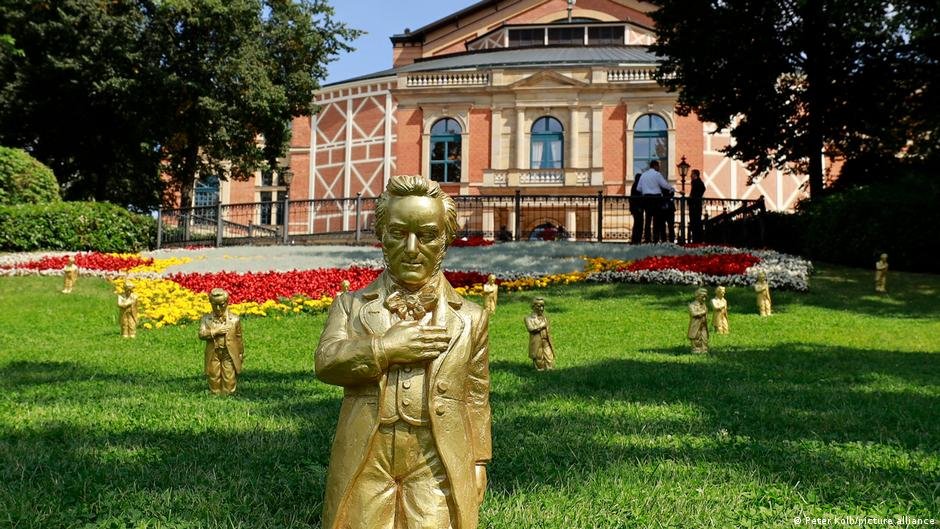
The last weekend of July marks the beginning of the Bayreuth Festival, which celebrates its 150th anniversary this year. The event regularly attracts international opera fans and distinguished guests, especially German politicians. This year, attendees include the current Chancellor, Friedrich Merz, and his predecessor, Angela Merkel, who regularly attend.
After years of disputes over the financing of Richard Wagner’s ambitious project, the first Bayreuth Festival opened on August 13, 1876. Wagner’s friend the philosopher Friedrich Nietzsche, who was also a guest at the festival, praised the event, calling it “the world’s first circumnavigation of the arts.”
special anniversary event
The anniversary program is diverse and includes a new staging of Richard Wagner’s historical work, “The Ring of the Nibelung”, using artificial intelligence, as well as a new production of the opera “Rienzi”, Wagner’s first major success, created at the age of 29.
These two productions replaced the festival management’s original plan to stage all 13 of Wagner’s finished operas during the anniversary year, which was considered financially unfeasible.
The inauguration ceremony on 25th July is expected to be spectacular. It includes a major work by Wagner’s idol, Ludwig van Beethoven – the Symphony No. 9. Notably, in 1872, Wagner conducted this same symphony in the Margravial Opera House in Bayreuth during the ceremony of laying the foundation stone of his Festival Theatre.
Despite some compromises, the anniversary program appears promising and innovative, living up to Wagner’s “Children, make new things!” Completely matches with the theory of.
Nevertheless, a shadow has been cast over the festivities before the inauguration: the initial exclusion and later re-invitation of German-French journalist Michel Friedmann, who is Jewish.
‘Friedman case’
At first glance, the scam appeared to be a planned accident. Friedman was invited to a memorial event called “Silenced Voices”, which was scheduled for the second day of the festival. It honors the many Jewish artists whose work in Bayreuth was ended by anti-Semitism, persecution, and murder.
Friedman, a leading voice on Jewish life and former president of the European Jewish Congress, was to speak about the festival’s efforts to confront anti-Semitism and its Nazi past.
An official release from the Bayreuth Festival states, “Especially in the year of its 150th anniversary, the Bayreuth Festival is aware of its historical responsibility with regard to the anti-Semitic views of Richard Wagner and the festival’s subsequent ties to National Socialism with some members of the Wagner family.”
Due to inadequate security measures, it was suggested that Friedman postpone his memorial speech to a later date – a mismanagement that made it appear that Bayreuth was trying to avoid confronting a history marred by anti-Semitism.
Following an apology from the festival management, Friedman will now attend. The program will include musical compositions by Jewish composers Gustav Mahler and Pavel Haas, who died in the Auschwitz-Birkenau concentration camp, as well as Wagner’s “Siegfried Idyll.”
On the festival’s website, Katharina Wagner, festival director and great-granddaughter of the composer, expressed her pleasure in welcoming Friedman to the festival.
A first for Bayreuth: Wagner’s ‘Rienzi’
This year’s special premiere is Wagner’s opera “Rienzi”, which will be performed for the first time at the Bayreuth Festival. Wagner composed it in the style of French “grand opera”. But he did not believe it aligned with the repertoire of operas he would present at his Festival Theater in later years.
Influenced by a literary adaptation of the 14th-century true story of the rise and fall of the Roman leader Cola di Rienzo, who fought against the aristocracy, Wagner chose it as the subject for the opera.
He was not alone in his interests; “Rienzi” was also one of Adolf Hitler’s favorite works. Sven Friedrich, director of the Richard Wagner Museum in Bayreuth, said, “What Hitler appreciated about ‘Rienzi’ was certainly the image of the self-made man who became the sole ruler through his charisma.”
The decision to premiere one of Hitler’s favorite operas during this important anniversary year has sparked debate. Nevertheless, Hungarian directors Alexandra Szemerédi and Magdolna Parditka are committed to updating “Rienzi” for contemporary audiences.
“We are therefore not just focusing on this specific dictatorship, but exploring the limits of how a state can gradually evolve from populism to an authoritarian regime,” he said in a statement.
Sensational AI Ring is set to surprise audiences, creators
The festival is eagerly awaiting new productions of the opera cycle “The Ring of the Nibelung”. This opera explores themes of power, greed and intrigue. According to legend, whoever seizes the gold from the Rhine will possess ultimate power. Wagner built his opera house in 1876 specifically for this massive 16-hour work.
Artistic director Katharina Wagner aims to break new ground with this anniversary production by incorporating AI. As curator Markus Lobs explained, “We will work with image layers partially generated in real time, creating a holographic 3-D space.”
The team chose archival footage of ring performances from 1876 to 2024 for the AI to analyze for the projections. Loebs said, “The purpose of the entire composition is to create the feeling of a huge, resonating image.” The creators promise “a visually radiant universe of light, texture, history and engagement.”
There will be unexpected moments, not only for the audience but also for Lobbs’ team as they discover what the AI ultimately produces. The Bayreuth Festival takes place from 25 July to 26 August.
Edited by: Sarah Huckle