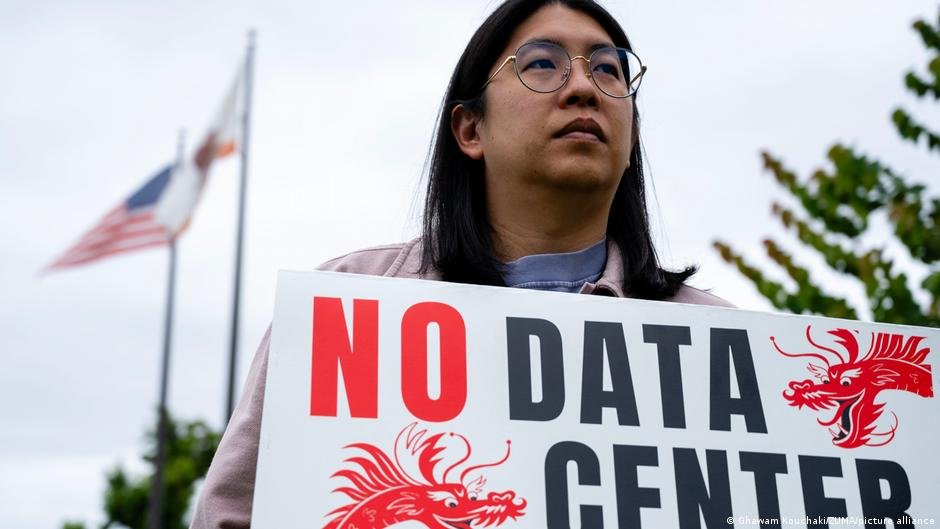
When construction of a major Amazon data center was underway in the small rural county of Frederick, Maryland, community activist Elizabeth Bauer found solace in it.
But when it expanded by about 1,000 acres from its original plan to dig into green space and agricultural land without addressing community concerns, it took a stand.
Along with other locals, she is protesting the proximity of the construction site to residential areas, which she says is causing dust and pollution that is exacerbating asthma among the population.
Bauer said, “I have no objection to data centers in the right place. I just don’t agree with them taking up prime agricultural land.”
Opposition to data centers is growing
A bipartisan backlash against data centers has intensified in the US, with nationwide demonstrations calling on politicians to take action.
The US District of Columbia, Maryland and Virginia area has been a flashpoint. There are currently approximately 640 data centers listed in Virginia alone.
These conflicts relate not only to the construction phase, but also to long-term impacts. According to the Environmental Protection Agency, data centers require huge amounts of energy to operate – the equivalent of the power to power 100,000 homes.
But those under construction could consume up to 20 times more, largely due to increased demand for the data storage and processing capabilities needed to support AI development and use.
Overall, data centers account for 4.4% of US electricity, but a study by investment banking firm Goldman Sachs projects that number to grow to 8.5% by the end of 2027.
Data centers consume electricity and water
The fight in Frederick reflects tensions across the U.S., which is already home to 4,600 data centers — about 1,000 more than the next 10 countries combined.
Nearly 40% of citizens live within five miles of at least one, and this number is likely to increase as more than 1,500 sites are under construction. Nowhere in the world is its concentration greater than in Northern Virginia.
All of this is happening against a backdrop of discontent, with a recent Gallup poll showing that 71% of the population opposes data center development in their communities.
Data centers can use up to 5 million gallons of water each day (as much as a city of 50,000). Nevertheless, it is not uncommon for them to be built in areas with water scarcity. According to the US Drought Monitor, Frederick County is experiencing a severe drought.
Francesca Dominici, a professor of biostatistics at the Harvard School of Public Health, said tech companies also routinely ignore this concern.
“They are not paying any attention to the water issue,” he told DW. “They prioritize where they can get cheaper land, where they can get faster approval from local politicians.”
High fuel bills and air pollution
States with high concentrations of data centers have seen electricity prices increase by 267% over the past five years.
“Electric utilities are building large amounts of new transmission lines to serve data centers,” said Hannah Wiseman, a professor of environmental law at Penn State University. “But the cost of those transmission lines is being paid for among ratepayers.”
There are also concerns that data centers could overburden the grid, meaning they would have to resort to backup diesel generators. In the case of the Frederick community, the planned center will have 99 diesel generators, which come with health risks.
“Exposure to particulate matter, even at low levels, [means] “There is an increased risk of birth defects, respiratory, cardiovascular, neurocognitive, and early death,” said Harvard’s Dominici. They also endanger local wildlife and reduce plant growth and yield, he said.
How are data centers regulated?
Despite negative impacts on communities, Wiseman said data center locations are mostly overseen at the municipality level, and many states offer data center developers a regulatory environment that allows rapid development regardless of proximity to people or nature.
“Many local governments have decided not to issue land use regulation, in which case a data center developer can do whatever they want.”
At the federal level, US President Donald Trump cut red tape to develop data centers as part of his 2025 executive order “Removing barriers to US leadership in AI”.
Many tech companies have insisted that localities sign non-disclosure agreements to limit communities’ understanding of the scale of projects and the consequences of extensive resource consumption.
So instead of inviting input from residents, they are working directly with municipality officials to prepare their plans.
Wiseman also said technology and development companies are increasingly collaborating with state governments in setting zoning and power consumption standards.
“They have been involved in all the state regulatory proceedings to create special electricity rates for data centers,” he said. “It appears that tech companies are now becoming more involved in a number of state legislative proposals to eliminate local control.”
How tech companies respond to pushback
Although tech companies argue that data centers strengthen local economies, a University of Michigan study found that they create temporary construction jobs for local communities, but not long-term tech positions.
There is some suggestion that these companies want to build trust with local communities. In March, Microsoft stopped using NDAs with local governments for data center development, saying they wanted to build more trust with their neighbors. And Meta says it is piloting and deploying low-carbon concrete in data center construction.
Dominici says she sees “a win-win future path” that combines technological progress with community benefit. “I would like to see an impartial scientific assessment of all impacts, and the data center can act on the basis of reducing this impact as much as possible.”
braking, at least temporarily
And the protests appear to have had an impact in local communities. Just last week, New York became the first US state to halt the construction of new large-scale data centers for up to a year. Moratoriums have also been proposed in other states, and some counties and municipalities have issued their own temporary restrictions.
In Frederick, Bauer and fellow activists are leading a continuing effort against a data center being built in their backyard. He collected enough signatures to propose putting the ordinance to referendum in the county elections, although any idea of this happening was rejected by the Supreme Court of Maryland.
The county has responded to this setback by issuing a temporary moratorium on new data center construction, yet Bauer feels the democratic process is failing Frederick residents.
“The average citizen doesn’t stand a chance,” he said. “This whole effort wasn’t about fighting data centers, it was about giving people a voice.”
Despite the challenges, Bauer still sees hope. He said there are candidates for County Council in the upcoming Frederick election who oppose the expansion.
“If the new council comes in they could completely flip this map,” he said. “We are disappointed, but we are not giving up.”
Edited by: Tamsin Walker, Sarah Stephan