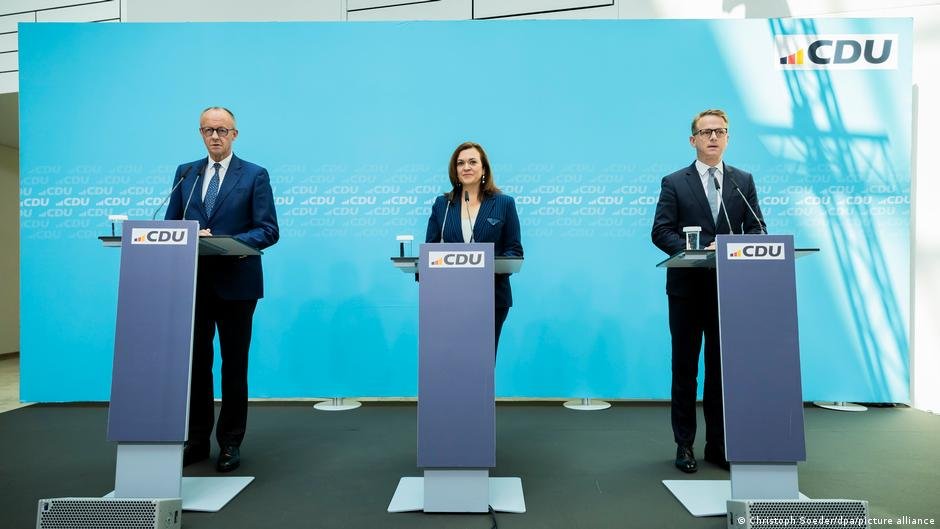
After a weekend of speculation and debate, on Monday Chancellor Friedrich Merz (CDU) was finally able to announce the name of the new Federal Transport Minister in Berlin. Stefan Bilger (CDU), aged 47 – who previously served as State Secretary at the Ministry of Transport from 2018 to 2021 – is stepping down to lead the ministry.
The chancellor had criticized the outgoing transport minister, Patrick Schneider (CDU), for doing little to address the chronic chaos and frequent delays plaguing the Deutsche Bahn railway system. Merz also blamed him for initiating too few projects to improve Germany’s poor infrastructure.
On Monday, Merz said he hoped the new ministers would ensure “that we become faster and better at driving a new era of progress in Germany.”
Bilger’s appointment is the latest move in a cabinet reshuffle of the conservative wing of the government. This chain reaction of personnel changes was triggered by the resignation of Jens Spahn, the powerful leader of the CDU/CSU parliamentary group in the Bundestag – who was forced to step down after being accused of hypocrisy over his decision to have a child through surrogacy in the United States, bypassing German law and violating his party’s principles.
Thorsten Frey: a Merz confidant
Thorsten Frei, who previously headed the Chancellery, is now set to become the new leader of the conservative parliamentary group on Wednesday, which includes the CDU and its Bavarian sister party, the Christian Social Union (CSU). The 208 CDU and CSU MPs will have to cut short their summer vacations to vote on this appointment.
Frei, 52, who currently serves as the chancellor’s chief of staff and is considered a close confidant of Chancellor Friedrich Merz, is now set to take over one of the most important posts in German politics. His job will be to articulate his party’s position in speeches in the Bundestag and in interviews with the media. Above all, he must win a majority for government policies and negotiate with the conservatives’ coalition partner, the center-left Social Democratic Party (SPD).
Nina Warken: A woman in a prominent position
Merz has a reputation for trusting only men within his inner circle. Now, 47-year-old Nina Warken – a politician from the south-western state of Baden-Wurttemberg – is taking over from Frei and will manage the Chancellery and be responsible for aligning the government’s overall policy agenda.
Warken is a member of the women’s organization of the Christian Democratic Union. As Health Minister, he recently pioneered a cost-cutting program for the Statutory Health Insurance Fund.
The Chancellor considers Warken to be firm and well-versed in security policy issues – an important quality, given that the head of the Chancellery also coordinates surveillance of Germany’s intelligence agencies.
Carsten Linnemann: Health minister focused on business
With Warken now leaving the health department, Carsten Linnemann – previously CDU general secretary – is set to take over.
Pundits argue that the chancellor certainly has a clear vision of how Lineman should lead the department. Until now, Linnemann has been known primarily as an economics expert – Friedrich Merz believes that background will serve him well in the new role: “Carsten Linnemann is taking over a ministry that represents the fastest growing sector of our economy. The sector as a whole – which, unfortunately, we all too often see only as a cost factor – is an important part of our social fabric.”
CDU politicians are scared about the prospects of September elections
Approval of the government’s performance is at an all-time low. State elections are to be held in three eastern states in September, where the far-right Alternative for Germany (AfD) is expected to make significant gains.
It is in this background that Merz is demonstrating decisiveness.
“I think things will calm down somewhat by September,” Merz said.
Sven Schulze (CDU), minister in the Saxony-Anhalt state government, takes a very different view. Speaking to public broadcaster Deutschlandfunk on Monday, Schultz said the past few days had been dominated by political discussions and “not at all okay.”
He said it was almost impossible to focus on state-level issues during door-to-door campaigning in his state.
This article was translated from German.