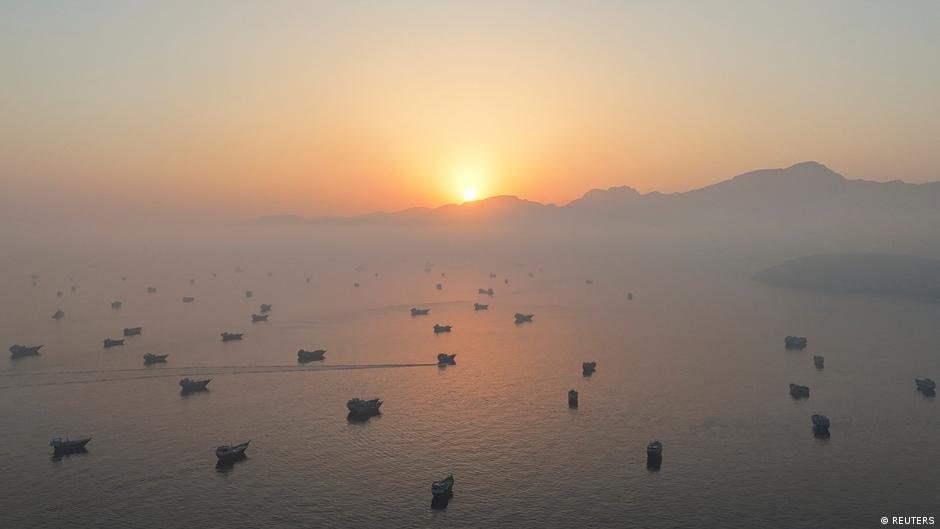
The Strait of Hormuz has become one of the world’s most dangerous waterways since March, when Iran began attacking shipping vessels as a pressure tactic in armistice talks with the United States. Nevertheless, although a significant portion of the global oil trade barriers lie in the strait, shipping traffic never stopped completely.
With the United States and Iran issuing conflicting statements on whether the Strait of Hormuz is open, DW Analysis Public data source to track how shipping traffic has changed during the war and which ships still risk crossing the maritime choke point, which connects the Persian Gulf to the Gulf of Oman.
Navigation disrupted through the Strait of Hormuz
As Iran continues to attack and intercept ships in the Strait of Hormuz, mines have also been reported in pre-war shipping lanes.
The Joint Maritime Information Center (JMIC), a project of US-led joint maritime forces, rates the threat to shipping as “severe”, its second highest alert level. However, according to one of the JMIC Latest Advisory Notes“Commercial traffic through the Strait of Hormuz remained at low levels, with ships transiting through both the southern Omani corridor and the northern Iranian-controlled route,” said the order, issued after the attacks resumed on 6 and 7 July.
JMIC said shipping vessels remained cautious of transiting the strait amid attacks on ships in recent weeks.
Analysis of data from DW’s open-source platform Global Fishing Watch showed that, nevertheless, many shipping companies have transited their vessels through the Strait of Hormuz throughout the war. Although the primary purpose of the platform is to monitor fishing efforts, it also collects data on all other vessels using satellite imagery and relying on signals transmitted by the vessels’ Automatic Identification System (AIS).
Since ships can turn off their AIS transponders – and have reportedly repeatedly chosen to do so while transiting the Strait of Hormuz – the number of ships is likely higher than shown.
Based on AIS signals, a total of at least 84 ships transited the Strait of Hormuz over the two periods of the conflict: from the beginning of the war on 28 February to the announcement of the ceasefire on 7 April and following new attacks on 6 and 7 July. This is aligned with reports The United States says it gave way to about 70 ships and also says that not all of them transmitted signals.
For comparison: over the same period in 2025, more than 900 ships transited the strait.
Of these 84 ships, 34 moved into the Persian Gulf from east to west and 50 exited the Gulf and crossed the strait in the opposite direction.
In which countries are ships passing through the Strait of Hormuz registered?
As part of AIS signals, ships report which flag they are traveling under, but this information is entered manually on ships. In only a few cases examined for this story does the flag reflect the actual country of origin of a ship’s registered owner or ship manager. This information can still be looked up manually in various databases using the ship’s international ID number and its name.
Only nine Iranian and two Pakistani-owned ships were transiting under their respective national flags. All 73 other ships flew a flag different from the shipowner’s country.
Analysis of this data shows that a wide variety of companies operating in the region continue to transit the Strait of Hormuz.
Topping the list is the United Arab Emirates, its neighbor across the strait. The United Arab Emirates’ Abu Dhabi Crude Oil Pipeline (ADCOP) runs on land parallel to the waterway in the south. Thirteen UAE-registered cargo ships transited the strait during the shutdown, along with two liquefied petroleum gas (LPG) tankers and three support vessels.
The dataset shows most UAE-based shipowners having only one to five ships in their fleets. One of the UAE-registered ships that was found floating in the Persian Gulf on July 11 is managed by Lubeck Shipping LLC, a company linked to an Iranian oil magnate that has been sanctioned by the United States.
so Salina Ship Management Pvt. Ltd. is approved by the United States of America.A company in the Indian state of Maharashtra that US officials accuse of helping move petrol to Iran. The company manages one of four Indian oil and LPG tankers that Global Fishing Watch recorded entering the strait.
India, like many Asian countries, is highly dependent on the Strait of Hormuz for energy supplies. China, Pakistan and Vietnam also had oil and LPG tankers in the Persian Gulf, which they had taken out of the Strait of Hormuz before the ceasefire was announced on April 7.
All seven ships, owned and managed by companies in Greece, the world’s largest shipping power, were freighters, typically carrying unpackaged dry goods such as iron, coal and grain.
Why risk crossing the Strait of Hormuz?
The primary motive for continuing the movement of oil and other goods through the Strait of Hormuz despite the threat of attacks by Iran is financial – “simply because the reward seems to outweigh the risk,” said Matt Smith, director of commodity research at Kpler, a business intelligence company headquartered in Belgium that specializes in analyzing global commodity flows.
“The bottom line is that producers of oil (or gas, aluminum and other products) within the Strait of Hormuz essentially have only two options,” economist David Veitch wrote in an email. Vetch monitors the flow of energy commodities such as oil and refined products for British company Vortexa.
“Option 1: Stop production and make no money at all – or even suffer a loss due to operating expenses,” Wecht wrote. “And option 2: Accept the risk of crossing the strait and thus earn 90% or more of your normal revenues. With oil currently priced at over $80 a barrel, we are talking billions of US dollars.”
With hostilities heating up again in July, the price of Brent crude oil is heading for another upward move, perhaps one of the most observed global impacts of the war and the near-closure of the Strait of Hormuz.
What are the alternatives to the Strait of Hormuz?
In pre-war times, roughly 25% of global seaborne oil trade Passed through the Strait of Hormuz. Alternative routes have limited capacity to compensate for the loss of oil flow through the strait, According to the International Energy Agency (IEA).
Two pipelines are currently used to bypass the Strait of Hormuz: the UAE’s ADCOP and the other in Saudi Arabia.
ADCOP in the UAE will allow ships to land and load at the northeastern port of Fujairah and transport oil from the Persian Gulf without crossing the Strait of Hormuz.
The IEA reported in February that Saudi Arabia had some capacity left in the Abqaiq-Yanbu crude oil pipeline system (East-West Crude Pipeline or Petroline). Publicly available shipping data for Yanbu shows an increase in oil-related ship traffic from May to June compared to previous years.
“Combined, Yanbu and Fujairah are capable of rerouting more than 4 million barrels of crude oil per day passing through the Strait of Hormuz,” Smith said. “It is able to act as a release valve to maintain the flow of barrels to major customers in Asia – but replenishes only 4 of the total 15 million barrels per day that typically pass through the strait.”
Alternative routes have their own risks. There have been increasing reports of piracy and attacks on ships by Yemen’s Iran-backed Houthi rebels in the Bab al-Mandeb Strait, the narrow bottleneck point between the Red Sea and the Gulf of Aden. “Bab el-Mandeb has the potential to add a further supply crisis to a global supply picture that is already severely disrupted,” Smith said.
Therefore, the release valve for the Strait of Hormuz may soon become a maritime choke point in its own right.
Edited by Milan Gagnon and Andreas Becker.
All The data and code behind this story can be found in this Github repository. More data-driven stories by DW can be found here.