August 30, 2026
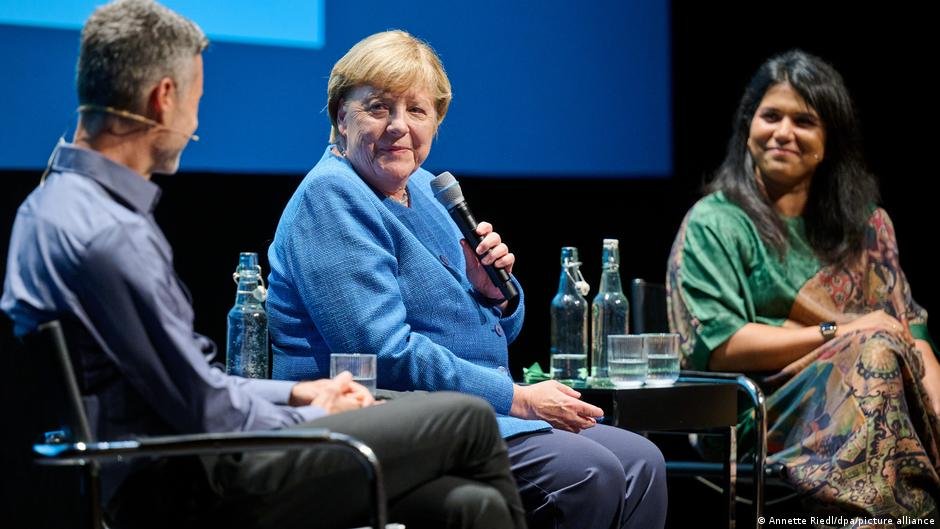
Merkel calls on Germans to ‘fight for this democracy’
Former German Chancellor Angela Merkel has called on her compatriots to “stand up” for democracy ahead of next weekend’s state election in Saxony-Anhalt.
The far-right Alternative for Germany party (AfD) is leading polls raising questions about what kind of government will be formed.
Despite this, the majority of Germans are not AfD voters, Merkel said at a political event in Berlin on Saturday night.
“I believe that now, once again — something we haven’t had to do for many decades — we must really fight for this democracy, simply stand up for it, be a little brave, stand by our word and say that this is a wonderful way to live,” she said.
Merkel said the AfD had, to some extent, managed to “dominate all our discussions from morning to night” about politics in Saxony-Anhalt. This meant that many voters no longer knew the policies of the other parties, she said.
But while the AfD has long polled strongest in the eastern states, Merkel — who herself hails from the former East Germany — said the rise of the AfD was not limited to those areas.
“It has become a pan-German phenomenon,” she said.
https://p.dw.com/p/5Jd8z
August 29, 2026
German government expected to hold Moscow responsible for Leipzig drone incident, reports say
German Chancellor Friedrich Merz’s government plans to officially hold Moscow responsible for the Leipzig drone incident in early August, several German news outlets owned by media company Axel Springer SE reported on Saturday.
Berlin is expected to announce the planned move in the coming days, including “extensive” sanctions, three officials familiar with the matter told German newspaper Welt am Sonntag and the media outlet Politico.
However, the three sources did not elaborate on what the specific measures could be. It is also unclear to what extent Berlin plans to hold Russia responsible for the Leipzig incident.
On August 4, a drone loaded with explosives was discovered near Ukrainian cargo planes at Leipzig/Halle Airport, which serves as a hub for military aid shipments to Ukraine for its war against Russia.
Merz told RTL in an interview on Thursday that the federal government would soon identify those responsible for the incident.
https://p.dw.com/p/5JcLz
August 29, 2026
Sick leave now costs Germany twice as much as in 2010
The total amount of wages German firms paid in sick and maternity leave has more than doubled over the past 15 years, a study from the Cologne-based German Economic Institute (IW) shows.
IW estimated that German companies paid a record-high €85.6 billion ($111 billion) in wages to employees who were out sick last year. This compares to €36.9 billion in 2010.
Of the larger figure, €72.5 billion represented gross wages, while €13.1 billion was earmarked for social security contributions.
IW said several factors have contributed to the rise, including wage hikes and inflation in other employee costs.
The institute said the total number of employed people has also grown since 2010, meaning more workers are eligible for sick leave.
IW, however, said it had noted a “significant” rise in recorded sick leave since Germany moved to electronic medical certificates in 2022.
Separate research by the Berlin-based IGES Institute in January showed that German workers now take an average of 19.5 working days as sick leave per year, a noticeable increase from about 13 days in 2018.
In an effort to stem the rise, Chancellor Friedrich Merz’s government will from January ban patients from receiving sick notes from doctors by phone.
In Germany, employers are generally required to pay workers’ salaries for up to six weeks before the statutory health insurance fund takes over by paying sickness benefits.
https://p.dw.com/p/5JcDp
August 29, 2026
Lower Saxony premier seeks deal on VW restructuring
Volkswagen’s second-biggest shareholder has called on all sides to agree on a restructuring plan for the German auto giant in the next few days.
Olaf Lies, state premier of Lower Saxony — which holds 18% of VW’s shareholder voting rights — said he was convinced “a viable solution” can be found.
“I strongly urge that we use the time remaining until the next meeting to bring the different positions together,” Lies told journalists on Friday.
The state leader noted that VW must face its numerous business challenges head-on, namely costly tariffs, falling demand and intense competition from China.
But he said the group’s position in Germany’s industrial landscape also had to be considered.
“With its sites in Lower Saxony and across Germany, its tens of thousands of employees and their families, and its suppliers and service providers, Volkswagen also bears an enormous responsibility for the wider economy and society,” Lies said.
VW’s management now thinks they may need to cut up to 100,000 jobs and that several German factories may face closure.
The supervisory board of Europe’s largest automaker is due to meet on September 4 to discuss a turnaround plan.
https://p.dw.com/p/5Jc9k
August 29, 2026
Survey: Trump’s return increased US influence over Germany
Two-thirds of residents think the United States has more influence on Germany since US President Donald Trump returned to the White House.
A poll by the Forsa research institute found that 67% of respondents agreed, while just 11% thought there was less US influence. Around 18% thought it was the same.
The survey for the German-language Internationale Politik (International Politics) magazine found only 2% of 18 to 29-year-olds and 6% of 30 to 44-year-olds think US influence in Germany is lower than before Trump’s second term. That’s versus 18% of respondents aged 60 and over.
Germany-US ties have soured since Trump’s reelection, due to surprise tariffs, talk of seizing Greenland and open sniping over Russia’s war in Ukraine and the closure of the Strait of Hormuz during the Iran war.
https://p.dw.com/p/5Jc1M
August 29, 2026
Report: Taliban team in Berlin to aid Afghan deportations
The Taliban has sent a team of three people to Germany to help facilitate the deportation of Afghan nationals, public broadcaster NDR reported.
NDR said the delegation arrived in Germany on Wednesday and is staying at the Afghan embassy in Berlin.
The broadcaster said their mission is to provide documents recognized by the Taliban in Kabul to Afghan nationals being deported from Germany.
The delegation is also due to spend time in Bonn and Munich, where Afghanistan has consulates general.
The arrival of the delegation is contentious as Germany — along with most of the rest of the world — does not recognize the Taliban government.
Chancellor Friedrich Merz calls the contacts a purely technical necessity to return people with no right to stay.
Critics, however, say his government is legitimizing the Taliban to help raise deportation numbers.
Germany suspended deportations to Afghanistan when the Taliban returned to power in 2021.
They resumed three years later, initially for convicted criminals.
According to German government data, 15,343 Afghan nationals in Germany are required to leave the country, as of the end of June, including more than 1,500 children.
https://p.dw.com/p/5JbvO
August 29, 2026
AfD youth wing: Germany shouldn’t leave euro
The youth wing of the far-right Alternative for Germany (AfD) has broken ranks with party leadership and called for Germany not to leave the euro currency.
“We do not want Germany to leave the euro, but to address the existing structural flaws in the euro system,” Jean-Pascal Hohm, head of the Generation Deutschland (GD) youth organization, told the Bild newspaper.
The GD is due to adopt a position on the issue at a conference in the city of Magdeburg on Saturday.
A draft statement says the euro has strengthened the European single market but has “structural flaws,” and calls for reforms that would improve stability without giving up Europe’s economic unity.
In its 2025 election manifesto, the euroskeptic AfD has called for Germany to leave the euro, the single currency of 21 EU member states.
The GD was established last year as the AfD’s new youth organization after the party dissolved its previous youth wing, the Junge Alternative (JA), after it was labeled right-wing extremist by intelligence officials.
https://p.dw.com/p/5Jbw6
August 29, 2026
Hundreds evacuated affter blaze at Berlin refugee shelter
A fire broke out early Saturday morning at a refugee shelter in Berlin-Spandau, a borough on the outer western edge of Germany’s capital.
The dpa news agency reported that the blaze broke out on the fourth floor of a six-story building, designed to accommodate about 1,200 people
Citing the fire department, dpa said furnishings caught fire in the hallway for reasons yet to be determined.
The smoke then spread to the fifth and sixth floors.
Four people were treated for smoke inhalation, the statement said. Three were taken to hospital.
Several hundred residents were evacuated from the shelter, with between 50 and 60 people moved to alternative accommodation.
https://p.dw.com/p/5JbpF
Welcome to our coverage
Good morning from Bonn, where the Rhine River water level is creeping back up after hitting a low earlier this month during the drought.
Overnight, a fire at a refugee center in Berlin forced the evacuation of hundreds of residents.
A report by public broadcaster NDR reveals that the Taliban has sent a delegation to Germany to help facilitate the deportation of Afghan nationals, whose asylum claims have been rejected.
Also, while the far-right Alternative for Germany (AfD) wants to leave the euro currency, the party’s youth wing has spoken out against the policy, calling instead for “structural flaws” in the euro system to be fixed.
Here you’ll find our coverage of the latest news, sport and analysis from across Germany this weekend.
https://p.dw.com/p/5JbpQ