Peru blames ‘geopolitical divisions’ for lack of COP31 progress
The head of Peru’s delegation at COP31, Andres Martin Garrido Sanchez, warned that the UN climate summit was unlikely to end with a concrete deal on climate financing or cutting fossil fuel use.
Garrido Sanchez lamented that the outcome “would be very limited.”
He reiterated how “geopolitical divisions” were stopping any final deal from mentioning reducing reliance on oil, gas and coal.
The Peruvian delegate singled out major oil producers, such as Gulf Arab states and Russia, as showing significant opposition.
He noted that while Latin American neighbor Panama had also signaled objection to including the term fossil fuels in the final text, Peru was “not so radical” and is keen to attract investment to “ensure our energy security” through renewables.
Edited by:Karl Sexton
https://p.dw.com/p/5Phzl
China throws weight behind ’35-by-35′ pledge
China has backed a plan proposed by COP host Turkey to raise global electricity demand to 35% by 2035 — up from the current 20%.
In a joint statement with Australia, which is leading negotiations between almost 200 nations at the COP31 summit in Turkey, Beijing said it welcomes “growing international ambition and cooperation … to increase electricity’s share of global final energy consumption to 35 per cent by 2035 on a voluntary basis.”
The statement goes on to highlight the benefits the transition can bring for the economy, jobs, energy security, public health and households.
The two partners also “acknowledge the importance of inclusive climate action that ensures no one is left behind,” the text continued.
Dozens of countries, including EU states, Japan, South Korea and Canada, have so far signaled support for the voluntary goal, which aims to boost clean energy use.
Yet, environmental groups have warned that the draft text doesn’t stipulate the use of solar, wind and other renewable energy sources, which could allow power plants using natural gas and coal to be included.
Edited by:Karl Sexton
https://p.dw.com/p/5Phvi
COP31: What to expect today
Good morning, and welcome back to DW’s coverage of the UN’s COP31 climate summit in Turkey.
Negotiators from nearly 200 countries worked through the night to finalize a deal, after a draft text dropped all mention of fossil fuels — the leading cause of climate change.
COP31, being held in the Mediterranean city of Antalya, was due to wrap up on Friday, but has run over time amid deep divisions over fossil fuels.
Hopes are fading that negotiators will finalize concrete plans to drastically slash the use of oil, gas and coal and a deeper commitment to renewable energy.
Stay tuned as we bring you the latest from the closing stages of UN climate summit.
Edited by:Karl Sexton
https://p.dw.com/p/5Phss
COP31 talks go on — we’re taking a break
Patrick Große
The UN climate summit in Antalya, Turkey, has gone into overtime, with countries still divided over key issues, including fossil fuels and climate financing.
The talks were scheduled to end on Friday evening, but negotiators have yet to reach an agreement. Germany and several other countries are pushing for a clear commitment to phase out fossil fuels, while poorer nations are demanding more concrete financial support to cope with climate change.
Negotiations are expected to continue into the weekend. We are pausing our live coverage for now and will bring you further updates as talks progress.
Edited by:Wesley Dockery
https://p.dw.com/p/5Phc2
WATCH — Turkey’s beaches are becoming too hot for sea turtles
While Turkey hosts COP31 in Antalya, a growing climate threat is unfolding on its Mediterranean beaches. Rising sand temperatures are causing most newly hatched sea turtles to be born female, raising concerns about the long-term survival of local populations.
Conservationists warn that climate change, combined with pollution, coastal development and fishing-related injuries, is putting increasing pressure on the species.
DW correspondent Julia Hahn follows the people working to protect Turkey’s iconic loggerhead turtles and shows how the climate crisis is already affecting wildlife far beyond the COP31 conference halls.
Edited by:Alex Berry
https://p.dw.com/p/5Pfgv
WATCH — COP climate summit under scrutiny over fossil fuel influence
The UN climate summit in Antalya is drawing criticism from activists and campaigners who question whether global climate talks can deliver meaningful change while fossil fuel interests remain influential. Turkey and Australia, both under scrutiny for their energy policies, are leading this year’s conference.
Activists, including Greta Thunberg, argue COP summits have become increasingly ineffective, while others defend them as a vital space to pressure governments. Climate policy experts say the talks have helped reduce projected warming, but stress that real progress depends on action taken by countries between summits, not just agreements reached at them.
Edited by:Alex Berry
https://p.dw.com/p/5PfgB
WATCH — Maldives environment minister: ‘We are not going to live in the dark’
For the Maldives, climate change is already affecting everyday life. Heavy rainfall has forced people from their homes, warmer oceans are damaging coral reefs, and changes in fish stocks are putting pressure on the country’s fishing industry. Rising sea levels pose another threat to the low-lying island nation. Meanwhile, global greenhouse gas emissions continue to rise, despite more than three decades of international climate negotiations.
At COP31 in Antalya, Turkey, the Maldives’ climate minister Ali Sharif discusses why progress has been so slow, what really happens during climate negotiations, and why moving away from fossil fuels is not as straightforward as it might seem.
For island nations like the Maldives, switching to renewable energy comes with practical and financial challenges. So what would it take to accelerate the transition? And can the UN climate process still deliver meaningful results?
Edited by:Alex Berry
https://p.dw.com/p/5Pfff
COP32 hosts Ethiopia call the conferences a relay, not a single race
The hosts of next year’s COP, Ethiopia, found a nationally tailored sporting metaphor to sum up the difficult, ongoing, sometimes tortuous process that the global environmental meetings can prove to be.
Speaking at the end of Friday’s plenary to confirm Addis Ababa’s intentions to host next year’s summit, Gedion Timothewos, the foreign minister and upcoming president of COP32, made reference to Ethiopia’s longstanding success in endurance running in track and field.
Referring to the COP process as a marathon, not a sprint, Timothewos said the country was looking forward to picking up the baton from Turkey and leading the next leg of the relay, taking the ongoing process forward into 2027.
His comments came during a late-night plenary session, but more talks are still expected in Antalya.
Edited by:Sean Sinico
https://p.dw.com/p/5PhVe
Late-night plenary session convenes after delay
Shortly after 9 p.m. local time in Antalya, delegates gathered for a plenary session, well past the official closing time.
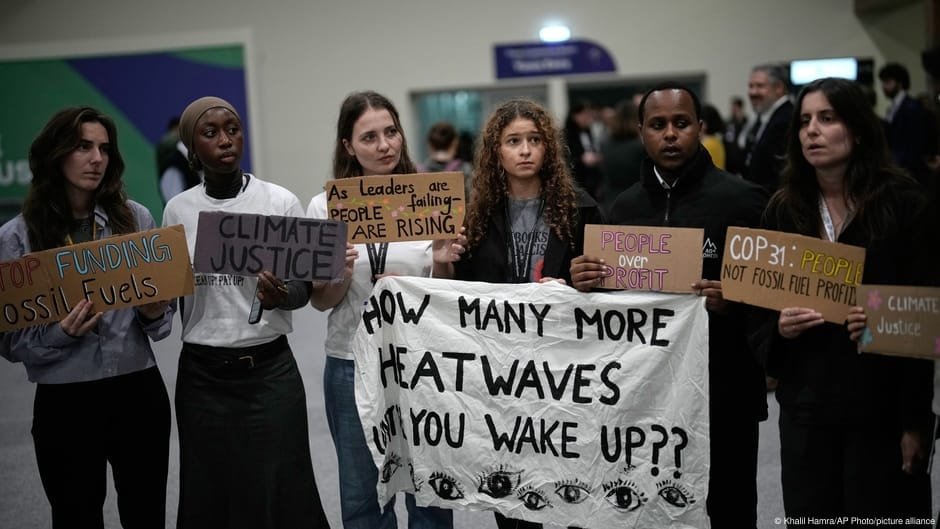
The Turkish presidency’s opening address was partly drowned out by a protester shouting objections in English such as “you are killing the future,” and gaining applause within the chamber.
“We’ve been negotiating for days to find the common ground,” COP31 President Murat Kurum, Turkey’s environment minister, told the plenary. He hailed the progress made and said the world “waits for good news from this room.”
But the plenary session noted how several of the more ambitious aspects of a political declaration remained incomplete, with no agreement yet reached at the summit.
Several national delegates spoke during the plenary to bemoan the elusive progress or even backsliding during the two weeks of negotiations.
The evening’s session, however, has been dealing with technical issues, and the possibility that discussions continue into the weekend remains.
Edited by:Sean Sinico
https://p.dw.com/p/5PhV8
IN DEPTH — Climate science disputes and disinformation hinder action at COP
Attacks on climate science and disinformation risk delaying key measures at COP31 in Antalya. As the UN climate talks draw to a close, how will that affect efforts to come to an agreement?
The UN’s IPCC should have already started work on its next series of multi-year scientific assessments on climate change’s progress, but the process is on hold at the urging of countries including fossil fuel-producing giants Russia, Saudi Arabia and Iran.
Read Tim Schauenberg’s full report on this obstruction to climate research and other similar issues complicating COP31 here.
Edited by:Sean Sinico
https://p.dw.com/p/5PhNY
IN DEPTH — US is strong at climate talks despite Trump no-show
The US government is snubbing UN climate talks in Turkey. That’s prompted a delegation of American lawmakers, mayors and governors to make the trip instead, aiming to show that climate action in the US is alive and well.
Head over to this report to learn more about who is representing the US at the summit, even if President Donald Trump, who has repeatedly dismissed global warming as a “hoax”, didn’t send a formal delegation for the second year in a row.
Edited by:Alex Berry
https://p.dw.com/p/5Pffz
IN DEPTH — Uganda minister at COP31: ‘We need a just transition’
Funding from wealthy countries to help deal with the impacts of climate change hasn’t materialized, says Uganda’s environment minister. The East African country is hoping oil and carbon credits will help boost finances.
Learn more about what Uganda’s environment minister Beatrice Atim Anywar said about climate financing in this report.
Edited by:Alex Berry
https://p.dw.com/p/5Pfjn
Activist Menotti: Europe has ‘learned a few of the Trump tactics’
Katharina Schantz
Veteran climate justice advocate Victor Menotti of the Demand Climate Justice NGO told DW that European governments appeared to be copying US President Donald Trump’s negotiating playbook at COP this year.
“We know the US isn’t here, but we can see that Germany and other European governments have learned a few of the Trump tactics, maybe in the trade disputes with the US,” Menotti said. “And we see them applying here in Antalya, where it’s like: Don’t admit to anything. Try to dilute your responsibilities. Weaken whatever obligations you have. And then take even more.”
He argued these countries were also expecting unreasonable or unfeasible commitments from developing countries, for instance restrictions on what they can spend money on and obligations to report on their expenditures.
“Germany is subsidizing quite a bit of coal still and fossil fuels, LNG expansion infrastructure,” he said, arguing that wealthier countries’ energy spending also had room for improvement.
“We need the North to act first,” Menotti said. “The deal from Paris, the deal from Rio 30 years ago, is that the North will lead. But yet we see too much bullying of the global South and not enough leadership like they agreed to.”
Edited by:Sean Sinico
https://p.dw.com/p/5Ph9I
Talks formally enter overtime as scheduled close elapses
You can cross off another box on your COP31 bingo cards, dear readers.
As of the top of this hour, the session has officially gone past its scheduled end time of 1500 GMT/UTC on Friday, or 6 p.m. local time on site in Turkey.
This is something of an annual tradition at COP summits, which are always scheduled to finish at the end of a working week but also almost invariably run into the closing weekend. Delegates and members of the media tend to book their travel plans with this in mind.
Edited by:Sean Sinico
https://p.dw.com/p/5Ph15
November 20, 2026
‘Electrification’: What to know about the revised draft declaration
The revised draft declaration, which critics have slammed as “watered down” due to the omission of fossil fuels, highlights the “electrification” of the global economy as a central pillar of the energy transition.
“Electrification is the key to transitioning away from fossil fuels,” Australian Climate Minister Chris Bowen told reporters.
What are the key points to know about the “35-by-35” electrification target?
- The draft wants to increase electricity’s share of global energy use from 23% to 35% by 2035
- The draft highlights electrification as a way to cut emissions and boost energy security — while omitting prior mentions of fossil fuels
- It aims to shift more transport, heating, cooling and industrial activity onto electricity, allowing those sectors to be powered by renewables such as wind, solar and hydro power, rather than by burning coal, oil or gas
But the text does not specify what energy sources would supply the electricity. Some countries are demanding that the text call for “clean” electrification to clearly favor renewable sources over coal, oil or gas.
Bowen, who has been trying to secure compromises, pledged to continue working over the “coming hours, for as long as it takes, to get the job done.”
“People have strong views of course — I am not stepping away from that. But no one has said to me let’s give up and go home,” Bowen said.
Edited by:Sean Sinico
https://p.dw.com/p/5Pgvj