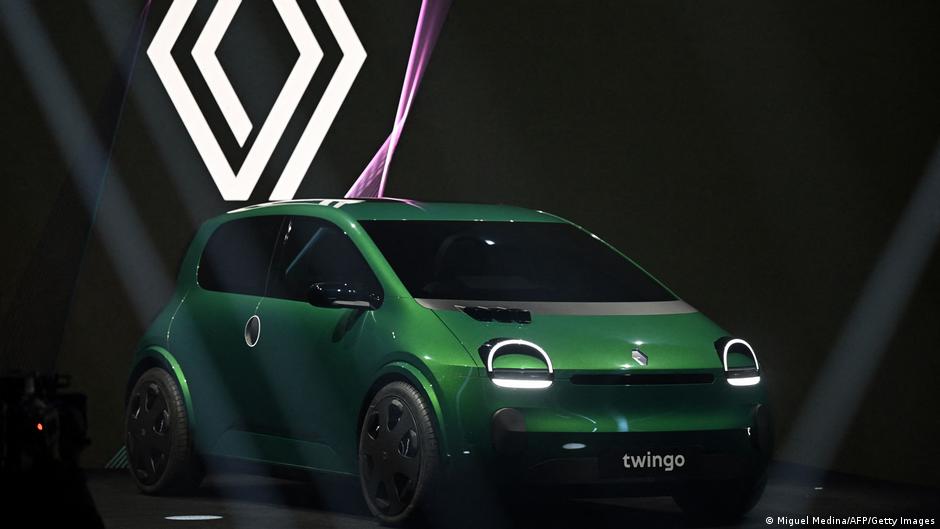
Renault’s new electric Twingo fits easily into the French carmaker’s portfolio.
It’s a modern mini passenger car aimed at urban European drivers, but it also tells a story of change in the broader auto industry.
Renault developed the new Twingo over 21 months in Shanghai, following an initial design phase in France.
The car is now in production in Slovenia, arriving at dealers this month priced under €20,000 ($23,000).
The continent-hopping Twingo is a snapshot of a hypercompetitive auto industry and its new center of gravity in China. There, many used car manufacturers are developing new models focusing on speed, cost and technology.
Bill Russo, a former Chrysler executive and car analyst, said, “The real competition is not China versus the West, it is faster systems versus slower systems.”
“If you want to understand where the future of the auto industry is going, you have to understand how China makes these types of products,” Russo told DW.
Automakers are increasingly turning to China
Western and Japanese carmakers such as Tesla, Volkswagen and GM have long been manufacturing in China for domestic and foreign markets.
More recently, many have expanded their footprints beyond manufacturing in the country to designing and developing entire models in hopes of benefiting from the concentration of EV suppliers, expertise and its consumer base.
Renault and Mercedes each open expanded research facilities in Shanghai in 2024. Volkswagen built its own R&D center in Anhui province in 2025, the same year that Toyota moved all new car development for China to the country.
“As one supplier said, China has become the gym of the world in terms of the automotive industry,” said Alexandre Marian, a consultant at global management consulting firm AlixPartners.
Still, as they compete with their Chinese rivals overseas, legacy carmakers are under pressure to cut costs in all markets and speed up product development – even domestically.
The development cycle of new vehicles in China takes about two years, less than half the time traditionally required by legacy automakers. Rousseau and other experts say carmakers in China rely more on automation. They run phases in parallel and they are more coordinated with suppliers and keep the design simple.
For Russo, shorter lead times are a byproduct of the industry’s shift toward a technology-first focus.
French ‘Le Frog’ is being updated in China
Renault stopped selling its brand in the Chinese market in 2020. But a trip to the Shanghai Motor Show in 2023 convinced Renault executives that it was time to develop something inside China.
“The point was how to speed up our development process,” said Olivier Lique, the company’s head of A-segment cars.
Renault’s development facility in Shanghai, known as the ACDC Centre, allowed the company to get closer to the Chinese ecosystem and see how it works.
The original Twingo debuted at the Paris Motor Show in 1992, where it was immediately dubbed “Le Frog” for its compact front and round headlamps.
Like said updating it as an EV was initially less attractive for Renault. Small cars bring low profit margins in Europe due to high fixed costs. Raising the price risks pushing consumers toward used vehicles or other models.
But producing it in China – something that top management immediately did – would cut costs and maintain its attractive price in Europe.
Less supplier input, but more frequent meetings
Laich estimates that the typical development cycle for a new Twingo would take Renault 42 months.
The majority of that time is devoted to vehicle validation, a testing period that spans several seasons of the year and includes experience at various altitudes, as well as driving and corrosive conditions.
Rather than building in one lengthy development phase following the validation process, ACDC Center engineers worked in parallel, which meant they could address issues on an ad-hoc basis.
Renault changed its supplier relationships to a model called “build to plan”.
Instead of asking suppliers for input on models, Renault designed the parts and sent exact specifications to the manufacturers, saving both cost and time. In some cases, they assembled supplier parts themselves, including seats.
Product designers in France also worked more slowly, Laich says. The team met more frequently, and company vice presidents were updated weekly.
Can legacy automakers bring those lessons home?
Renault estimates that using its Chinese ADAC center resulted in a 40% cost savings compared to the traditional development process.
The company plans to produce two more models in the coming months, one for its subsidiary Dacia and the other for partner Nissan. And it aims to reduce development time even more.
Like says future models will also include Chinese parts. Even the Twingo’s front lights came from a Chinese supplier after French and European suppliers failed to meet Renault’s requirements.
The question is whether carmakers can replicate what they call “Chinese momentum” in their home markets.
Hierarchical Structures, AI and Software
Alexandre Marion believes older carmakers can gain advantages in other areas, including better use of artificial intelligence and learning how to move away from hierarchical structures that drag out lead times.
Marian says that engineers in Europe are very good and technologically advanced.
“They have developed a lot of knowledge, experience and they have developed really good cars,” Marianne told DW. “So, the point is that they need to change, but along with changing, they also need to be a little more empowered.”
For Bill Russo, the importance of customization extends beyond electric vehicles to autonomous driving and software.
“It’s a pressure cooker here,” Russo said. “If you are not fast, you will miss the opportunity.”
Edited by: Tim Rooks