
Analyst Scott Melker stated on April 29, 2026 that “prediction markets killed altcoins.” His statement was made after analyzing the recent movement of capital towards event betting platforms. According to the specialist, investors have abandoned alternative cryptocurrencies—assets other than bitcoin (BTC)—because they found more efficient and transparent speculation systems.
This thesis is not new for the analyst. «I’ve been talking about this for almost a year. “I wrote about it in December,” Melker recalled to the point out that his thesis It has finished materializing today. For the specialist, the Quick profit instinct simply found an ecosystem with more dynamic feedback loops.
The trigger for this confirmation was the financial results of Robinhood corresponding to the first quarter of 2026. Melker highlighted that these numbers are definitive proof of the change in trend. “Cryptocurrency revenue was down 47%, but total revenue was up 15% because prediction markets filled the gap,” he explained.
Melker maintains that migration responds because these platforms better satisfy the need for speculation than the altcoins in which memecoins are included. «Altcoins didn’t die because people became wiser; “They died because gamblers found better casinos,” said the analyst about the operational superiority of these markets.
Platforms like Polymarket and Kalshi —which lead this market— offer what the user was originally looking for in altcoins, fast price action and clear results. While a small-cap cryptocurrency requires weeks to show results, prediction markets resolve in hours or days, offering almost immediate gratification.
Furthermore, the cultural relevance of forecasts about real events has surpassed the meme narrative. “After your 200th animal coin and your 10th Trump-derived coin, the joke stops being funny,” Melker noted. Instead, interest has moved toward “coordinated curiosity.”
Despite their recreational aspect, these markets have a legitimate utility as aggregators of collective intelligence. Melker states that These platforms force honesty because each forecast costs money. “When Polymarket gives a 70% probability to a political outcome while traditional analysts insist on 40%, Polymarket is usually right,” he said.
This ability to “eliminate illusions” through real-time financial data positions it as a new information standard. However, Melker warns that this boom reflects an erosion of social trust. “People bet when they no longer believe they can plan,” he said of the psychology behind these moves.
The economic weight of this trend is reflected in the consolidation of its main exponents. Open interest—the total value of active contracts—in prediction markets reaches today, April 30, 6.2 billion of dollars. Of this total, Kalshi dominates with 3.3 billion and Polymarket with 2.1 billion. The rest is distributed in firms such as Limitless, Predictdofun and Myriad, according to Artemis data.
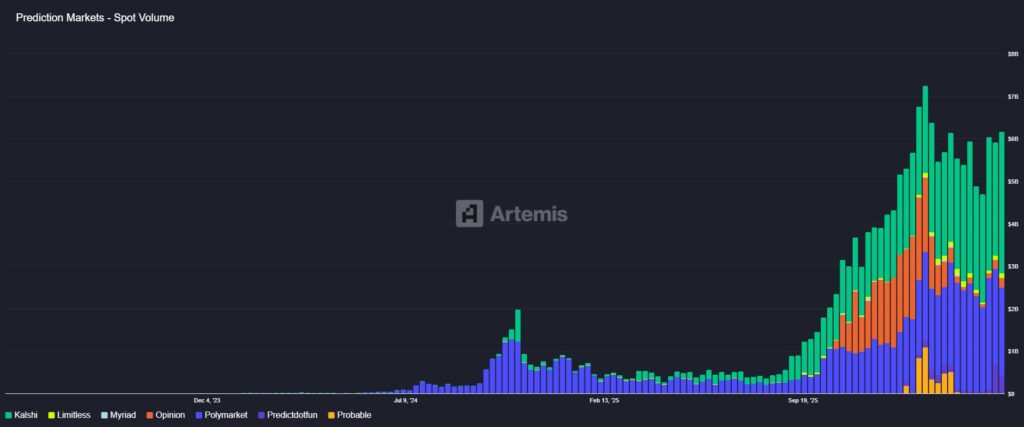
If this trajectory continues, Melker projects a full integration of prediction markets into traditional finance. This scenario would include Bloomberg terminals transmitting real-time odds and a series of ethical challenges, such as politicians and influencers manipulating their own markets or public figures “betting on themselves.”
In fact, institutional integration is almost a reality. CriptoNoticias reported that the first exchange-traded funds (ETFs) linked to prediction markets could be launched in the United States next week. These financial products will allow institutional investors to position themselves on events such as the 2026 and 2028 elections.
Melker concludes that the speculation economy has not disappeared, but has evolved into a more honest model that does not pretend to be technology. «Cryptocurrencies did not lose against fundamentals; “They lost against a better casino with better narratives,” concluded the analyst.