
Spain has eight weeks to implement strict control over transactions with bitcoin (BTC) and cryptocurrencies. This is because the European Commission issued an ultimatum to the Spanish Government on April 28, 2026 to fully apply the regulations that require the identification of senders and receivers in each transfer.
The ruling represents the last administrative step before non-compliance be brought before the Court of Justice of the European Union (CJEU).
The warning from Brussels comes before the Madrid’s delay in implementing traceability standards in cryptoasset transfers established in the Transfer of Funds Regulation (TFR)which is the European version of the Financial Action Task Force (FATF) Travel Rule.
Although the Executive has not offered a public explanation Regarding the causes of this delay, the mechanism seeks to integrate bitcoin and cryptocurrencies into the conventional financial surveillance system, requiring that each movement of funds be accompanied by the personal data of the parties involved.
As with a bank transfer, the objective is to eliminate the pseudonymity that has characterized this market, ensuring that no operation remains outside the reach of supervisors.
This measure is a fundamental piece in the security strategy of the European Union. According to the official statement, traceability is essential to “prevent, detect and investigate money laundering and terrorist financing.”
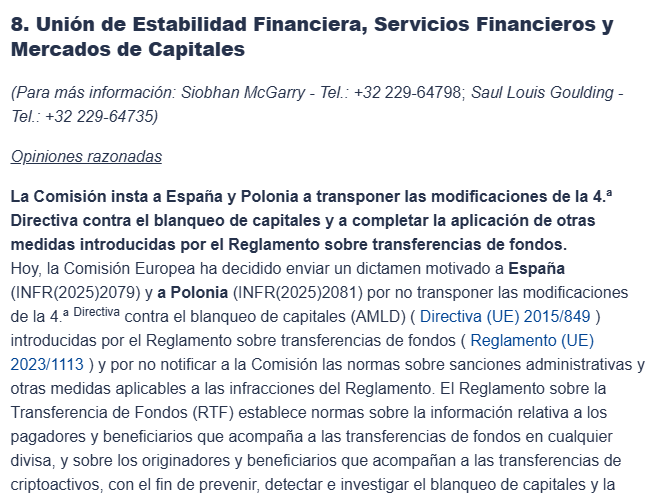
By failing to notify the sanctions framework and transposition measures by the December 2024 deadline, Spain, along with Poland, is singled out for not complying with integrity standards of the area’s single market.
Regulatory pressure now falls on the Bank of Spain and the National Securities Market Commission (CNMV). But the most profound operational change is faced by companies that offer cryptocurrency services.
These service providers must further adjust your data collection and transmission systems even in operations that involve non-custodial or private wallets. With this step, the regulatory distinction between fiat money and digital assets disappears in favor of a much more supervised and centralized model.
A market under the umbrella of MICA
This tightening coincides with the final deployment of the MiCA Regulation. In that sense, Spain is barely two months away from the end of the transitional period. From then on, the digital asset ecosystem will abandon any vestige of autonomy. And only companies with full authorization will be able to continue operating legally, which will force the imminent closure of those that have not managed to complete the registration process.
So if MiCA defines the rules of the market, it must also be taken into account that the DAC8 Directive already plays its role in fiscal surveillance. Since January 1, exchanges report balances and movements automatically.
According to economist José Antonio Bravo Mateu, the current level of detail is already higher than that of the traditional banking system. Therefore, in the cryptocurrency environment of 2026, “not even a two-euro change is lost,” even allowing direct seizures to settle tax debts.
On the other hand, sectors of the community criticize what they consider an erosion of privacy and the nature of bitcoin, as CriptoNoticias has already reported.
Some community members argue that converting platforms in police surveillance extensions Not only does it suffocate innovation, but it pursues a goal that is more revenue-raising than preventive, expelling smaller operators from the market due to the regulatory burden.
Meanwhile, if Madrid’s response is not satisfactory before the deadline expires, the escalation to European justice will be inevitable. This scenario would place Spain facing possible financial sanctions for administrative negligencea risk that increases as the country tries to resolve pending adjustments against the clock to fit into the demands of the new digital financial order.