
In Haiti, where the distance between life and death is often measured in the more than 45 kilometers that separate an injured person from the nearest hospital, Bitcoin (BTC) emerges as the last refuge of dignity. This is the urgency of a mother or a worker who, faced with the collapse of the State, finds in a digital wallet a safety net that institutions have denied them.
During the first quarter of 2026, the Yes Bitcoin Haiti organization claims to have achieved what decades of official promises could not, such as bringing real management tools, that is, the ability to receive, save and transfer value without depending on non-existent banks, to the 10 departments of the nation.
From the plains of the Artibonite to the coasts of the South and Southeast, and from the density of Port-au-Prince (West) to the regions of the North, Northeast, Northwest, Nippes, Grand’Anse and the Center, The digital network expands on the ruins of a physical system that stopped working.
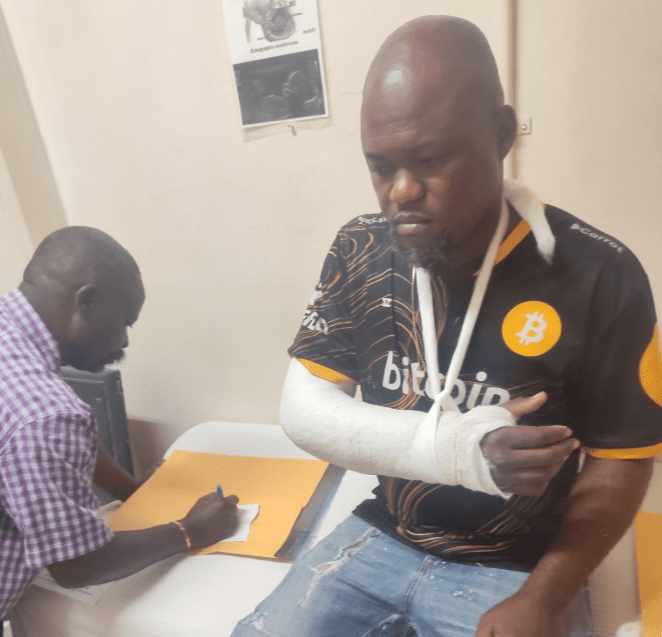
This advance is led by figures such as Val (HaitianHODL), who coordinates the translation of technical materials into Haitian Creole to educate the social base to read and write.
Val recently recounted her own struggle after breaking her wrist in an accident; in their locality, the commune of Saint Michel de l’Atalaye, located four hours by car from the capital, Port-au-Prince, where there are no health centers. This makes each medical consultation a logistical and economic odyssey that It shows why digital sovereignty is today the only frontier of aid available.
Here even breaking a bone is free. I face mounting medical bills and the challenge of simply getting medical care.
Val, leader of the Yes Bitcoin Haiti community.
Satoshi arrives where the road network stops
As CriptoNoticias reported at the time, this movement has its roots in 2024, when Haiti was already facing a constant crisis of extreme poverty, gang violence, and non-existent basic services.
Back then, the Yes, Bitcoin Haiti project was born as a circular economy effort to offer hope in the midst of uncertainty. Now this initiative dedicated to bringing education about bitcoin to the social bases has evolved today into a national survival infrastructure.
The strategy is based on the creation of circular economies that operate through the exchange of satoshis (the smallest unit of bitcoin), allowing value to flow even where formal banking has disappeared.
The integration of the currency created by Satoshi Nakamoto into everyday platforms, such as the Paryaj Pam betting house, is proof that the common citizen validates this technology as real money in the face of the inefficiency of traditional structures.
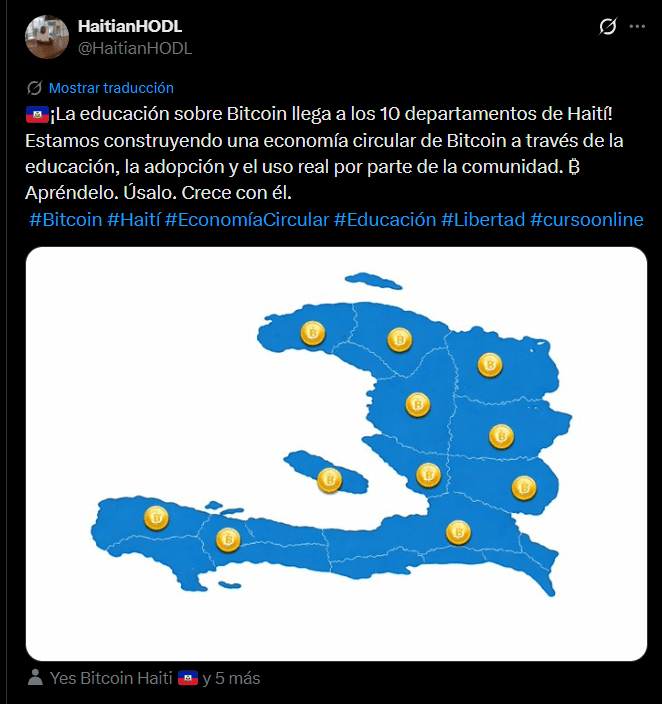
However, the path to adoption faces structural challenges that the code cannot solve alone. While advocates highlight the empowerment of the unbanked, analysts warn that asset volatility and irregular connectivity They remain obstacles to long-term stability. However, in the Haitian context, The risk of volatility is usually perceived as lower compared to the risk of total exclusion.
Haiti is showing the world how Bitcoin empowers the unbanked and builds real circular economies.
Val, from Yes Bitcoin Haiti.
The consolidation of new management teams and education in the mother tongue mark the trend for 2026. What we see in Haiti is a profound transition towards self-management. This in the face of the withdrawal of the State and the collapse of its structures, civil society takes refuge in decentralization to build their own survival networks. It is the demonstration that, when physical infrastructure fails, human resilience is reorganized in the decentralized digital world of bitcoin so as not to be left out of the map of the future.