Romanian governments rarely stay in power for long. The last time a Romanian Prime Minister completed his full term was between 2004 and 2008.
Since the 2012 constitutional crisis, the country has had at least 11 elected prime ministers, seven interim leaders, and 19 different cabinets.
In short, Romania has been increasingly unstable for years. Now another government has fallen.
Government lost no-confidence vote
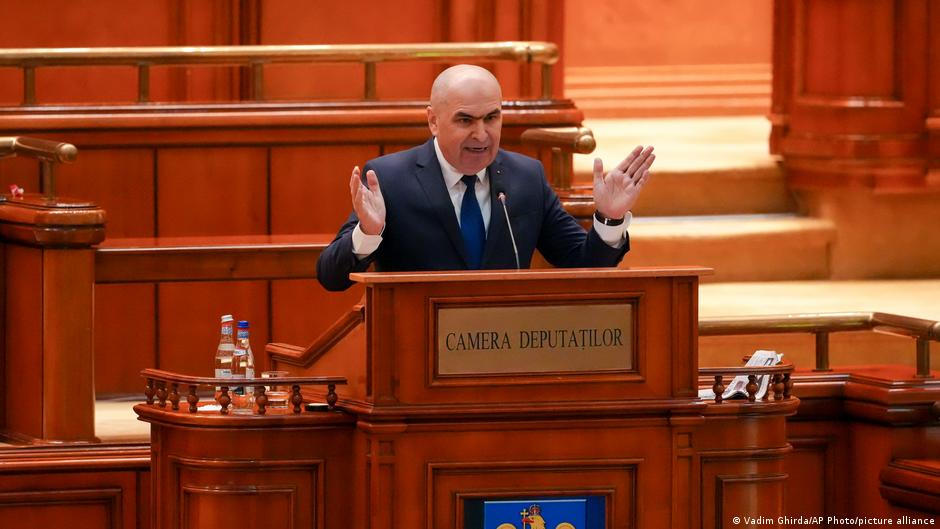
On Tuesday, the cabinet led by Elie Bologen of the National Liberal Party (PNL) was defeated in a parliamentary no-confidence vote. Bologen had been in office for only 10 months.
But this is not just another crisis for the Romanian government.
For the first time in Romania’s post-communist history, a party in the democratic, pro-European camp – the Social Democratic Party (PSD) – joined forces with the far-right, pro-Russian party, the Alliance for the Union of Romanians (AUR), to file a motion of no-confidence in parliament and then vote together to topple the government.
Although there had been previous examples of such joint votes in the Romanian Parliament, this was the first coordinated, jointly planned action of this kind.
This means that the “firewall” against the far right, which was explicitly agreed upon and announced last year by all pro-democracy parliamentary parties, has collapsed – even if the PSD is playing down that interpretation of events.
If snap elections are called, toppling the government could pave the way for the far right to take power.
A critical month is building
Elie Bologen’s cabinet was facing a month-long crisis before the no-confidence vote.
The situation worsened two weeks ago when the Social Democrats withdrew their ministers from the government and began gathering support in parliament for a no-confidence motion.
Bologen’s government took power in June 2025 during a major political crisis, promising ambitious reforms.
It was a four-party coalition united under a broadly pro-European banner that included the Social Democrats, the National Liberals, the progressive-liberal Save Romania Union (USR), and a party representing Romania’s Hungarian minority (UDMR).
A difficult political restart
At the time, Romania had endured two difficult presidential elections: the first in November 2024, which was annulled on the grounds of foreign interference, and the second in May 2025, in which George Simien, leader of the far-right AU party, lost by only a slim margin, receiving just over 46% of the vote.
In the parliamentary elections held in late 2024, three far-right parties, including the AUR, received a combined total of about 30% of the vote.
Following his victory in May 2025, Romania’s newly elected President, liberal-conservative former civic activist Nicăor Dan, called for a firewall against the far right and the formation of a strong pro-European coalition, which subsequently formed.
comprehensive reform program
The new government took office amid a severe economic crisis due to a budget deficit of more than 9%, declining growth, an over-sized state and administrative apparatus, and stalled reforms in many sectors.
One of the government’s first measures was to introduce a series of tax increases, including an increase in the sales tax.
Although this sparked public discontent, opinion polls indicate that many Romanians still feel that the Bologna government’s reform agenda is necessary.
The government also pursued one of the most comprehensive reform programs in Romania’s recent history, targeting the state and administrative apparatus, state-owned companies, and the pension system.
Thousands of positions were cut at both the national and local government levels, bureaucratic structures were streamlined, and expensive, unnecessary jobs in state-owned enterprises were cut.
Controversial pension reform
The most controversial reform, which caused tension within the coalition last autumn, was the abolition of a special pension scheme for members of the judiciary.
Under the old system, these civil servants could retire before the age of 50 with an average pension of €5,000 ($5,800) per month, up to €15,000 in some cases. The average pension in Romania is only €500-€600.
The Bologna government began to phase out these special pensions and raise the retirement age. It remains to be seen whether this improvement will last.
Future alliance options
Despite signs that the reform agenda is having a positive impact – for example, by reducing the budget deficit – the PSD’s opposition to Bologen’s course has increased in recent months.
Despite its name, the Social Democratic Party is a successor to the former Communist Party that now supports some right-wing populist and nationalist positions and even has a small far-right faction.
Although the PSD, which was part of previous governments, is not solely responsible for Romania’s economic crisis and the pending reforms, it bears considerable responsibility.
This explains why Bologen described the motion of no confidence against his government as “dishonest, cynical and artificial” and accused the PSD of playing “the role of the opposition” in the government from the beginning.
what happens next?
The Social Democrats’ cooperation with the far right was greeted with concern and criticism across Europe, particularly within the Socialists and Democrats (S&D) group in the European Parliament, of which the PSD is a member.
It is not clear what will happen next.
The President can repeatedly nominate a candidate for the post of Prime Minister and entrust that person with the task of forming the government. After this the proposed cabinet will have to face a trust vote in Parliament. If it is lost, the process will start again from the beginning.
If multiple attempts fail, the President can dissolve Parliament – although he is not obliged to do so.
Of the coalition parties, some members of Bologna’s PNL are advocating the formation of a new government with the Social Democrats. The USR and UDMR are opposed to the idea.
The far-right Auer has repeatedly ruled out a coalition with the Social Democrats in the past, as she sees it as an “establishment party”. He wants snap elections as soon as possible in the hope of being able to increase his support by the 2024 general election.
However, President Nikosor Dan immediately put the brakes on such a scenario.
In a brief statement late Tuesday, he described the no-confidence vote as a “democratic decision” and called for peace, saying there is a pro-Western, pro-European consensus in the country.
Dan ruled out early elections and expressed confidence that at the end of all consultations and constitutional processes, Romania “will once again have a pro-Western government.”
This article was originally published in German.