The Foundation presented a revised version, but decided not to intervene in the vote.
The community will define the direction of the event that will take place in October in Singapore.
The Cardano Foundation, a non-profit organization focused on the development and expansion of that ecosystem, decided to abstain from voting on funding the Cardano Summit 2026 conference.
This occurred following strong community rejection of the original proposal to withdraw funds from the Cardano treasury, a decentralized managed reserve that belongs to the network and is controlled by the community through the governance system.
The decision was communicated this May 6, 2026, after the organization presented a revised version of the project in response to criticism.
Through a publication in The vote (which ends on May 29) is in the hands of the DReps, the representatives of the governance system. The organization clarified that this decision responds to the specific context of this proposal and does not establish a precedent for future votes.
The conflict originated from initial plan which contemplated withdrawing nearly $2.8 million (10.3 million ADA) from the treasury to finance Summit 2026, scheduled for October 5 and 6, and participation in Token2049, scheduled for October 7 and 8, both events in Singapore.
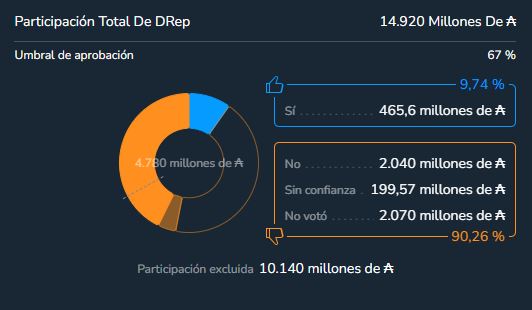
Governance data shows that the proposal initial was far from reaching the threshold necessary to be approved (it needed 67%). Voting ended on May 5 and only 9.74% of the delegated stake voted in favor of the initiative, the equivalent of 465.6 million ADA.
It should be clarified that ADA is the native currency of Cardano and is used, among other functions, to pay commissions, participate in staking and delegate voting power within the governance of the network, as explained by CriptoNoticias.
In response, the Foundation presented an adjusted version of the plan on April 29with a budget reduced by 22% (about $550,000 less), decoupled from the sponsorship of Token2049 and with operational changes such as the reduction of three scenarios to two, which reduces production and logistics costs. The contribution of the Foundation’s internal resources was also increased, with the aim of reducing dependence on external suppliers. Voting on this initiative will end on May 29.
The case exposes the operation of Cardano’s decentralized governance system, where the use of treasury funds must be approved by the community through DReps. This mechanism, implemented in January 2025, prevents central entities directly dispose of the resources without collective validation.
What is happening also reflects a broader tension within the ecosystem. While some actors (such as the Foundation itself) defend the strategic value of the Summit as a space to close alliances and attract institutional capital, others believe that the expense is excessive and that the funds should be allocated to local development or expansion initiatives.
Figures such as Charles Hoskinson, creator of this ecosystem, also questioned the use of these resources. On April 11, Hoskinson held that Cardano needs to attract new participants and show the market that the ecosystem is still active, but not through big events. “Going to parties doesn’t do it, having permanent community centers with people attending weekly events does,” he said.
Now, the definition will be in the hands of the DReps and the community, who will have to decide if the new Cardano Summit 2026 budget justifies the use of treasury funds.