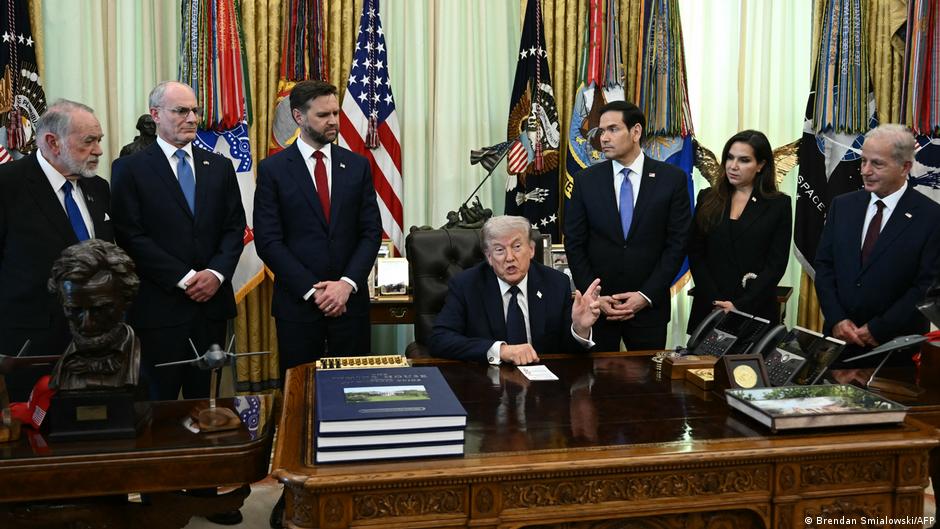
At present, diplomatic efforts are also going on parallel to the ongoing violence. In mid-April historic talks between Israel and Lebanon took place in Washington, the first since 1993. Officially, the two countries have been at war since 1948.
But at the same time, fighting continues in southern Lebanon, as it has for decades, to varying degrees. Members of the local group, the military wing of Hezbollah – which considers Israel an enemy and has strong support in southern Lebanon – have previously fired rockets into Israel.
Israel has frequently bombed southern Lebanon and recently declared it a “security buffer zone”, but its critics call it an occupation. Hezbollah, which has been designated a terrorist organization by Israel, the US and Germany, among others, is now fighting Israeli troops in southern Lebanon.
Despite this, the Lebanon–Israel talks are seen as progress by many observers.
power imbalance and absence
However, they have a bigger problem, says Hanna Voss, who works in the Beirut office of Germany’s Friedrich Ebert Foundation.
She says Hezbollah is not involved in those talks – even though it is one of the parties to the conflict. Voss says this limits the chances of success from the start, and questions the validity of any potential outcome.
Hezbollah, which is backed by Iran but also deeply embedded in Lebanese society and politics, has refused to negotiate directly with Israel.
On Monday this week, Hezbollah leader Naim Qassem said the group supports “indirect talks diplomacy” only because direct talks only work for Israeli President Benjamin Netanyahu and US President Donald Trump just ahead of the US midterm elections.
Observers say there is another problem too. “The political power and military capabilities of the negotiating parties are completely different in nature,” explains Stefan Lucas, chief executive of the Berlin-based consultancy. middle east brain.
Lucas told DW that Israel has what is known as “surge capability” and is using it.
“Diplomacy assumes a certain degree of autonomy for the negotiating parties,” Hussein El Moualem, program director of the Lebanon office of the Friedrich Ebert Foundation, wrote in an April analysis for a German magazine. International politics and society.
But Lebanon-Israel talks “are taking place in an environment of imbalance,” he said.
That is why, “the current direct negotiations between Lebanon and Israel in no way represent a transition to peace, but rather reflect a troubling dynamic: the strengthening of power imbalances under the guise of diplomacy,” El Moualem argued.
weak lebanese army
“Who exactly is ‘Lebanon’ anyway?”. Luke asks. He says the government does not have a strong power base of its own while Hezbollah remains a major player and can act independently.
Despite recent losses, many experts believe that Hezbollah’s military wing is probably still stronger than the Lebanese National Army. This is when the Lebanese army must help disarm Hezbollah.
“Basically, the Lebanese state has no influence,” Voss confirms.
Israel and the US want to disarm Hezbollah, but this would be almost impossible to implement under the current circumstances. Voss points out that Israel is making progress in negotiations and a ceasefire on terms that Lebanon cannot realistically meet without destabilizing itself.
Experts say there is also external pressure, which further weakens Lebanon. The US supports Israel while Iran and its proxy Hezbollah advance their interests and further restrict the already weak government in Beirut.
“The country is torn between camps and is barely able to take action,” Voss says.
“Washington is applying tremendous pressure,” Lucas says. But Iran also looks at the problems inside Lebanon strategically. “Iran knows how to influence negotiations with minimal effort,” he explains, “which also makes Lebanon a stage for larger regional conflict.”
Opinion on Hezbollah is changing
Hezbollah is a factor in the talks in two ways. It is a military adversary of Israel, but at the same time, it also has a social and political wing, with significant representation in the multi-confessional Lebanese parliament and deep roots in Lebanese society, especially among the Shia Muslim demographic.
“It’s deeply embedded in society,” Voss says. This gives Hezbollah political influence and, at the same time, makes it difficult to control.
However, its role in Lebanese society in general has become increasingly controversial.
Lucas describes Hezbollah’s reputation as “mixed” and work by the US-based research organization Arab Barometer paints a similar picture.
Twenty-eight percent of Lebanese people were surveyed arab barometer say their top priority would be ending Israel’s presence in Lebanon, while another 20% say their priority would include disarming non-state actors, i.e. Hezbollah. Rejection of Israel and skepticism about Hezbollah’s co-existence in Lebanon reflects internal demographic and social divisions.
Many people in southern Lebanon have little hope that the talks in Washington will yield any results.
“I don’t believe the Lebanese government can bring my country back,” says Hana Zalghout, whose village in the south has been captured by Israeli forces; His house there was also destroyed by the Israelites. “Even if there is a deal, I am worried it will be at the expense of my village.”
Local farmer Ahmed Ismail also considers the current situation disappointing. “I will be able to see my home again only in my dreams,” he laments. “If they want to solve it, it will be at the cost of our lives.”
Will Israeli forces remain in Lebanon?
Israel argues that Hezbollah fighters should permanently withdraw from areas south of Lebanon’s Litani River to prevent them from attacking northern Israel. This is why Israel has established its own “security buffer zone” inside Lebanon between 5 to 10 kilometers (3 to 6 mi) from the shared border.
Observers suggest that Israel may be tempted to achieve through de facto occupation what the Lebanese army is unable to do.
Voss explains, “If Israel is not forced to withdraw, it will permanently establish a so-called buffer zone.” This basically creates facts on the ground that will be almost impossible to reverse.
Statements from Israeli government officials partially support this. Finance Minister Bezalel Smotrich, a far-right politician, has repeatedly raised the possibility of territorial realignment in Israel’s favor. Prime Minister Benjamin Netanyahu has not ruled out a long-term military presence and has said several times that Israel will remain in the security zone for the long term.
Does this mean that an Israeli occupation of Lebanon is imminent? It can’t be denied, Voss says: “Israel is using the language of security to create territorial facts on the ground.” She says this is a pattern that has also been seen in other conflict zones.
For the Lebanese government, this means trouble – even if talks in Washington end with a peace treaty or something similar – because both Israel and Hezbollah could use force to ensure that Beirut cannot abide by any agreements and get caught in the crossfire.
With additional reporting by Sarah Heit in Lebanon.
This story was originally published in German.