
99% of the supply is in three anonymous wallets, facilitating market manipulations.
With zero price and automatic activity, the token acts as a bait for phishing.
The Ethereum infrastructure today allows almost any currency in the world to be represented, but not all “tokenization” is synonymous with security. In fact, behind a bolivar or the Venezuelan Bolivar Digital (VBOD), which recently appeared in records of the Base layer 2 network along with 29 other fiat currencies, hide metrics that activate all the financial risk alarms.
The real control of this Venezuelan token resides in a handful of anonymous wallets, since 99% of the supply is concentrated in only three directions. In the cryptocurrency ecosystem, this level of concentration is a «red flag” criticism. It is an indication that the majority holders have the power to manipulate the market or withdraw any trace of liquidity instantly, leaving the rest of the users with a worthless asset.
On the other hand, the VBOD market lacks the basic pillars of any functional financial asset, operating more like a ghost market. In block explorers and analysis platforms like Birdeye, the asset marks a non-existent value, confirming the absence of a real market and zero liquidity.
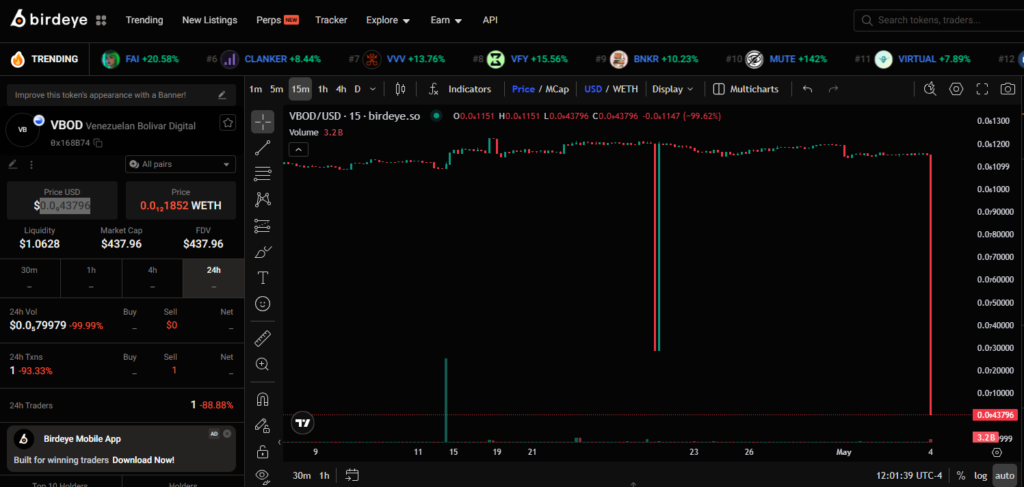
Without a reference price or oracles to support it, the token has no use as a store of value or stable means of payment. This precariousness is reflected in an activity that, although it registers a theoretical base of thousands of addresses, reveals a purely artificial nature in its on-chain metrics.
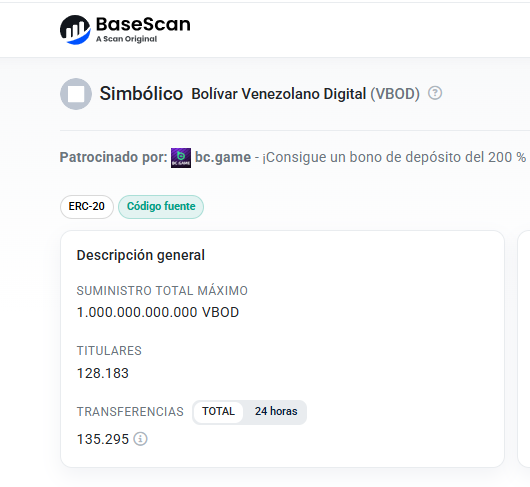
Furthermore, the technical trace of these operations shows the tag «handle ops«, suggesting that the movement of the network is not coming from real users, but from automated smart contract processes and not from organic adoption by real users.
Additionally, the opacity of the VBOD goes further. This is due to the lack of an official administrator, since there is no institution, company or auditable reserve that guarantees the legitimacy of these tokens, the user is exposed to an absolute legal vacuum.
Under the guise of an immutable protocol, the anonymous management of the token makes it impossible to verify who really controls the majority wallets or For what purpose these automated interactions are being encouraged.
In an economy where Venezuelans seek refuge in consolidated assets such as USDT, Tether’s stablecoin, to protect their assets, VBOD emerges as a systemic risk.
Without transparency in the distribution and with clear signs of technical manipulation, this asset presents common characteristics in phishing or scams aimed at capturing data and funds from unsuspecting users. For now, This digital bolivar remains closer to being a trap than a legitimate financial tool.
In that sense, interacting with contracts of uncertain origin and opaque metrics, such as those surrounding this asset, can be the gateway to this “digital hook” designed to steal confidential information, including passwords and seed phrases from bitcoin and cryptocurrency wallets, as CriptoNoticias has warned.