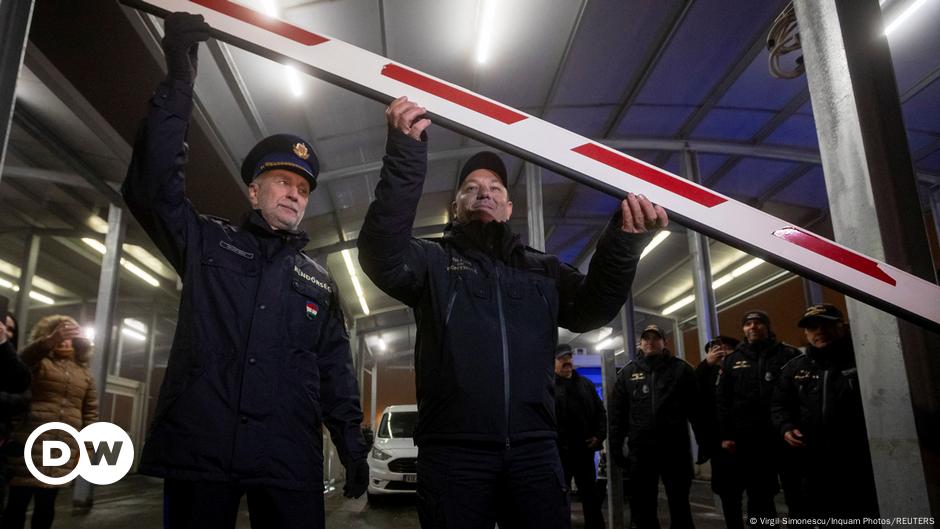
Romania and Bulgaria fully joined the EU’s Schengen zone on Wednesday, eliminating land border controls for other member states.
The Schengen zone allows residents to travel between countries without passport checks.
While the Schengen Zone has expanded continuously since its inception, several countries, including Germany, have reintroduced border checks at their crossings in recent years.
Early last month, the Netherlands also introduced border controls for travelers entering from Germany and Belgium.
Romania, Bulgaria celebrate full Schengen membership
Bulgarian Prime Minister Dimitar Glavchev, speaking from the southwestern city of Kulata on Bulgaria’s border with Greece, described the expansion of the Schengen area as a “historic event.”
On New Year’s Eve, Romanian Interior Minister Catalin Predoiu and Bulgarian counterpart Atanas Ilkov presided over a ceremony at the Giurgiu-Rousse border crossing at which barriers were lifted.
A similar ceremony was held at the Nádlak-Sanadpalota crossing between Romania and Hungary.
Why are Romania and Bulgaria only joining Schengen this year?
Romania and Bulgaria entered the European Union in 2007. While both countries had met the requirements to enter the region since 2010, many countries objected to their access over fears of a burden on the welfare system and unsustainable migration in the EU’s wealthier regions. ,
One of the opponents of their entry into Schengen was Austria, which started exercising its veto in 2022. While air and sea border controls were to be lifted in March 2024, the bloc decided to lift border controls on both countries only after Austria lifted its veto. In December.
The Schengen free movement area now includes all EU countries except Cyprus and Ireland. It also includes Switzerland, Norway, Iceland and Liechtenstein.
sdi/dj (dpa, Reuters)