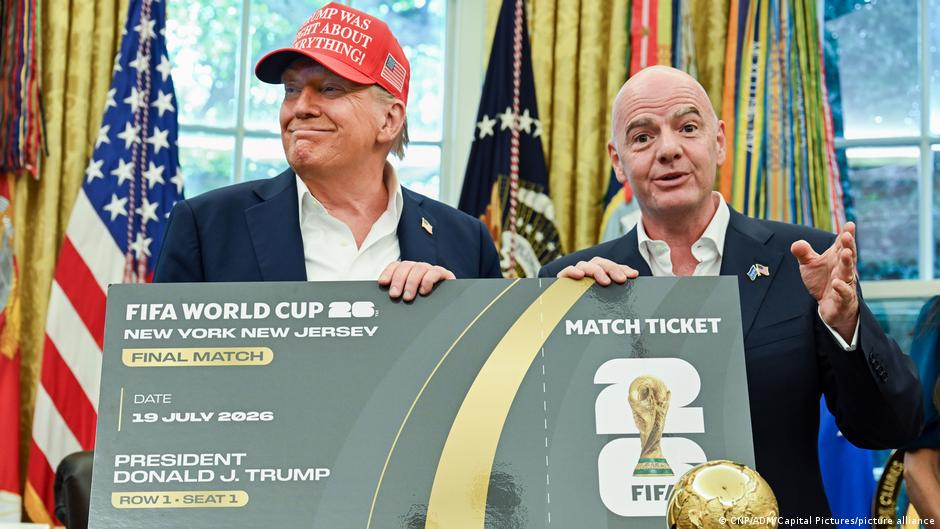
In January, FIFA president Gianni Infantino said the demand would be equivalent to a “once-in-a-lifetime World Cup.” But with a month to go before the 2026 World Cup begins, tickets for most matches remain unsold and it is unclear whether any games have actually sold out.
“As it seems to me, I wouldn’t be too concerned about the hype around World Cup ticket sales,” Gilad Zilberman, CEO of SeatPick, a leading secondary market comparison site, told DW.
“I think prices will fall. That’s my gut feeling. I think FIFA is struggling.”
While FIFA failed to answer several questions from DW on demand and sales figures, a Recent report from the American Hotel & Lodging Association (AHLA) Supported Zilberman’s analysis. It said about 80% of hotel bookings in host cities were running below initial forecasts. AHLA said this was probably due to the lack of international travelers.
With visa difficulties, high airfares and other logistical challenges, the tournament is increasingly likely to be largely attended by fans from the host countries – the US, Mexico and Canada – who may look forward to the drop in prices predicted by Zilberman and others.
Dynamic pricing and secondary markets are key for FIFA in 2026
For this year’s tournament, FIFA, the governor of world football, has introduced a form of dynamic pricing. The organization has stated that they set prices but adjust them according to demand, unlike the more common practice of using algorithms. Almost every day headlines are being seen about extortion for World Cup tickets.
Another new element of FIFA’s ticketing strategy this year is the introduction of its own secondary market, where people who have won tickets in a series of ballots can resell their tickets at no cost, with FIFA taking a 15% cut from both buyer and seller. A ticket there was recently listed for $2,299,998.85 (about €1.95 million), meaning it would net FIFA $690,000 (€585,000) if it sells.
The most expensive ticket at face value for the final was $11,000 and FIFA expects to earn $3 billion from ticketing and hospitality sales alone. Infantino defended his organization’s ticketing strategy last week.
“We are in a market where entertainment is the most developed in the world. So we have to charge market rates,” Infantino said. “Reselling tickets is also allowed in the US. So if you sell tickets at a very low price, these tickets will be resold at a much higher price.
“And in fact, even though some people are saying that we have higher ticket prices, they still go for even higher prices on the resale market, more than double our price.”
Is there really a demand?
However, Zilberman says market data disputes this. seatpick Tracks data from all major resellers outside of FIFA’s platformSuch as Viagogo and StubHub. He told DW that, at the end of April, 72% of matches where FIFA and secondary market data were available came out cheaper on the secondary market. DW has tested this and found that in most cases tickets from resellers are cheaper, although it is not always possible to assess the direct equivalent.
Zilberman said he understands that FIFA would be “leaving money on the table” by adopting the cheap, face value strategy adopted by UEFA for the Euros, but that they are not equipped to use ticketing strategies.
“From past history of dealing with these types of big tournaments, it often happens like it’s happening now. They get stuck with a lot of tickets. Dynamic pricing is not FIFA’s expertise.”
He said people seeking tickets are turning to secondary markets because they reflect supply and demand. Ticket prices may fall for matches without high demand, unlike FIFA tickets, which have not yet declined in value.
“FIFA is basically doing dynamic pricing themselves. And they’re trying to emulate pricing on the secondary market and try to compete and get the maximum amount of the pie for themselves.”
Fans urged to wait until 2030 remain in doubt
FIFA released two separate tranches of tickets, dubbed “last minute sales”, over just two weeks in April and May, as they had previously said this was the final phase. This is evidence that they are possibly withholding tickets to influence the market, Zilberman said.
“It could be that they are incompetent in technology, which wouldn’t surprise me, but I don’t think that’s the case. It’s most likely that by releasing in batches you get a spike in demand on release day, see how the market reacts and use dynamic pricing. So, ‘How do I minimize damage to my perception with fans but at the same time maximize my profits?'”
A challenge to FIFA’s strategy has come from the Canadian province of Ontario, which in late April passed a law banning the resale of event tickets at prices higher than face value. While Mexico has some restrictions on secondary markets, there are few restrictions in the US and Canada until Ontario’s move, which affects prices in Toronto, where resale tickets will not be able to exceed face value. Soccer Supporters Europe and lobby group Euroconsumers also filed a complaint with the European Commission in late March about FIFA’s ticketing strategy for the tournament.
FIFA has not yet announced whether it will continue these strategies for the next World Cup in Morocco, Portugal and Spain, but Zilberman thinks it will not be as easy next time.
“I think they’ll try, but it’s not the same,” he said. “The American platforms are very, very advanced in terms of the second-hand market and consumers are familiar with prices five times higher than the price of releases in the primary market. In Spain, Morocco and Portugal, this is not the case.”
It certainly seems unlikely that tickets will be listed north of $2 million in 2030. Even though being listed does not mean being sold, Infantino has promised any potential buyer the most unusual thing in this World Cup – a free gift.
“If someone bought a $2 million ticket to the final I would personally bring him a hot dog and a Coke to make sure he had a great experience.”
Edited by: Chuck Penfold