
As Myanmar’s military government prepares for elections in 2025, attention turns to neighboring China, which critics say is pushing Southeast Asian countries to regard the vote as a solution to Myanmar’s ongoing political crisis. Is putting pressure.
In February 2021, a military coup in Myanmar overthrew the democratically elected government and triggered a civil war that left thousands dead and millions displaced. Myanmar’s neighboring countries are looking for a solution to this crisis and recently held meetings in Bangkok, Thailand to discuss it.
China was a participant in December. 19 meetings which included Bangladesh, India, Laos and Thailand. These five countries are neighbors of Myanmar.
At the meeting, Chinese Vice Foreign Minister Sun Weidong urged representatives of neighbors to support Myanmar’s “peace and reconciliation,” according to a statement from China’s Foreign Ministry.
“All parties should respect Myanmar’s national circumstances and … give priority to people’s livelihoods,” Sun said.
At the 19th meeting in December, Myanmar’s Deputy Prime Minister and Foreign Minister Than Swe outlined the junta’s 2025 election roadmap. Opposition groups, including the ethnic armed forces and the National Unity Government, or NUG, a parallel government formed after a 2021 coup, rejected the plan, questioning its legality and whether the elections would be free and fair.
On December 20, a meeting of representatives of all ASEAN countries except Myanmar was held as junta political appointees are usually barred from attending high-level meetings of the bloc since the coup.
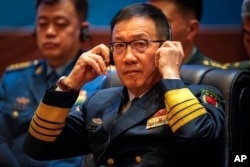
Thai Foreign Ministry official Bolbongse Wangphene said the bloc was still awaiting details of the proposed vote, which China supports.
Myanmar’s military leadership did not respond to VOA’s request for comment regarding the Bangkok meetings, controversies surrounding its proposed elections, or preparations for the elections.
China maintains close ties with Myanmar’s military and rebel groups near its border.
In his recent Christmas and New Year messages, Myanmar junta leader Min Aung Hlaing reiterated and affirmed the government’s commitment to “strengthening the multi-party democratic system and returning to the right democratic path.”
VOA asked the Chinese Embassy in Myanmar for comment on China’s support for the elections in Myanmar but did not receive a response. However, during a visit by Chinese Foreign Minister Wang Yi to Myanmar’s capital Naypyidaw in mid-August, Beijing called for “all-inclusive elections” as per the state-run elections. Myanmar’s global new light Newspaper.
Skeptics argue that any elections called for by the junta will lead to only a superficial peace that ignores decades-long political and ethnic grievances.
China’s increasing dominance
Experts told VOA that Beijing is encouraging ASEAN members to deepen their engagement with Myanmar’s military.
According to Jason Tower of the United States Institute of Peace, China is pressuring its Southeast Asian neighbors to accept the junta’s election as a quick solution.
“From China’s vantage point, if ASEAN is bringing back governance and having high-level dialogue, it legitimizes what China is doing,” Tower said.
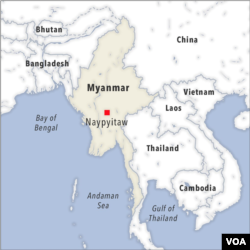
Htet Min Lwin, a Myanmar expert at York University in Canada, said Beijing prefers to leverage its influence over Western intervention.
“If the resolution passes through ASEAN, where China has considerable influence, Beijing will continue to pursue an ASEAN-led path,” he told VOA.
Myanmar regional political analyst Sai Ki Zin Soe agreed.
“Some ASEAN member states will not be able to recover from China’s influence, either economically or security-wise,” he said. “China’s power doesn’t stop at ASEAN; This also extends to domestic groups, including ethnic armed groups in Myanmar, which now control almost all border areas with China and have traditionally been closely linked to China.
Meanwhile, Tower sees “no viable plan” for a political solution and says Beijing views Myanmar’s generals as “completely on the sidelines” and open to “significant concessions” that could jeopardize sovereignty. That includes allowing Chinese troops to protect investments.
“China is empowering two of the northern ethnic armed organizations to negotiate with the regime,” Tower said. “Chinese influence continues to grow, and [Beijing] “Is influencing other countries in the region, trying to bring those countries along with it.”
He warned that the junta is “bankrupt when it comes to real solutions,” instead relying on “air strikes, forced conscription and a sham election to legitimize junta leader Min Aung Hlaing.”
Tower predicted that ASEAN would eventually realize the continued decline of the military.
increasing losses on the battlefield
The junta’s China-backed election bid comes amid a series of defeats.
“The Army is losing ground at an alarming rate and is demoralized,” Tower said.
Tower believes that following the collapse of two major regional commands, Myanmar’s weakened military has no choice but to trade parts of its sovereignty with China.
“It is giving big concessions,” he said, referring to China’s proposed joint venture security company. “For China, it turns Myanmar into a testing ground for its global security initiatives and new approaches to securing interests beyond its borders.”
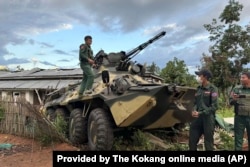
In October, the Myanmar National Democratic Alliance Army, or Kokang group, which is part of the Three Brotherhood alliance, together with the Ta’ang National Liberation Army and the Arakan Army, captured the city of Lashio in northern Shan state.
Lashio is considered strategic to the China-Myanmar Economic Corridor, marking the first time in modern Myanmar history that a regional command has fallen into rebel hands.
On December 20, the Arakan Army seized the junta’s Western Regional Command in Rakhine state, a natural gas-rich region that includes major Chinese projects. Videos on social media showed exhausted junta soldiers surrendering. Tower said it was an “embarrassment of the Army.”
“The result is that frustration is rising,” Tower said. He said this explains why Myanmar’s military is handing over sovereignty to China, including the possible deployment of Chinese private security troops to Rakhine state.
Concern about ‘negative peace’
Analysts say elections without genuine negotiations will lead to a fragile ceasefire.
“All neighboring countries, including China, cannot understand that each ethnic group in Myanmar has its own right to governance and sovereignty,” Htet Min Lwin said.
Tsai Ki Zin Soe, citing World Bank and United Nations figures, said 42 million of Myanmar’s 53 million people now live in poverty.
He said the humanitarian crisis could force many armed groups to stop fighting but would not necessarily resolve the conflict.
Tsai Ki Zin Soe said, “If the international community puts pressure on them, the war can stop and elections will be held.” “However, this will not be a solution that will benefit Myanmar in the long term. “It needs to be understood that only negative peace will prevail.”
Tower told VOA there may be opportunities for ASEAN to expand its role this year, but China’s involvement, especially in border areas, could overshadow that.
“If other countries don’t pay careful attention to Chinese interference, the reaction in Myanmar will lean more toward where Beijing is going,” he said.