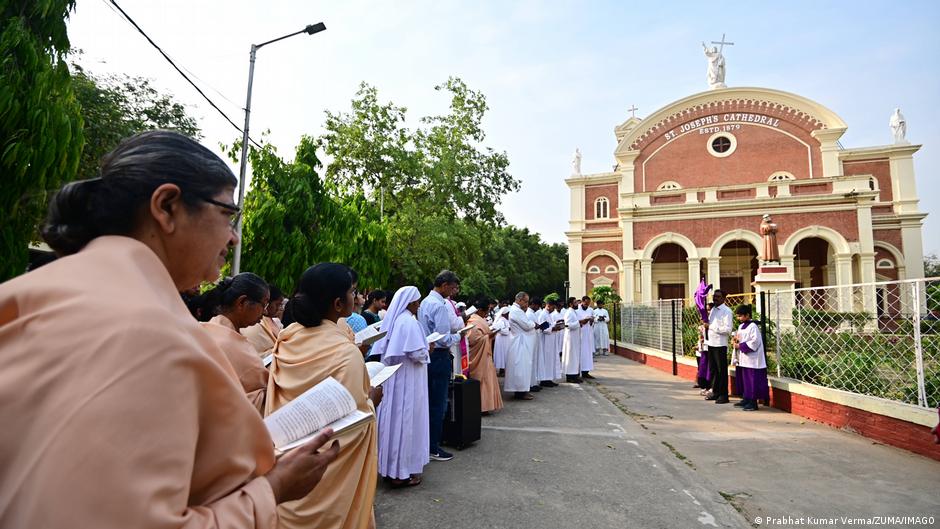
On a muggy Sunday afternoon in July last year, a small Christian service inside an ordinary home in the Indian state of Uttar Pradesh was disrupted by a mob.
Pastor Jayendra (name changed), who was leading the prayer, said, “When people were getting the religious message, at least 50 to 60 people belonging to a Hindu right-wing organization came.”
What happened next, he said, was chaos.
“The mob created a ruckus and closed the prayer room,” Jayanendra said.
The gathering held inside his house was not unusual in Shahjahanpur district. Like many Christians in northern India, Jayendra hosts a house church known as a house church. It is a quiet form of worship that is common among small and poor Christian communities. But in recent years, such gatherings have increasingly attracted the attention of Hindu right-wing watchdog groups who accuse Christians of carrying out forced conversions.
According to the 2011 census, Christians in India constitute just over 2% of the country’s population, while Hindus constitute around 79% and Muslims constitute over 14%.
Data compiled by rights groups indicate a disproportionate increase in violence against Christians over the past decade. In 2025 alone, local monitoring groups documented nearly 900 incidents across several Indian states, including physical attacks, disruptions of church services and threats targeting worshippers, according to A report by Christian Solidarity InternationalA global Christian rights organization based in Switzerland.
Pastor arrested after attack on home church
Jayanendra’s account is one of several that suggest a recurring pattern. Mobs descend on prayer meetings, make allegations of forced conversion and the police are called. Often, victims say, worshipers are detained rather than violent mobs.
After the attack in Uttar Pradesh, police “took about 10 to 11 people to the police station and detained them,” Jayendra said. “They detained my family and other people the whole day.”
A 13-year-old girl was also among those detained, he said.
“The police interrogated them and found out that they had no money or pressure to attend the gathering. Everyone had come here to pray here of their own free will,” he said. “But they kept them anyway.”
The priest himself was later arrested. He spent more than four months in jail under charges related to Uttar Pradesh’s anti-conversion law. The law is a controversial state law that criminalizes religious conversions carried out through force, fraud or inducement. Critics say the law is often weaponized to target minority communities. Courts in the area have also noted the same “Troubling trend” in false claims..
“There was no evidence against me,” he said, “but there was a lot of pressure.”
Despite repeated attempts to contact Uttar Pradesh Police, he refused to speak on the issue.
‘They started beating people’
Similar stories are emerging across North and Central India.
In Madhya Pradesh’s Chhindwara district, Vinay Patil (name changed) described an attack on his congregation during Sunday prayers earlier this year.
“Around 35 to 40 people came,” he said. “They were young boys. They started using abusive language and said, ‘You are forcibly converting people here.’
He told that some of the attackers were drunk. Many people had sticks in their hands.
“They started beating people. Women, children, everyone,” he said. “Someone’s shoulder was broken. Someone was bleeding from the head.”
By the time the police arrived, the attackers had fled. But instead of pursuing them, authorities detained the victims and accused them of “forced conversion,” Patil said.
“The police picked us up and took us away,” he said.
“Our people made videos,” he said. “It was visible that they were beating. After that the police did not take any action.”
Patil said that fear has become a part of everyday life.
“Today a Christian, especially a pastor, cannot even sit at another person’s house,” he said. “We have to think before we go out. Even going on someone’s birthday can become a problem.”
Violence is increasing in Modi’s BJP!
Rights advocates say that such incidents are no longer isolated.
Dr. Michael Williams of the United Christian Forum said the organization recorded 134 incidents of anti-Christian violence in 2014, the year India elected the Hindu nationalist Bharatiya Janata Party (BJP) to power, while nearly 900 incidents were recorded in 2025.
“What you can see now, which we couldn’t see before, is that there is no fear on the faces of the people who are committing these crimes,” he said. “They are stopping in broad daylight, in public places, without any fear.”
“This is a growing trend.”
Williams and others link the increase in violence to the political climate following the rise of the BJP in 2014. The party, which promotes Hindu nationalist ideology, rules the Center and several states where anti-conversion laws have been enacted.
These laws, intended to prevent forced or fraudulent conversions, have been widely criticized by rights groups due to their vague definitions and potential for abuse.
Attackers operate with ‘a sense of impunity’
Jayendra was charged under a law related to forced religious conversion.
He denied the allegation, saying, “They made the same allegation twice.”
“We don’t have money to pay our rent,” Patil said. “How can we give money to convert someone?”
The Indian Constitution guarantees freedom of religion, including the right to practice, profess and propagate one’s faith. But activists argue that implementation on the ground often falls short.
“People are walking inside the church and breaking things,” Williams said. “They have no right to take any law into their hands.”
Veteran human rights activist John Dayal said the violence follows a consistent pattern that has lasted for decades but has intensified in recent years.
“The cast involved has remained consistently the same,” he said. “But when the BJP is in control, there is a feeling of impunity.”
Dayal said the widespread use of cellphones has also changed the nature of these attacks.
“Almost all crimes are now committed on camera,” he said. “Filming is part of the crime. It’s to show power, to get support.”
Videos of such incidents have circulated widely on social media, sometimes sparking outrage, but rarely prompt accountability, victims say.
‘The police took their side’
In many cases the police response has come under scrutiny.
“It is strange that people are attacked and cases are registered against the victims,” Dayal said.
Patil also repeated the same thing.
“The crowd that had come, their associates came to the police station and talked to the officer,” he said. “Our people were thrown out. The police took their side.”
AC Michael, another leader of the United Christian Forum, said the lack of action had emboldened criminals. “They have no fear of the law because they have protection behind them,” he said. “In so many places, no action has been taken.”
“Last year we had about 900 incidents,” he said. “This means that there are more than two incidents of attacks against Christians every day.”
Over 100 priests arrested, then acquitted in Uttar Pradesh
In Shahjahanpur, Jayendra said tension was not always so high in his area.
“There were minor problems at times, but not major ones,” he said. Now, he said, the message to his community is clear: “There is no freedom for you here,” the pastor said. “India is only for Hindus.”
Government officials have repeatedly said that India is committed to protecting all religions. He has also defended anti-conversion laws needed to prevent exploitation.
But critics argue that the laws have created an environment where a single charge could incite violence. “Even serving a cup of tea and two biscuits can be considered a temptation in some places,” said AC Michael. “How can anyone convert for that?”
He said that in many cases, those accused of forced conversion are ultimately acquitted due to lack of evidence. “More than 100 priests were arrested in Uttar Pradesh,” he said. “All of them have been acquitted.”
Still, the process itself can be punishing.
Jayendra spent months in jail awaiting bail. “My wife also went to jail on July 25 and was released in October,” he said. “I was released on December 13.”
The case against him is still going on.
Christian kids stay out of schools
For many, its impact extends beyond the legal battle.
Patil said the fear of violence is now interfering with the education of Christian children.
“My own children are so terrorized that they have not gone to school for 15 days,” he said.
“Some people were beaten and thrown out of their homes,” he said. “They had to leave their villages.”
Despite the risks, both men say they intend to continue their work.
“Our job is to spread the message,” Patil said. “It’s up to people whether they want to listen or not.”
For Jayendra, the experience has been transformative but not devastating.
“The atmosphere has changed a lot,” he says softly.
“I have been living here since birth,” he told DW. “This is the first time I had to go to jail.”
(Reporting of the story was supported by a grant from the HRRF Journalism Grant Program.)
Edited by: Darko Janjevic