Colombia shows an increasingly mature and functional adoption of digital assets. Far from being limited to speculation, cryptoassets are integrated into users’ financial routine to protect themselves from the volatility of the peso and facilitate daily transactions, according to Bitso’s Latin American Crypto Panorama report.
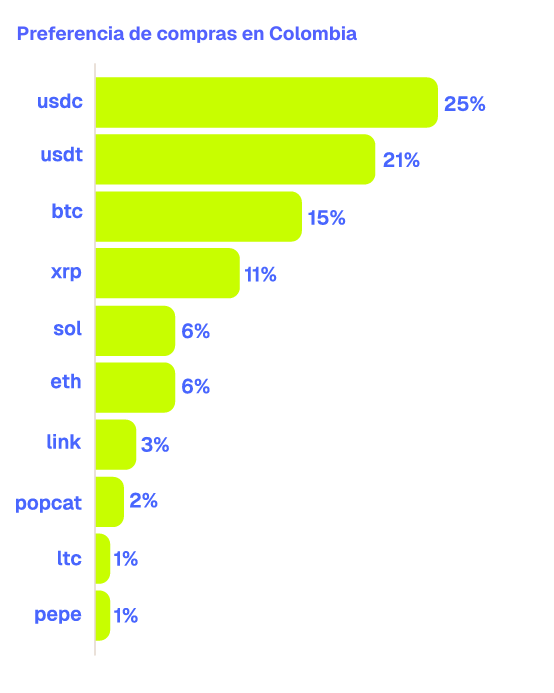
He most relevant data is the strong preference for stablecoins. During 2025, 46% of purchases on the platform corresponded to USDC (25%) and USDT (21%).
This phenomenon, which is called digital dollarization, responds to the macroeconomic context. The Colombian peso is depreciated 5.3% in the year and persistent inflationary pressures encouraged the search for stability in assets linked to the dollar.
Juanita Rodríguez Kattah, Country Manager of Bitso in Colombia, explains that this x-ray of Colombia and the region allows us to “perceive that the challenge for 2026 is not whether the adoption of cryptocurrencies will continue, but how the financial infrastructure will be transformed around these services to facilitate local payments, remittances, access to global markets, among others.” And he added:
Specifically in Colombia, the challenge is not to fall behind at the pace the region is advancing, and to resolve regulatory issues so that the blockchain innovation train does not leave us and it is too late to take advantage of all the benefits it brings with it.”
Juanita Rodríguez Kattah, Country Manager of Bitso in Colombia.
Bitcoin, for its part, represented 15% of purchases, but maintains a predominant role as a store of value since it appears in 49% of the portfolios analyzed. They are followed by the stablecoins themselves (16%), ether (11%) and XRP (9%).
Colombia stands out in the region for diversification, 21% of its users own four or more different assets, only behind Mexico, as reported by CriptoNoticias. The user profile also attracts attention.
The young segment leads adoption, with 32% between 25 and 34 years old and 28% between 18 and 24. In addition, female participation reaches 28%, surpassing markets such as Mexico (22%).
Stablecoin-peso trading pairs concentrate much of the activity, indicating transactional rather than merely speculative use.
Adoption figures in Latin America
The Bitso report, based on data from more than 10 million users in the region, shows that Colombia is in an intermediate position in digital dollarization compared to the Latin American average (40%).
While stablecoins gain ground for liquidity and payments, Bitcoin retains its status as main long-term value preservation asset (52% in regional portfolios).
This evolution suggests that the average Colombian user no longer only invests, but uses crypto assets to better manage their money, make transfers and diversify in the face of traditional economic uncertainty.
The increase in users with advanced trading profiles reinforces the idea of a market that is gaining in sophistication. Looking ahead to 2026, analysts and actors in the sector agree that the next step will largely depend on regulatory advances.
Resolving pending issues regarding financial infrastructure and regulatory clarity could allow Colombia to fully take advantage of the so-called “blockchain technology” (which is original to Bitcoin) in remittances, local payments and access to international markets.