“The remaining supply is consolidated in the hands of those with the most conviction,” says Santiment.
In the past, this behavior helped lay the foundation for subsequent bull runs.
The Bitcoin network has registered a decrease of 245,000 wallets with balance in just five daysbetween May 2 and 6, 2026.
According to the data the analysis firm, Santiment, this is the fastest pace of withdrawal observed since mid-2024.
The phenomenon, according to the interpretation of the analysts of the aforementioned company, would be driven mainly by retail investors who have decided to sell their positions at a profit after the recent rise.
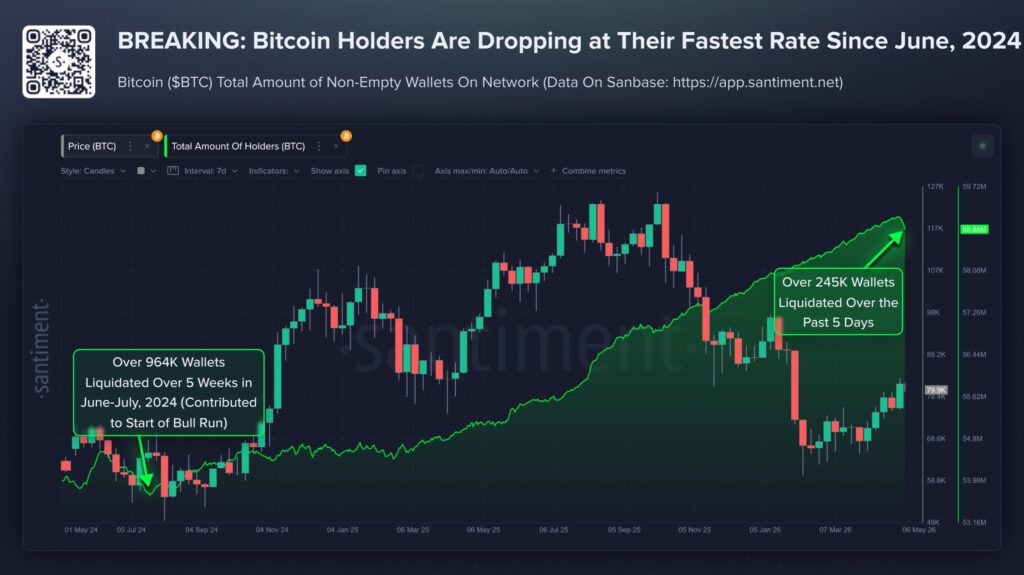
This movement occurs at a time of high tension for the market. This week, the price of bitcoin (BTC) exceeded $82,000to then retrace and trade around $80,000 at the time of this publication.
The reduction of active wallets is interpreted as a combination of profit taking and fear of the complex macroeconomic outlook. The war in Iran, which has continued since February 28, and the blockade of the Strait of Hormuz (a key maritime passage for the global oil industry) have generated an environment of uncertainty that puts pressure on bitcoin.

Santiment explains that the capitulation of retailers can occur both in declines (due to fear of greater losses) and in increases (due to the expectation that the price will not rise further). In this case, the rise towards $82,000 appears to have been the catalyst for smaller volume investors to close their positions.
Despite the drop in the number of users, analysts see this process as a necessary step for long-term market health. “The remaining supply is consolidated in the hands of those with the most conviction,” says Santiment.
This asset transfer process has two direct implications:
- Reduction in liquid supply: when passing from speculative hands to long-term investors (hodlers), the amount of BTC available for immediate sale decreases.
- Upside sensitivity: With fewer coins in circulation, any moderate increase in demand can create a larger impact on the price upwards.
History suggests that this behavior is not necessarily bearish. Santiment clarifies that between June and July 2024, bitcoin experienced the departure of more than 964,000 wallets in a period of five weeks. At that time, this massive capitulation did not precede a collapse, but rather helped lay the foundation for the subsequent bull run.
If the pattern repeats, The current market would be going through a “cleansing” phase of weak hands. Remaining investors would be those who have already decided not to sell at current prices, strengthening bitcoin’s structural support for the next growth cycle.
As CriptoNoticias has reported, there are several analysts who project that bitcoin could perhaps head to the $85,000 area or more.
But, probably everything will be determined in the short and medium term by how the war in Iran evolves and if the long-awaited opening of the Strait of Hormuz is achieved.