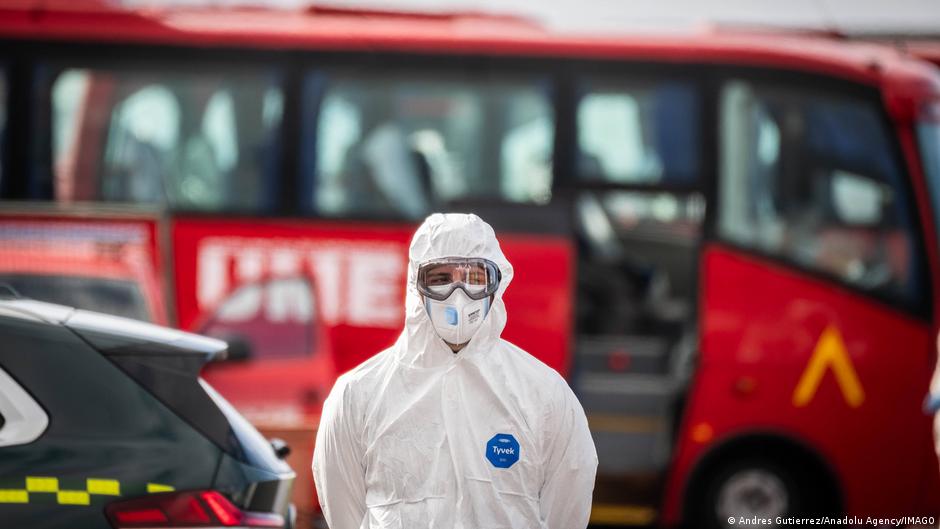
So far, three people have died and several others have fallen ill due to the Hantavirus outbreak on the cruise ship MV Hondius. Hantavirus is a rare rodent-borne disease with several strains of varying severity.
With the ship now docked, passengers are being returned to their countries of residence. Each will face a slightly different process in the coming days and weeks, depending on their infection status and their country’s responses to such outbreaks.
A Dutch couple, who first fell ill and later died, were visiting South America before setting sail from Ushuaia, Argentina’s southernmost city, in late March.
Argentina’s health ministry is investigating whether the couple were infected by exposure to rat droppings while bird-watching at a landfill site in the city. The World Health Organization (WHO) has confirmed that two deaths were caused by the virus, with the others “probable” at this stage.
What happened on the MV Hondius cruise ship?
Hantaviruses are relatively well known, if rare, and are transmitted mostly from rodents to humans. Symptoms are respiratory and strains that can develop into ‘hantavirus cardiopulmonary syndrome (HCPS)’ have a “fatality ratio that can reach 40–50%”, according to WHO. The intensity also varies according to region. In Europe, strains generally cause mild disease and mortality rates between one and 15%, with cases in North and South America often above 30%.
The people on the ship contracted the Andes strain. It is believed to be the only one capable of limited human-to-human transmission, and can cause HCPS. Close, prolonged contact, such as the conditions found on a cruise ship, is usually necessary to transmit the virus in this way. But WHO and the scientific community immediately said it could not be compared with COVID-19.
“As we understand it, the Andes virus requires very close, sustained contact between people,” Ann Rimoin, a professor of epidemiology at the UCLA Fielding School of Public Health in the United States, told DW.
“I understand that people have a lot of anxiety after experiencing the (COVID-19) pandemic, but this is a very different virus and a different set of circumstances,” she said.
The six to eight week incubation period, during which symptoms may not be apparent, means that the disease will take some time to manifest on the MV Hondius. According to WHO, there were 147 people on board the plane Of which seven are confirmed cases and two are probable. Meanwhile, the European Center for Disease Prevention and Control (ECDPD), a branch of the European Union, says Their activities are being traced It is important to prevent the spread of the virus before and after boarding a plane.
What happens to the passengers on the MV Hondius?
The cruise ship arrived in Tenerife over the weekend. Because most of the people on board the plane have not yet tested positive or shown symptoms, most passengers are either returning to their places of residence or are already there. People with symptoms are in various hospitals in South Africa, the Netherlands and Switzerland. A German woman, who was a suspected case, has tested negative.
Four other German citizens arrived in Frankfurt on Monday, asymptomatic patients who were either sent to hospital after medical checks or sent into self-isolation, depending on the circumstances.
The 14 Spanish citizens flew to Madrid on Sunday and will be isolated in a hospital in the capital. Passengers from Türkiye, Belgium, Greece, Britain and Argentina are traveling to medical facilities after socially distanced flights on Sunday. The last evacuation flight is expected to leave for the Netherlands on Monday afternoon.
Prime Minister Sébastien Lecornu said five French citizens aboard the Hondeus would be kept in “strict isolation until further notice” after they developed symptoms on board the plane. One of the 17 American travelers tested “weak positive” in Cape Verde, according to the U.S. Department of Health and Human Services, which will conduct further testing.
What is the plan to stop the spread of Hantavirus?
WHO recommends that “high-risk contacts” of confirmed cases be “quarantined for 42 days after last exposure”. People who had minimal contact with a sick patient should only “conduct passive self-monitoring and seek medical evaluation if symptoms appear.”
Although countries will generally follow such guidelines, the circumstances of isolation are specific to each individual. Those who are in good health and have no symptoms may be sent home to isolate after a medical check-up, while others will be kept under long-term observation. Infectious disease expert Rimoin told DW that like any virus, it is important to monitor people’s movements and interactions.
“We’re talking about multiple jurisdictions, multiple organizations, people traveling globally, so international coordination and cooperation will be important to get all the information, understand it, and prevent cases like this from happening in the future,” he said.
How have previous hantavirus outbreaks been dealt with?
The most notable recent outbreak of the Andes strain was in Argentina in 2018–19. Three people who came in contact with infected rodents spread hantavirus to 34 other people. Altogether 11 people died.
Contact tracing and isolation were established relatively quickly after the virus was discovered, with the first transmission detected at a birthday party.
Molecular biologist and science journalist Kai Kupferschmidt told DW that transmission at social events could remind the world of COVID-19, but hantavirus poses no such threat and could serve as a useful test case.
“It was interesting to see that there were problems getting the boat to dock anywhere and getting countries to work together. But overall, so far, I’m quite relieved that the science is winning in terms of the way people are responding,” Kupferschmidt said.
Edited by Cai Nebe