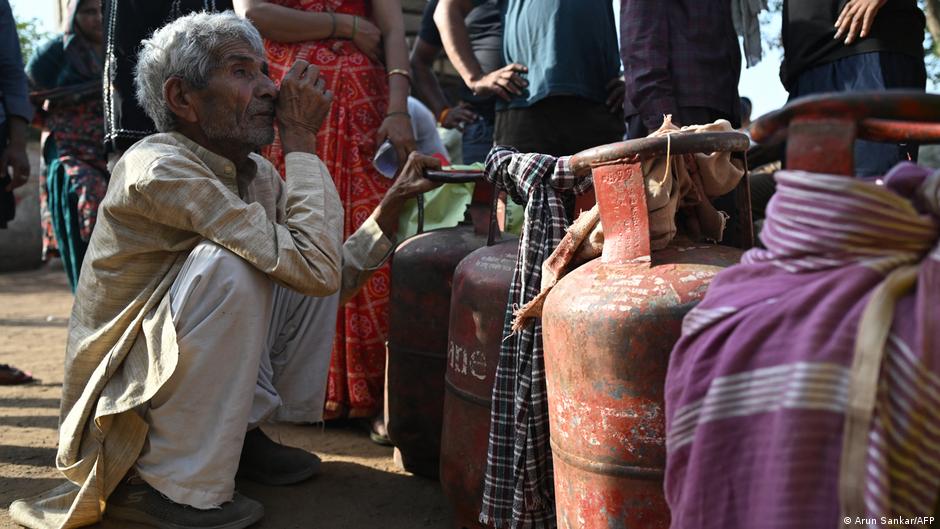
At a roadside eatery outside Delhi, India, Ramesh Verma has stopped to check the price of cooking gas every morning. The numbers only concern him now. Also, their business is starting to slow down as customers are cutting back on small, regular expenses like tea and snacks.
The price of the commercial gas cylinder that runs his makeshift kitchen has increased from about Rs 2,078 to Rs 3,071 ($21.7 to $32.1) in just three months – an increase of about 48% that is steadily eroding the narrow margins on which his business survives.
“I can’t charge truck drivers and laborers more per plate,” Verma told DW as he wiped down steel tables after the lunch rush. “If the prices go up too high, they stop eating here. So, I suffer losses until I can’t survive anymore.”
The way Narendra Modi responded to Iran, that was the result
For years, most Indians considered the war in the Middle East a distant phenomenon, watched on television but rarely impacting their lives.
This changed when Iran was driving up global energy prices. Last weekend, Prime Minister Narendra Modi publicly appealed to citizens to adopt voluntary austerity to save India’s economy from the consequences of the Iran conflict in West Asia.
Speaking at a rally in the city of Secunderabad, Modi urged Indians to cut fuel consumption, work from home, postpone foreign travel, avoid unnecessary imports and delay gold purchases. The message was framed as a patriotic responsibility in a time of global instability.
He said, “The West Asia crisis is one of the worst crises of this decade; just as we have overcome the COVID-19 pandemic, we will come out of this too.”
However, his critics were quick to point out that Modi made his appeal just days after the state election cycle ended. The campaign was dominated by expensive political road shows, helicopter tours and mass rallies, with the opposition accusing the government of delaying delivering a tough economic message until after voting was over.
“I said it – the summer of inflation will come after the elections,” Indian National Congress opposition leader Rahul Gandhi posted on Twitter.
Beyond the political arena, ordinary Indians are wondering whether Modi’s appeal is an appeal for short-term solidarity during the global crisis or the first official warning of enduring hardships to come.
What impact do Modi’s austerity measures have on Indians?
As of mid-May, India has imposed no mandatory restrictions and no rationing orders. Despite the increase in global crude oil prices, the prices of gasoline and diesel have not been increased yet.
But state oil distributors are losing about $105 million (€97 million) every day as they absorb rising costs caused by the disruption in the Strait of Hormuz, according to government figures. Liquefied petroleum gas (LPG) prices have already risen sharply for consumers and businesses in India.
At Lucknow’s wholesale vegetable market, trader Ranjit Prasad says customers are buying in smaller quantities and bargaining more.
“People are nervous,” Prasad told DW. “The Prime Minister says save fuel and spend carefully. But common people are already making every possible cutback.”
India imports more than 80% of its crude oil, leaving it vulnerable to fluctuations abroad. As oil prices rose, India’s import bill rose sharply, while its foreign exchange reserves declined by nearly $38 billion in two months. India also imports hundreds of tons of gold annually, which also weakens its currency.
The government’s economic concerns are straightforward: Higher oil prices make imports more expensive, weaken the currency and drive inflation across the economy – from rising costs of transportation and fertilizers to cooking gas and food.
‘We don’t need anyone’s speech to tell us that things are getting expensive’
In south Chennai, auto-rickshaw driver Murugesan Kumar says commuters have started walking short distances instead of taking rides.
“Now everyone is saving money,” he said. “I heard [Modi’s] Speeches and Thoughts…What else should really poor people be cutting?’
In Pune, Sunita Deshpande, a housewife, quietly canceled her plans for a summer holiday to Thailand after the rupee weakened and travel costs rose.
“We don’t need anyone’s speech to tell us that things are getting expensive. Food inflation is rising,” Deshpande told DW. “The economy already told us that.”
Most of India depends on LPG cylinders for cooking. The sharp rise in natural gas prices is affecting restaurants, tea shops and small businesses across the country.
Economists say these increases will inevitably flow through to food prices and household spending.
“Commercial LPG prices affect the entire informal consumption chain – eateries, transport-related services and small businesses,” Lekha Chakraborty, an economist at the National Institute of Public Finance and Policy, told DW.
“When energy costs rise sharply, the burden is not limited to fuel alone. It spills over into retail prices, reducing household consumption and adversely affecting lower-income groups that already spend a larger share of income on essential commodities,” he said.
BJP hits back at claims of losing control
Taking advantage of the growing concern, the opposition has accused the government of asking citizens to bear the burden of economic mismanagement.
Akhilesh Yadav, president of the regional Samajwadi Party, hit out at Modi and said his appeal was an “admission of failure”.
Yadav said, “It appears that the BJP government has completely lost control. The dollar is skyrocketing and the Indian rupee has fallen. The BJP should appeal not to the public but to its corrupt allies to stop buying gold.”
The ruling Bharatiya Janata Party (BJP) has rejected those allegations, arguing that the crisis is external and global rather than policy-driven. Party leaders have described restraint and low consumption as an act of national unity needed to protect the economy from deep shocks.
“There is no panic. It is about preparedness and collective responsibility in a difficult international environment,” BJP spokesperson Tom Vadakkan told DW.
a lifetime of poverty
At the moment, the major risks appear to be economic as well as psychological. India is not facing shortages, rationing or mandatory austerity – but the combination of rising prices, currency pressures, falling remittances from abroad and official warnings has started to create a widespread sense of insecurity among the common people.
At his eatery, Verma counts the day’s earnings and wonders how long he can keep food affordable while his own costs continue to rise.
He never traveled abroad. He does not buy gold. He conserves fuel in advance because he cannot afford wastage.
“I don’t need the government to teach me austerity,” Verma said. “People like us live our whole lives with caution. The fear is that life is about to get even more difficult.”
Edited by: Darko Janjevic