After years of a tense coexistence marked by regulation through sanctions and a persistent legal gray area, the United States is facing a moment of redefinition for its financial system.
That uncertainty has an expiration date because this May 14, 2026, the Senate Banking Committee will begin the final review of the Clarity Act (Digital Asset Market Clarity Act).
This is a piece that would arrive to complete the scheme initiated by the GENIUS Law approved in 2025 for stablecoins, in order to establish lasting rules of the game for the entire ecosystem of decentralized finance (DeFi).
To understand whether this law can really give global leadership to the United States in the digital assets ecosystem, it is necessary to break down the most relevant provisions of its extensive 309 page draft, which dedicates two fundamental pillars to the sector, such as Titles III and VI.
Clarity: a legal shield for DeFi developers
In reality, the heart of this legal architecture lies in Title VI, whose purpose is to shield those who build digital infrastructure without directly managing third-party capital.
Through Section 601, the law establishes a “safe harbor” or safe harbor statutory that protects developers, validators, node operators and non-custodial wallet creators.
The pillar of this protection is the absence of custody. Under this premise, the regulations establish that if a person or project does not have control of the funds or private keys of its users, it is legally classified as a non-custodial software developer.
This category explicitly prohibits being considered a financial intermediary, broker or money transmitter. This distinction is fundamental, as it shields the act of writing, maintaining and distributing open source code, excluding it from the heavy responsibilities that come with securities laws at both the state and federal levels.
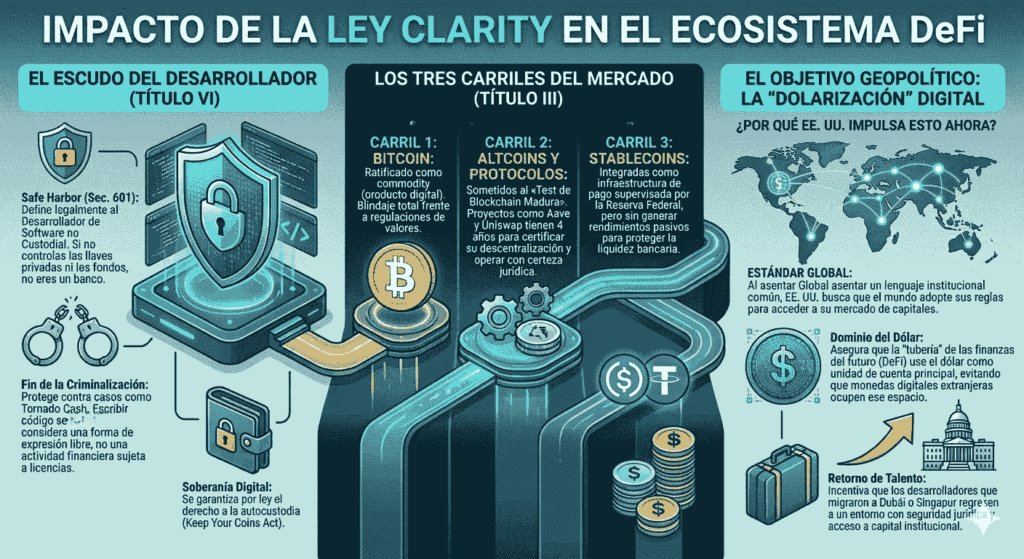
This is a measure specifically designed to prevent a repeat of the criminalization of the code seen in cases such as Tornado Cash, where justice questioned whether the development of privacy software amounted to facilitating money laundering.
Guarantees for self-custody and source code protection
In addition to the above, Section 605, or “Hold Your Coins”, complements this structure by elevating to the rank of legal right the ability of the citizen to exercise self-custody of his or her assets.
At the same time, the Blockchain Regulatory Certainty Act (Sec. 604) acts as an additional barrier that prevents developers who do not control the software from being stifled by restrictive money transmission laws.
Together, these provisions seek to guarantee that technological development is treated as a form of free expression, distancing it from the judicial persecution of software that marked legal uncertainty in recent years.
Clarity and institutional responsibility
However, if Title VI functions as the shield of the ecosystem, Title III stands as its supervisory mechanism, balancing the drive for innovation with strict obligations regarding financial security.
Under this section, Section 301 gives the Securities and Exchange Commission (SEC) the mandate to issue specific rules to identify when a DeFi protocol, failing to meet full decentralization standards, must formally register as a securities intermediary.
This approach ensures that only those Truly autonomous systems enjoy full protectionswhile layers with elements of centralized control are subject to institutional surveillance.
For protocols the size of Aave or Uniswap, the implementation of this standard represents the definitive step towards commercial maturity in the US. Explicit recognition of their decentralized nature removes compliance barriers, allowing them to absorb massive institutional capital flows that, until now, remained on the sidelines for fear of regulatory risk.
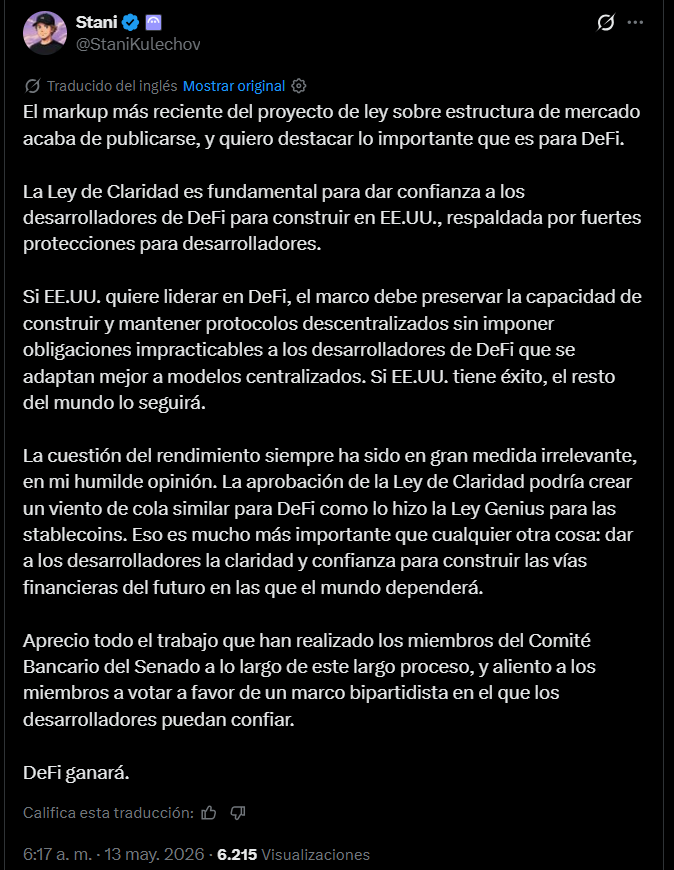
Such a perspective finds echo among the protagonists of the sector; Recently, Stani Kulechov, founder of Aave, pointed out that regulatory clarity is the fuel DeFi needs to scale, suggesting that a secure framework in the United States allows global protocols to operate with the confidence of a mature financial system.
At the same time, sections 302 and 306 impose compliance obligations against financial wrongdoing and cybersecurity. While Section 309 puts anonymity tools under scrutiny to ensure that market growth does not compromise global financial stability.
Which DeFi projects are ripe for Clarity?
For American leadership to be effective, the law introduces the Madura Blockchain Test, an exam designed to recognize genuinely decentralized systems that operate without a central issuer, as previously reported by CriptoNoticias.
Ultimately, the Clarity Act seeks to distinguish with surgical clarity between truly autonomous protocols and those that retain elements of central control, which will operate under much stricter regulation.
Why does US leadership represent a Global Standard? The reasoning is simple because establishing rules for liquidity protocols will ensure that the US currency remains the central axis of an ecosystem that could otherwise be articulated around digital currencies outside the country’s supervision.
In any case, if the United States manages to establish this common institutional language, it will establish the global standard for how a power manages the tension between traditional control and programmable freedom of the finances of the future.
This situation elevates tomorrow’s debate above mere legislative technique, positioning it as a referendum on the country’s economic model: the result will mark the path between integrating DeFi as an engine of sovereign growth or allowing regulatory prudence to keep it on the periphery of legality.