
The entity maintains 3.04 million IBIT shares, valued at USD 116.9 million.
Institutional managers report these portfolio movements on a quarterly basis.
Harvard Management Company (HMC), the entity that manages the endowment fund of Harvard University in the United States, completely liquidated its position in BlackRock’s ether (ETH) exchange-traded fund (ETF) and reduced its exposure to bitcoin (BTC)
The movement became known through form 13F before the United States Securities and Exchange Commission (SEC), where institutional managers with More than $100 million under management report their stock and ETF positions quarterly.
According to the document presented on May 15, 2026, Harvard no longer reports holdings in the iShares Ethereum Trust (ETHA). In the previous quarter, the study house had maintained a position of 86 million dollars.
Likewise, it is highlighted that HMC reduced its participation in the iShares Bitcoin Trust ETF (IBIT), the BTC fund managed by BlackRock. The entity now owns 3,044,612 shares of IBIT, valued at $116,973,993.

The reduction marks a significant drop compared to the previous report. As CriptoNoticias has reported, Harvard had 5.35 million IBIT shares valued at about $265 million. Even so, the university did not completely exit its exposure to bitcoin.
The 13F forms do not explain the reasons behind each portfolio movement, so it cannot be determined whether the sale responds to profit taking, a tactical reduction of risk or a reallocation towards other instruments.
This move also reopens a frequent debate within the BTC market: whether active rotation strategies really outperform simple long-term position holding.
Matías Mathey, a graduate in cryptoeconomics and a specialist in decentralized finance (DeFi), published an analysis on DCA (Dollar Cost Averaging), a strategy that consists of buying BTC periodically with fixed amounts regardless of the price.
According to your study“there is no window in bitcoin history of 3.5 years or longer where monthly DCA has ended in loss.” The analysis adds that, in four-year periods, the historical average profitability exceeded 380%, as seen in the following graph:
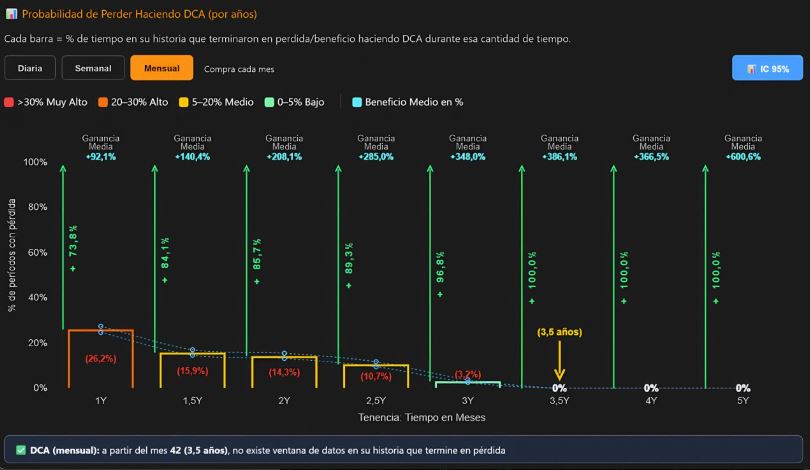
Although historical data does not guarantee future results, the approach reinforces a common idea within the ecosystem: Maintaining long-term exposure to BTC has historically shown better results than trying to anticipate short-term market movements.