The information comes from reports from media linked to the government, not from an official statement.
The premiums would be 1-2% of the value of the cargo, but the platform is still not operational.
Reports from Iranian state media report the launch of “Hormuz Safe”, an alleged platform that would seek to offer maritime insurance and certificates of financial responsibility to ships transiting the Persian Gulf and the Strait of Hormuz, with payments in Bitcoin (BTC).
The information comes mainly from the Fars News agencyclose to the Revolutionary Guard Corps, which summoned the Ministry of Economy.
The announcement was broadcast on May 16, 2026. According to these reports, the initiative Aspires to generate revenues of more than $10 billion through coverage against risks such as inspections, arrests and confiscations.
Hamshahri Online added that the premiums would be between 1% and 2% of the value of the cargo, with discounts for Iranian vessels, and that payments would be settled only in bitcoin.
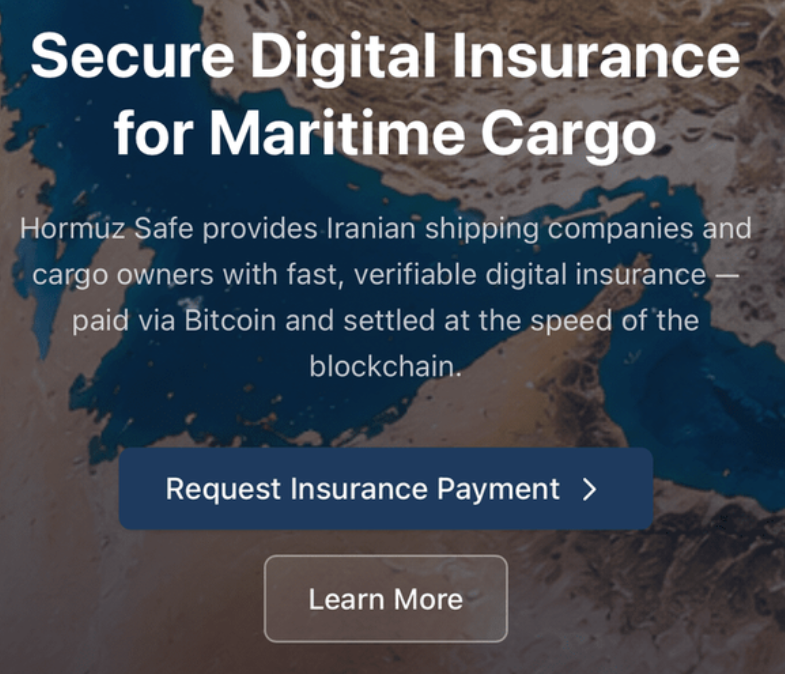
The platform is presented as a mechanism under Iranian sovereignty, with payment verification through the so-called “blockchain technology” that is actually original to Bitcoin. However, the announcement raises more questions than certainties.
The $10 billion projection lacks a detailed public calculation basis, fueling skepticism about its realism. The official hormuzsafe.ir website remains in the “under construction” phase, showing only basic contact information and an operations center via VHF radio. In addition, the site repeatedly gives errors when trying to access it.
This indicates that, beyond the statement, the visible operational infrastructure is still very limited. Analysts like Arnel Murga, of the maritime sector, doubt significant adoption.
The Strait of Hormuz remains a critical artery of global trade, through which nearly 20% of the world’s oil transits. Faced with years of sanctions restricting Iranian access to conventional financial systems and insurance markets, Tehran is seeking alternatives to monetize its geographic control without resorting to a direct toll.
The main international shipping companies usually operate with consolidated insurers in London, Singapore or Europe, backed by global reinsurers.
Adopting an Iranian product paid in Bitcoin would imply high risks of secondary sanctions by the United States and the European Union, something that few companies are willing to take on.
The use of Bitcoin is not new in Iranian strategy. The country has used cryptocurrencies in recent years to circumvent financial restrictions, as reported by CriptoNoticias. This outlet also reported in April that a group of scammers had been requesting payments in bitcoin and USDT in exchange for “safe passage” through Hormuz.
Still, transforming such a sensitive shipping route into a bitcoin-based insurance market represents an ambitious step whose practical viability depends on factors beyond technology: trust, geopolitical stability and international acceptance.
For now, Hormuz Safe seems to be more in the terrain of intentions and state communication than in that of a consolidated platform and functional. Its real development will be key to evaluating whether it is an innovative solution to economic isolation or an advertisement with a strong propaganda component.
In a context of regional tensions that have already reduced traffic through Hormuz, any concrete progress on this project could add new diplomatic and regulatory complications to global maritime trade.