These instruments capture capital that could go to other more volatile assets, such as bitcoin.
Globally there is a rise in government bond yields.
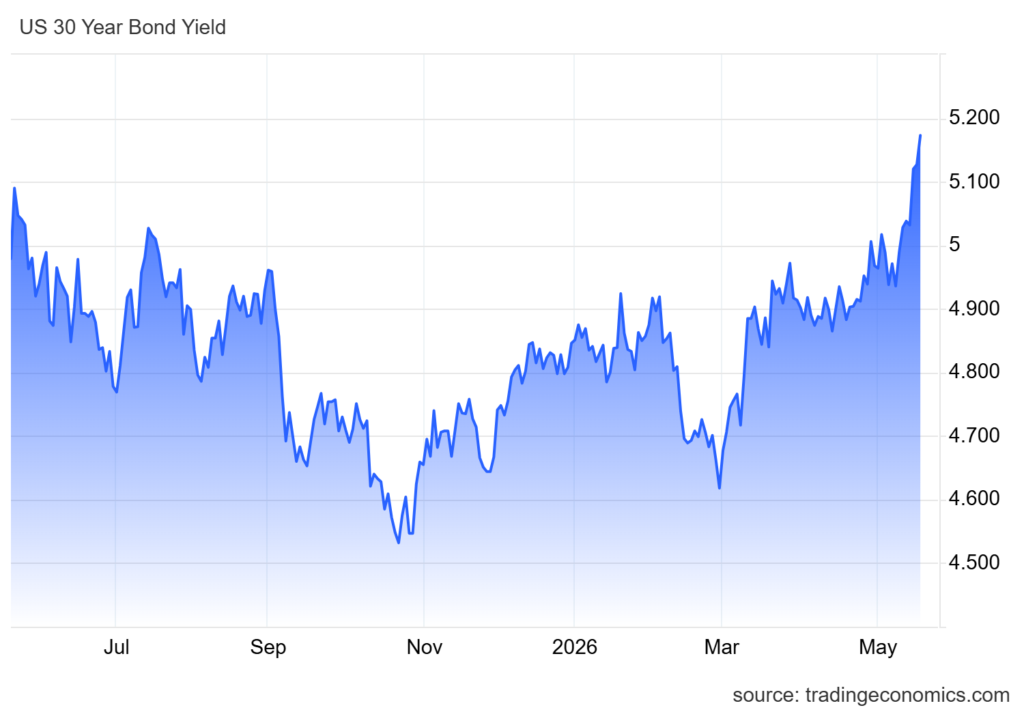
The yield on the 30-year United States Treasury bond reached its highest level since July 2007 this Tuesday, May 19, standing at 5.19%, which sets off alarms in the bitcoin (BTC) market, since this may affect the price of the digital currency.
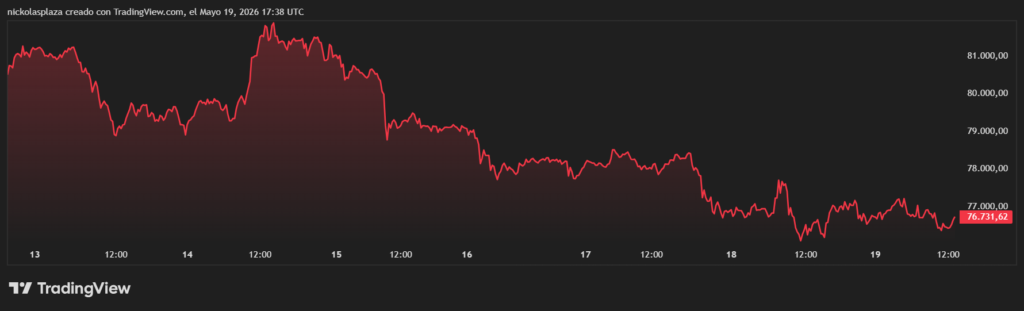
This increase in US public debt instruments may be responsible, among other factors, for the 6% drop in the price of bitcoin during the last week, which fell from $81,100 to $76,800a price that the crypto asset had not registered since last May 1.
The reason for the increase in bond yield is directly related to the increase in energy prices.
This energy rebound originated from the United States war with Iran that began on February 28, a geopolitical conflict that aggravates inflationary pressures internationally and that could force the United States Federal Reserve (FED) to consider an increase in interest rates.
Before the outbreak of this conflict in the Middle East, US debt yields trended downward after years of persistent inflation, reaching a price of 4.62%, as seen in the graph.
The analysts of the financial newsletter The Kobeissi Letter They explained that In the early days of the Iran war, “U.S. Treasury yields rose, but the move was largely contained. The consensus was that the war would be short and that the Strait of Hormuz would not remain closed. Today, traffic is still close to 0.
The Strait of Hormuz is a key strategic sea route linking the Persian Gulf with the Gulf of Oman, through which 20% of the world’s oil transits. Its blockade has caused crude oil prices to exceed $100 per barrel for almost two months, reaching prices not seen since 2022.
This accelerated the US producer price index (PPI) until the 6% year-on-year in April 2026, compared to the 4.3% registered in March. For its part, the consumer price index (CPI), which measures direct retail inflation on citizens, rose to 3.8%, placing both indicators at their highest levels since 2023.
In this regard, analysts at The Kobeissi Letter stated that “as inflation increases, long-term interest rates rise to compensate lenders for this risk,” also adding that “we are seeing the worst inflation since the post-pandemic recovery.”
The investor Quinten François opposes the idea about what the FED can continue raising rates safely. According to François, the market “is basically backing the FED into a corner,” leaving the institution with only two extreme options: print money again (which would devalue the dollar and could benefit bitcoin in the long term) or allow the system to collapse under the weight of its own debt. “You know what it will be,” he says, implying that massive money printing will be the chosen response.
For his part, Ajay Rajadhyaksha, global president of research at Barclays, warned that “While returns may be at annual highs, that alone does not justify long-term investment.” Even so, Barclays strategists estimate returns could exceed 5.5%levels not seen since 2004.
This environment negatively impacts bitcoin (BTC) and the rest of the cryptocurrencies. In a scenario of higher rates, Treasury bonds – backed by the US government – offer attractive and safe returns, which makes assets considered “risky” less attractive and causes capital outflows from these markets.
The crisis is not limited to the United States. As CriptoNoticias reported, in countries like Japan, for example, state bonds have also registered a strong rebound, driven by the same global oil prices. The strong energy dependence of the Asian country has triggered its internal inflation, adding additional pressure to the global fixed income landscape.