
Vitalik raised the “abandonment test”: Ethereum must function without its core members.
Last February, the former CEO of the EF, Tomasz Stańczak resigned from his position.
Developers Pablo Voorvaart and Julian Ma announced their resignations from the Ethereum Foundation (EF), where they both worked for four years and their departures add to a series of departures at different levels of the organization that have accumulated since the beginning of 2026.
Voorvaart, a developer and engineer who was part of the Devcon and Usecase Lab teams, explained his decision on X this May 19 pointing out personal reasons: “I have decided to leave because I want to focus on entrepreneurship and creating new products.”
Ma, EF researcher, He also indicated his reason of distancing from the organization: «Why did I leave? The first three years at EF I did market design research. The last year, I focused on product work and growth. “I really enjoy that domain and want to move further in that direction.”
Like Voorvaart and Ma, Tomasz Stańczak, as reported by CriptoNoticias, resigned as co-chief executive of the EF on February 13. In this case, the reason for his resignation was not known. Following Stańczak’s departure, Bastian Aue took over on an interim basis alongside Hsiao-Wei Wang.
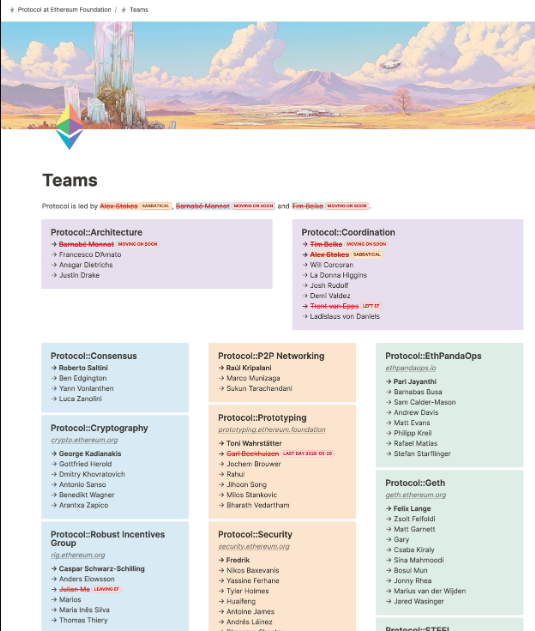
Likewise, the developer known as ‘banteg’ in X and belonging to the Yearn Finance protocol, shared an image that summarizes all the people who have recently left the EF (names crossed out with red lines).
Banteg maintained that “the three leaders of the EF have resigned”considering the departure of the three main developers, Tim Beiko, Barnabé Monnot and Alex Stokes, although the latter is on “sabbatical” leave, as the EF explained last May 11.
Vitalik’s “abandonment test” and departures from the Foundation
The volume of exits revived a thesis that Vitalik Buterin raised on January 12: Ethereum must overcome the “walkaway test” or “the abandonment test.” With this, the network’s co-founder suggested that the chain must continue to function and be useful even if its core developers decided to retire.
“The value of Ethereum should not strictly depend on any features that are not already in the protocol,” Buterin wrote. The idea is that the protocol reaches a point of maturity such that it does not require constant interventions to remain valuable.
From the Ethereum Daily analysis account they interpreted the outputs as part of a planned strategy and they highlighted that the EF aims “reduce the relative influence of the Foundation over time”.
Ryan Sean Adams, cryptocurrency investor, it was more direct: “It is clear that the future of Ethereum cannot depend on the EF,” and called for other institutions to occupy that space with a focus on the price of the asset.
On the other hand, Ignas DeFi, an ecosystem analyst, proposed another reading in reference to the resignations and departures from the Foundation: «Did they stop believing in Ethereum? Is the salary low and competitors pay more? Or are they just tired?”, and noted that Stańczak’s brief stint as co-director seemed “especially strange.”
According to Ignas, the mandate that the EF would have required its members to sign or withdraw could be “the real reason behind the departures”although he did not provide evidence to support it.
What the turnover at the EF puts on the table is whether Ethereum is close to that point of autonomy that Buterin described, or whether the accelerated departure of those who led technical development in recent years is instead a sign of internal tension that the organization did not explain. Aya Miyaguchi, who led the EF since 2018, also left the executive leadership in February 2025, although in her case to assume a more strategic role as president, in what the organization itself presented as a change of focus, not a resignation.