
Armstrong recognizes that change requires regulatory reform, not just technological development
In the publication the CEO never mentioned Bitcoin.
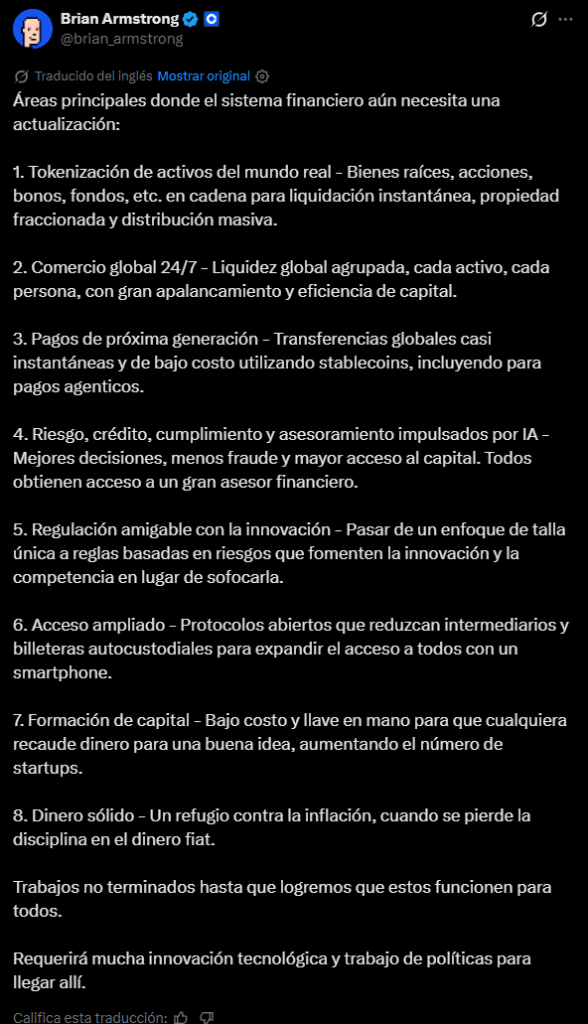
Brian Armstrong, founder and CEO of Coinbase, published this May 24 on his X account a list of eight areas where the global financial system requires a fundamental transformation.
The publication, which exceeded 384,000 views at the time of writing, does not propose gradual improvements: Armstrong maintains that the infrastructure current financial system fails by design in eight simultaneous dimensions.
According to Armstrong, real-world assets (RWA)—real estate, stocks, bonds, and funds—must migrate to cryptocurrency networks to enable instant settlement and fractional ownership. In parallel, the manager suggests that stablecoins are the natural mechanism for low-cost global payments, including transactions executed by artificial intelligence agents.
The CEO of Coinbase also points out that unequal access to credit and financial advice can be corrected through AI, which in his opinion would reduce fraud and extend services to populations that are currently excluded. Armstrong cautions, however, that none of these changes are possible without real risk-based regulation, distinct from the one-size-fits-all approach that currently predominates.
Ecosystem reactions
The publication generated immediate debate among figures in the sector. Pierre Rochard, known as @BitcoinPierre, criticized the order of the list: according to his position, solid money —located by Armstrong at point 8— should lead any financial reform agenda, not close it. To this comment, Adam Back, CEO of Blockstream, added his opinion saying that “Bitcoin is #1”, taking into account that in Armstrong’s writing, he never directly mentioned Bitcoin.
Mert, CEO of Helius—infrastructure on Solana—, proposed to add point zero: financial privacy. His argument is that Without functional privacy, the rest of the proposed architecture loses value in environments surveillance and strict regulatory compliance. The same position was supported by Fairblock, a project specialized in on-chain privacy.
Armstrong closed his post with a warning that summarizes the scope of his proposal: the work, he said, will not be done until these tools work for everyone, and getting there will require both technological innovation and profound changes in public policy.